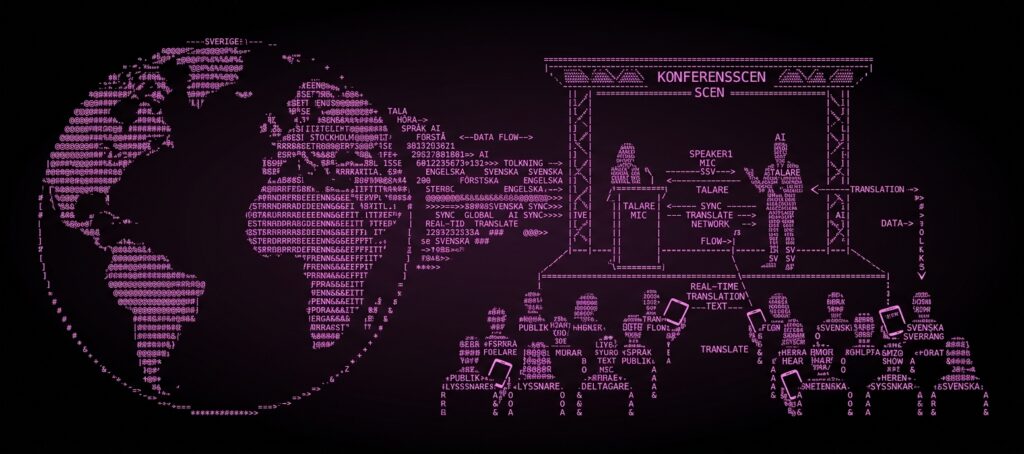
Sweden ranks 8th globally on the EF English Proficiency Index with a score of 609 (EF EPI, 2025), and Stockholm scores even higher at 637, placing it among the top five cities worldwide for English fluency. So why would any event organizer planning a conference in Sweden invest in Swedish event translation? Because the 35,000 participants who attend Almedalen Week each July, the 1.8 million annual visitors to the Swedish Exhibition and Congress Centre in Gothenburg, and the thousands of public-sector professionals at government-mandated events across the country all operate in contexts where Swedish is not optional. It is the language of record, regulation, and trust.
Sweden’s relationship with English is more nuanced than the proficiency rankings suggest. In boardrooms and tech startups, English flows freely. But in municipal government sessions, healthcare conferences, labor union congresses, and the dense political ecosystem of Swedish civil society, the working language is Swedish. Event organizers who assume English will suffice across all contexts risk alienating the very audiences whose engagement matters most.
Sweden’s Event Landscape: A Nordic Powerhouse
Sweden has long punched above its weight in the international conference market. Stockholm ranked 18th globally in the ICCA rankings with 66 international association meetings in 2022. The country consistently places among Europe’s top 15 conference destinations.
Almedalen Week: Democracy as a Conference Format
Almedalen Week (Almedalsveckan) is unlike any political event in the world. Held annually during week 26 in Visby on the island of Gotland, this gathering brings together approximately 35,000 unique visitors for over 2,400 official seminars, debates, and speeches (Almedalsveckan, 2025). What began in 1968 when Olof Palme delivered a speech from the back of a lorry has evolved into Sweden’s most important forum for policy, business, and civil society dialogue.
The seminars are overwhelmingly conducted in Swedish, yet international observers, foreign correspondents, and Nordic-region attendees are increasingly present. Real-time AI translation offers a way to open these sessions to a broader audience without disrupting the format that makes Almedalen unique.
Stockholm Furniture Fair and Design Week
Stockholm Furniture Fair attracts approximately 40,000 visitors from more than 60 countries and over 1,100 media representatives annually (Stockholm Furniture Fair, 2025). The fair operates largely in English for its international audience, but the surrounding Design Week events frequently run in Swedish.
Sustainability Conferences: Sweden’s Global Stage
Sweden’s position as a sustainability leader has made it a magnet for green-focused conferences. Sustainable NORDIC 2026 unites over 800 participants in Stockholm, featuring speakers from companies like Oatly and South Pole. Energimässan, Sweden’s largest energy expo, brings together professionals across energy and environment sectors. The 8th Nordic Conference on Sustainable Healthcare takes place at Malmö Arena Hotel in October 2026.
The recurring pattern: Swedish participants, who often represent government agencies, municipal authorities, and domestic NGOs, contribute in Swedish. When a Stockholm municipality’s sustainability officer presents their carbon-neutral transport strategy, they present in Swedish. Providing real-time translation ensures international delegates capture these contributions alongside the English-language keynotes.
The Swedish Language: What Event Organizers Need to Know
Swedish is a North Germanic language spoken by approximately 10 million people as a native language, primarily in Sweden and as an official language in Finland (Ethnologue, 2024). It belongs to the same language family as Norwegian and Danish, and the three share enough mutual intelligibility that speakers can often understand each other informally.
- Tonal accent system. Swedish has two distinct tones on stressed syllables (Britannica, Swedish Language). This pitch accent system gives Swedish its characteristic melodic quality and distinguishes word pairs otherwise identical in spelling.
- The 29-letter alphabet. Swedish uses the Latin alphabet plus three additional characters: Ã…/Ã¥, Ä/ä, and Ö/ö. These are distinct letters, not diacritical variations. Rendering “Malmö” as “Malmo” signals a lack of attention that Swedish-speaking attendees will notice immediately.
- Enclitic definite articles. Swedish attaches the definite article to the end of the word: “konferensen” (the conference), “evenemanget” (the event). This affects word boundaries in real-time transcription.
- Text contraction in translation. English to Swedish contracts by approximately 10%; Swedish to English expands similarly (Unbabel Language Guidelines). This affects caption display timing.
- Compound word formation. Swedish readily creates compound words without spaces: “hÃ¥llbarhetsstrategi” (sustainability strategy), “kongressanläggning” (congress facility). These long compounds can challenge NLP systems.
The English Paradox: When Swedish Translation Remains Essential
Government & Public Sector
Swedish government agencies, municipalities, and public authorities conduct official business in Swedish. When Naturvårdsverket hosts a climate adaptation conference, the proceedings are in Swedish, even if the audience includes international researchers.
Healthcare & Medical
Swedish medical professionals, while English-proficient in research contexts, often present clinical findings and discuss patient-facing implications in Swedish. The Nordic Conference on Sustainable Healthcare in Malmö illustrates this dynamic.
Labor and civil society. Sweden’s strong labor movement and civil society organizations conduct their congresses and annual meetings in Swedish. These events frequently involve international guest speakers who need translation to follow proceedings.
Stockholm, Gothenburg, and Malmö: Sweden’s Event Triangle
| City | Key Venue | Strengths |
|---|---|---|
| Stockholm | Stockholmsmässan (75 years, twelve restaurants, Scandinavia’s largest) | Top-20 globally for international association meetings. Arlanda Airport hub. |
| Gothenburg | Svenska Mässan (1.8 million annual visitors, 1,200+ room capacity) | Industrial events, automotive conferences (Volvo HQ). Top 5 European convention venues. |
| Malmö | Malmö Arena Hotel, convention facilities | Öresund Bridge connection to Copenhagen. Cross-border Scandinavian-continental events. |
Concrete Scenario: A Sustainability Summit in Stockholm
Picture this: you are organizing a three-day Nordic Green Innovation Summit at Stockholmsmässan. Your 600 attendees include Swedish municipal leaders, Norwegian energy executives, Finnish cleantech startups, Danish sustainability consultants, and a delegation of 80 from Germany, the UK, and the Netherlands. Keynote speakers include Sweden’s Minister for Climate and the Environment (presenting in Swedish), a Norwegian state secretary (presenting in Norwegian), and a German automotive executive (presenting in English).
Traditional interpretation requires six interpreters for plenary sessions alone covering Swedish-English, Norwegian-English, and German-English, plus additional coverage for four parallel breakout tracks. At rates of $50 to $200 per hour per interpreter (Capital Linguists, 2025), your budget for three days easily exceeds $25,000.
How Snapsight handles this: Real-time transcription captures every session in its source language (Swedish, Norwegian, English, or German) and delivers live translation to each attendee’s device. After the event, the Analyst Agent synthesizes insights across all sessions and all languages, delivering a unified intelligence report that captures Swedish breakout room sustainability commitments alongside English plenary financing models.
The Nordic Dimension: Swedish in a Regional Context
The Nordic Language Convention means that Swedish, Norwegian, and Danish speakers have a formal right to use their languages in cross-Nordic official contexts. But mutual intelligibility has limits, particularly in technical or specialized discussions. A Swedish healthcare researcher and a Danish hospital administrator may understand each other over coffee, but when discussing clinical trial protocols, the nuances matter.
Snapsight’s ability to handle Swedish alongside Norwegian, Danish, and Finnish turns a logistically complex multilingual setup into a seamless experience.
Frequently Asked Questions
It depends on your audience and format. If your event is an English-language international conference with attendees who self-selected for English, you likely do not. But if your event includes Swedish government speakers, public-sector panelists, labor union representatives, or domestic industry participants who will present or engage in Swedish, providing translation ensures your international attendees capture the full substance, not just the English portions.
Yes. Snapsight supports all three Scandinavian languages simultaneously, plus Finnish, Icelandic, and 70+ other languages. For Nordic events where speakers present in their native Scandinavian language, each attendee receives real-time translation in their preferred language. This eliminates the common compromise of forcing all Nordic speakers into English.
Human Swedish-English interpreters typically charge $50 to $200 per hour, and simultaneous interpretation requires two interpreters per language pair rotating every 30 minutes (Capital Linguists, 2025). For a three-day conference with multiple parallel sessions, interpretation costs can exceed $25,000 before travel and logistics. AI-powered translation through Snapsight scales to the number of sessions and languages without per-interpreter staffing costs, and it captures a permanent transcript that traditional interpretation does not.
Yes. Snapsight’s Swedish transcription renders all 29 letters of the Swedish alphabet correctly, including Ã…/Ã¥, Ä/ä, and Ö/ö. These characters are essential. Malmö is not Malmo, and Göteborg is not Goteborg. The platform treats them as the distinct letters they are in the Swedish writing system.