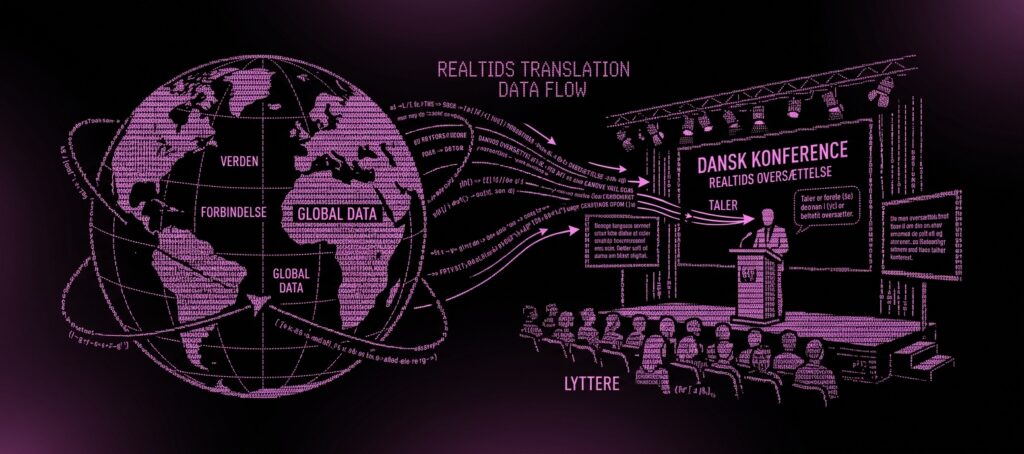
Copenhagen ranked 12th globally in the ICCA’s most recent country and city statistics report, making it one of the world’s most popular congress cities (Wonderful Copenhagen), and every major event held there faces the same paradox. Danes speak near-perfect English. The EF English Proficiency Index consistently places Denmark among the top five most English-fluent nations on earth. So why does Danish event translation matter at all?
Because fluency is not the same as preference. When Novo Nordisk hosts a pharmaceutical symposium, when Orsted convenes offshore wind stakeholders, or when Folkemodet draws 65,000 citizens and decision-makers to debate democracy on Bornholm, the working language shifts to Danish: fast, vowel-dense, and peppered with the glottal phenomenon called stod that makes it the hardest Scandinavian language to parse, even for Norwegians and Swedes. International attendees who assume “everyone speaks English” discover that the most substantive conversations, the sharpest Q&A exchanges, and the networking that drives deals all happen in Danish.
Denmark’s MICE Market: Small Country, Outsized Conference Footprint
Denmark’s population sits at roughly 5.9 million, with approximately 5.5 million native Danish speakers concentrated in Denmark proper, along with communities in Greenland, Germany’s Schleswig-Holstein, and Sweden (Ethnologue). Those numbers make Danish one of the smallest languages by speaker count to anchor a top-15 global MICE destination. The explanation is economic weight: Denmark’s GDP per capita is among the highest in Europe, and its key industries (clean energy, pharmaceuticals, maritime shipping, design, and food technology) generate disproportionate conference demand.
Conference Infrastructure
Bella Center Copenhagen is Scandinavia’s second-largest exhibition and conference venue, with 121,800 square meters of indoor space, 100 meeting rooms, and a plenary hall seating 7,000. Connected to the 812-room AC Hotel Bella Sky, Scandinavia’s largest hotel, and sitting five minutes from Copenhagen Airport, it anchors Denmark’s position as Northern Europe’s most accessible conference city (Bella Center).
- Tivoli Hotel & Congress Center: 550 rooms plus a 1,650-capacity congress hall in the heart of the city
- Copenhagen Marriott Conference Center: Waterfront venue popular for corporate offsites
- Radisson Blu Scandinavia Hotel: Host of LSX Nordic Congress and mid-size pharma events
The Events That Define Denmark
TechBBQ, Scandinavia’s largest tech and startup summit, draws over 10,000 attendees from 70+ countries to Copenhagen each August. The 2026 edition (August 26-28) features 150+ speakers across AI, fintech, climate tech, and health tech tracks (TechBBQ).
LSX Nordic Congress, the premier Nordic life sciences partnering event, gathers senior biotech, medtech, and healthtech decision-makers with investors and R&D leaders at the Radisson Blu Scandinavia Hotel (Informa Connect).
Folkemodet (The People’s Meeting), Denmark’s annual democracy festival in Allinge, Bornholm, attracts up to 65,000 visitors over three days in mid-June, with more than 2,000 political events. Crucially, nearly all debate happens in Danish: international observers without translation miss the substance entirely (Folkemodet).
Other key events: Copenhagen International Fashion Fair (CIFF) at Bella Center, Offshore Energy Denmark reflecting Denmark’s 59.3% wind power share of electricity generation, and MCE North & West Europe 2026 (April 12-14, Copenhagen).
Industries Driving Danish Event Translation Demand
Clean Energy and Wind Power
Denmark is the global epicenter of offshore wind. Vestas holds the largest market share of any turbine manufacturer worldwide (outside China), and Orsted is the world’s largest offshore wind developer. Technical discussions about turbine specifications, grid integration, and maritime safety regulations default to Danish among domestic participants.
Pharmaceuticals and Biotech
Novo Nordisk is Europe’s most valuable company by market capitalization. The pharmaceutical cluster around Copenhagen (known as Medicon Valley, spanning to Malmo in Sweden) generates a steady stream of biotech conferences, clinical research symposiums, and regulatory forums with significant Danish-language content.
Maritime and Shipping
Maersk, the world’s second-largest shipping company by tonnage, is headquartered in Copenhagen. Danish Maritime Days and related industry gatherings bring together shipowners, port authorities, and technology providers, with working sessions frequently conducted in Danish.
Why Danish Is Harder Than It Looks: The Translation Challenge
Event organizers who group Danish with Swedish and Norwegian as “basically the same language” are making a costly mistake. While written Danish, Norwegian, and Swedish share substantial mutual intelligibility, spoken Danish is a different story entirely.
The Stod Problem
Danish features a prosodic phenomenon called stod (literally “thrust”), a form of laryngealization or creaky voice that divides syllables in ways that can change word meaning. The presence or absence of stod can distinguish different words, but it is not represented in spelling and must be learned through exposure (The Local Denmark). For AI transcription systems, stod creates a challenge where the same sequence of phonemes can map to different words.
Vowel Density and Consonant Weakening
Danish has one of the largest vowel inventories of any European language, approximately 27 distinct vowel sounds compared to English’s 14-16. Combined with systematic consonant weakening (the “soft d” sound), spoken Danish becomes notoriously difficult to parse. A landmark study confirmed that Danish children take longer to acquire their native language compared to Swedish and Norwegian children, partly because of this phonological complexity (ScienceDirect).
The Asymmetric Intelligibility Problem
The Nordic intelligibility paradox: Norwegian functions as a “bridge language” between Swedish and Danish. Norwegians generally understand both reasonably well, but Swedes struggle more with Danish, and Danes sometimes struggle with Swedish. At Nordic events, a panel with Danish, Swedish, and Norwegian speakers may appear to be “all speaking the same language,” but audience comprehension varies dramatically by nationality. Real-time translation resolves this by giving each attendee content in their actual language.
A Real Scenario: The Nordic Sustainability Conference
Consider this situation. You are organizing a 2-day sustainability and clean energy conference at Bella Center Copenhagen. Your 800 attendees include 45% Danish-speaking, 25% English-speaking, 15% Swedish-speaking, 10% Norwegian-speaking, and 5% German-speaking participants.
Your keynote is from Orsted’s CEO, presenting in Danish with dense technical content about offshore hydrogen production. Three parallel breakout tracks run simultaneously, two in Danish, one in English. Traditional interpretation would require booths and headsets for five language pairs, 8-10 interpreters across two days, running EUR 30,000-50,000.
How Snapsight changes the equation: Rather than staffing interpretation booths, Snapsight captures every session through real-time transcription in the source language, then delivers live translation to each attendee’s device. The Orsted CEO’s Danish-language keynote, dense with offshore wind jargon, is transcribed in Danish and simultaneously available in English, Swedish, Norwegian, and German. With 627 events powered and 10,415 sessions transcribed across 75+ languages, Snapsight handles this scenario with 91% autonomous operation.
Cultural Context That Shapes Danish Events
The Hygge Factor
Danish event culture reflects hygge: informal networking over formal presentations, flat hierarchy in panel discussions where a junior researcher will challenge a CEO’s claims directly, sustainability as default (single-use plastics are a social faux pas), and cycling infrastructure for attendees.
The Informal-Formal Paradox
Danish business culture is simultaneously informal (first names, casual dress) and direct (blunt feedback, no small talk before substance). Translation must capture this register accurately. An overly formal translation misrepresents the tone; an overly casual translation of technical content undermines credibility.
Snapsight’s support for Swedish event translation and Norwegian event translation means organizers can use the same platform across the Nordic circuit. The event translation hub covers the full range of 75+ supported languages.
Frequently Asked Questions
Traditional Danish-English simultaneous interpretation typically runs EUR 1,500-2,500 per interpreter per day, and most setups require two interpreters per language pair (they alternate every 20-30 minutes to maintain accuracy). For a 2-day event with three language pairs (Danish-English, Danish-Swedish, Danish-German), expect EUR 18,000-30,000 in interpretation costs alone, plus EUR 5,000-10,000 for booth rental, headset distribution, and technical staff. AI-powered solutions like Snapsight significantly reduce these costs while scaling to more language pairs simultaneously.
Denmark consistently ranks in the top five globally for English proficiency (EF EPI). However, high English fluency does not mean Danish professionals prefer working in English. Technical discussions, regulatory debates, Q&A sessions, and networking conversations default to Danish in domestic events. Additionally, not all attendees are Danish: Nordic events attract Swedish, Norwegian, Finnish, and Icelandic participants who may understand written Danish but struggle with spoken Danish due to its unique pronunciation features.
Modern AI transcription models have improved substantially in handling Danish phonology, including stod. The key differentiator is training data: systems trained heavily on conference and business speech perform significantly better with the technical vocabulary and speaking patterns typical of Danish events. Snapsight’s models are trained specifically on event content, which improves accuracy for the kind of speech, including formal presentations, panel discussions, and Q&A, that characterizes conferences.
Written Danish and Norwegian Bokmal are extremely similar: a Danish speaker can typically read Norwegian text with minimal difficulty. Swedish is slightly more distant in writing. However, spoken Danish diverges significantly from both Norwegian and Swedish due to its vowel-heavy pronunciation, consonant weakening, and stod. For event purposes, a single Scandinavian interpreter cannot reliably serve all three language communities. Separate translation feeds for Danish, Swedish, and Norwegian ensure every attendee receives content they can fully understand.
Greenland uses both Greenlandic (Kalaallisut) and Danish as official languages. For events held in Nuuk or Ilulissat targeting local audiences, Greenlandic should be the primary language with Danish as a secondary option. In the Faroe Islands, Faroese is the primary language, though Danish is widely understood. For international events in either territory, a Danish-English translation pair typically covers the core need, but organizers should confirm language preferences with local partners.