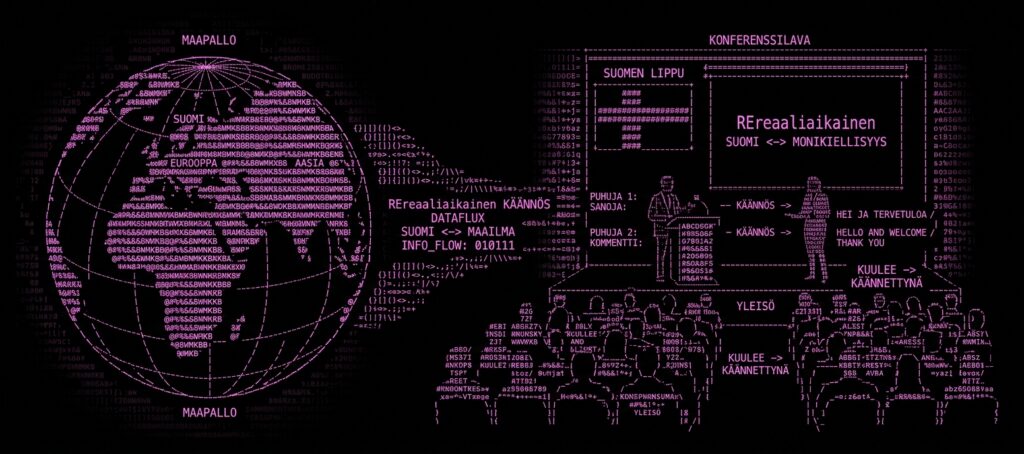
When Nordic Business Forum announced that 8,000 tickets had sold eight months before its September 2026 event at Messukeskus Helsinki, with attendees confirmed from over 50 countries, the translation math became staggering. A single Finnish noun can take over 2,000 forms depending on grammatical context, and Finnish verbs conjugate in nearly 10,000 ways (Institute for the Languages of Finland, Kotus). For the AI systems and human interpreters tasked with delivering real-time Finnish event translation, this is not an abstract linguistic curiosity. It is the defining technical challenge of every multilingual conference held in Finland.
Finland punches far above its weight in international events. A nation of 5.6 million people hosts Slush, Europe’s leading startup conference (13,000 attendees from 70+ countries in 2025), the Nordic Business Forum (8,500 business leaders expected in 2026), Helsinki Design Week (the Nordics’ largest design festival, 250+ events annually), and a year-round circuit of technology, cleantech, gaming, and education conferences that draw global audiences to a country where the local language belongs to one of the most linguistically isolated families in Europe. Getting Finnish event translation right is not optional: it is the difference between an inclusive, high-impact conference and one that leaves Finnish-speaking participants on the outside of their own country’s events.
Why Finland’s Event Market Demands Specialized Translation
A Small Language With an Outsized Conference Scene
Finnish is spoken natively by approximately 4.8 million people in Finland, with an additional 300,000 Finland-Swedish speakers who are bilingual, and small Finnish-speaking communities in Sweden, Norway, Estonia, and diaspora pockets in North America and Australia (Statistics Finland, 2024). Unlike Swedish, Danish, or Norwegian, which are mutually intelligible across Scandinavia, Finnish is a Uralic language, related distantly to Hungarian and Estonian but not mutually intelligible with either. This isolation means that no neighboring language provides a useful shortcut for interpreters or AI systems. Finnish must be handled on its own terms.
Despite the small speaker population, Finland’s MICE industry is robust. Messukeskus Helsinki, the country’s flagship venue, hosts over 1,500 meetings, congresses, and galas annually, drawing 1.2 million visitors through its 58,000 square meters of exhibition space, 40 meeting rooms, and a 4,400-seat Amfi Hall auditorium equipped with 5G WiFi supporting 20,000 concurrent users (Messukeskus Helsinki). Finlandia Hall, Alvar Aalto’s modernist landmark on Toolonlahti Bay, serves as Helsinki’s premier congress center for high-profile government and diplomatic events. Tampere Exhibition and Sports Centre and Turku’s convention facilities round out a national infrastructure that belies the country’s population size.
The Industries Driving Demand
Finland’s conference circuit is powered by several globally significant industries:
- Technology and startups. Finland’s tech ecosystem, built on Nokia’s legacy and now centered on companies like Supercell, Remedy Entertainment, and hundreds of venture-backed startups, generates enormous event demand. Slush alone drew 5,000+ startups and 3,000+ investors in 2025, with the 2026 edition (November 18-19) projecting 6,000 startups and 3,500 VCs managing $4 trillion in AUM for 20,000+ scheduled meetings (Slush.org).
- Gaming. Finland’s gaming industry is one of the world’s most concentrated, with 98% of Finnish gaming companies exporting globally (Neogames Finland). Companies like Supercell, Rovio, and Remedy Entertainment anchor an ecosystem that generates conferences, industry meetups, and developer events throughout the year.
- Cleantech and sustainability. Finland positions itself as a global leader in clean technology, circular economy, and sustainable forestry. Events like the World Circular Economy Forum (hosted in Helsinki) draw participants from across Europe, Asia, and North America.
- Education. Finland’s education system is studied worldwide. Events like EDUFI conferences and the HundrED Innovation Summit bring educators from non-Finnish-speaking countries who need translation support.
- Forestry and bioeconomy. UPM, Stora Enso, and Metsa Group are among the world’s largest forest industry companies, all headquartered in Finland. Their conferences frequently involve Finnish-language presentations that must reach international stakeholders.
The Finnish Language: Why It Breaks Conventional Translation Systems
Finnish is not merely “a difficult language.” It is structurally different from the Indo-European languages that most translation and interpretation systems are optimized for. Understanding why matters for anyone planning a multilingual event in Finland.
Agglutination and the Case System
Finnish is agglutinative, meaning it builds meaning by stacking suffixes onto root words. Where English uses prepositions and separate words, Finnish modifies the word itself. The noun “talo” (house) becomes “talossa” (in the house), “talosta” (out of the house), “taloon” (into the house), “taloissa” (in the houses), “taloistani” (from my houses), and this is just the beginning. Finnish has 15 grammatical cases, and when combined with possessive suffixes, plural markers, and other morphological elements, a single Finnish noun can appear in over 2,000 distinct forms (Stepping Stone Localization, 2023).
Why this matters for events: A Finnish speaker at a conference might use a word form that appears nowhere in the training corpus of an AI translation system, because Finnish’s combinatorial morphology means that any reasonably sized text corpus will contain only a fraction of possible word forms. The Institute for the Languages of Finland (Kotus) catalogs 51 declension types for nouns alone.
Compound Words Without Limits
Finnish freely creates compound words by joining nouns together, producing terms that can stretch to extraordinary lengths. “Lisenssinhallintaorganisaatio” (license management organization) is a routine business term. At technology conferences, compound words for emerging concepts are coined on the fly, and interpreters must parse them in real time. When translating from Finnish to English, text typically expands by 30-40%, which affects captioning layout, slide timing, and subtitle display (Stepping Stone Localization, 2023).
Vowel Harmony & Consonant Gradation
Finnish enforces vowel harmony, dividing vowels into front and back groups that cannot mix within a word. Consonant gradation adds another layer where consonants weaken or strengthen depending on syllable structure. Even small speech recognition errors cascade into mistranslations.
The Spoken-Written Divide
Spoken Finnish (puhekieli) differs significantly from written Finnish (kirjakieli). Conference speakers, particularly in startup settings, use colloquial forms that diverge substantially from the standard language. A transcription system trained on written Finnish will struggle with contractions, dropped syllables, and slang.
Finnish has no grammatical gender and uses a single pronoun (“han”) for he and she. This simplifies some translation tasks but creates challenges when translating into gendered languages. More importantly for events, Finnish has distinct registers for formal and informal communication. A government summit at Finlandia Hall and a startup pitch at Slush require different linguistic registers, and tone-deaf translation that applies the wrong register undermines credibility.
A Scenario: The Cleantech Summit at Messukeskus
Picture a three-day Nordic Cleantech Summit at Messukeskus Helsinki. You have 1,800 registered attendees: 45% Finnish-speaking, 35% English-speaking, and 20% from other Nordic and European countries (Swedish, German, French, Estonian). The program includes 6 plenary sessions, 24 breakout workshops, and an exhibition floor with 120 booths.
Your Finnish keynote speaker, a circular economy researcher from VTT Technical Research Centre, presents in Finnish using dense technical vocabulary around biorefinery processes, lignin valorization, and carbon-negative materials. An Estonian cleantech CEO presents in English but takes audience questions in Estonian. A Swedish minister delivers remarks alternating between Swedish and English.
Traditional interpretation would require a minimum of 8-10 interpreters covering Finnish-English, Finnish-Swedish, and English-Swedish pairs across parallel sessions, plus booth interpreters for the exhibition floor. At Nordic market rates, this runs EUR 40,000-55,000 for the three days, assuming you can find interpreters with cleantech vocabulary in Finnish, which is a specialty niche with limited availability.
How Snapsight handles this: Rather than staffing interpreter booths for every session and language pair, Snapsight’s AI captures each presentation in its source language through real-time transcription, then delivers live translation to attendees’ devices in their preferred language. The Finnish researcher’s presentation, complete with compounds like “ligniininjalostusprosessi” (lignin refining process), is transcribed in Finnish and simultaneously available in English, Swedish, Estonian, and any other language the attendees need. Having processed over 10,415 sessions across 627 events in 75+ languages, Snapsight’s models have encountered the agglutinative patterns that trip up general-purpose translation engines. After the summit, AI-generated summaries synthesize insights across all sessions regardless of source language.
Finland’s Conference Calendar: Events That Need Translation
Slush (Helsinki, November)
Europe’s premier startup event brings 13,000+ participants from 70+ countries to Helsinki. While the main stage operates in English, the side events, matchmaking meetings, and Finnish startup pitches create a constant Finnish-English translation demand. The 2026 edition projects 6,000 startups and 3,500 investors for 20,000+ meetings in two days (Slush.org), each of those meetings potentially crossing a language barrier.
Nordic Business Forum (Helsinki, September)
With 8,500 business leaders expected in 2026 and speakers including Oprah Winfrey, Steven Bartlett, and Angela Duckworth (Nordic Business Forum), this is one of Europe’s largest business leadership conferences. The Finnish business community forms the core audience, but the growing international attendance from 50+ countries means that networking sessions, panel Q&As, and informal conversations constantly bridge Finnish and English.
Helsinki Design Week (August-September)
The Nordic countries’ largest design festival hosts over 250 events across Helsinki, from open studios to exhibitions to professional talks (Helsinki Design Week). While many design events operate in English, the Finnish design community’s discussions, studio visits, and workshop sessions are predominantly in Finnish, creating translation needs for international design professionals.
Arctic Design Week (Rovaniemi, February)
Held in Finnish Lapland, this event draws international designers and architects to explore design in extreme conditions. The Arctic context adds specialized vocabulary around polar architecture, winter testing, and indigenous Sami culture that standard interpreters rarely encounter.
Cultural Context: What Event Organizers Must Understand
Silence Is Communication
Finnish culture values silence differently than most Western cultures. Pauses in conversation signal thoughtfulness, not confusion. Interpretation systems that rush to fill silence with filler text misrepresent the speaker.
The Sauna Dimension
Business relationships in Finland are often cemented in the sauna, not the conference room. These informal conversations, where deals are actually discussed, happen entirely in Finnish. Organizers who focus translation only on the formal program miss the conversations that matter most.
- Sisu and directness: The Finnish cultural concept of sisu (stoic determination) shapes communication style. Finnish speakers tend to be direct, understated, and allergic to exaggeration. Translation that adds enthusiasm not present in the original Finnish betrays the speaker’s intent.
- Punctuality as respect: Finnish events start on time. Exactly on time. Interpretation and captioning systems must be ready at the scheduled start, not “warming up” during the first few minutes.
Planning Finnish Event Translation: Practical Guidance
Language Pair Priorities
For most international events in Finland, the primary language pair is Finnish-English. Events with Nordic participation frequently need Finnish-Swedish support (Swedish is Finland’s second official language, spoken by approximately 5.2% of the population). Events with Baltic participation add Finnish-Estonian, which shares Uralic roots with Finnish but is not mutually intelligible. For the event translation hub, Finnish is one of the more technically demanding languages in the European portfolio.
Venue Infrastructure
Messukeskus Helsinki’s 5G infrastructure supporting 20,000 concurrent users makes it ideal for device-based translation solutions like Snapsight, where attendees access translations on their own phones or laptops. Finlandia Hall and the Helsinki Congress Center (Paasitorni) similarly offer robust connectivity. Outside Helsinki, verify bandwidth at venues in Tampere, Turku, and Oulu before committing to a streaming-based translation approach.
Budget Considerations
Human Finnish-English simultaneous interpretation typically costs EUR 1,200-1,800 per interpreter per day at Nordic market rates, with a minimum of two interpreters per language pair for sessions exceeding 30 minutes. For a multi-day, multi-track conference, costs escalate quickly. AI-powered solutions like Snapsight, operating at 91% autonomous efficiency, offer a fundamentally different cost structure, particularly for events with parallel sessions where staffing interpreters for every room is prohibitive.
Neighboring Language Connections
Finland’s geographic and cultural position connects it to several language markets. For events drawing participants from across the Nordic and Baltic regions, consider pairing Finnish translation with Swedish event translation for the Finland-Sweden corridor and Estonian event translation for the Gulf of Finland’s growing cross-border business community. The Uralic language family connection between Finnish and Estonian does not mean shared intelligibility, but linguistically aware translation systems can leverage structural similarities to improve accuracy in both languages.
Frequently Asked Questions
Finnish has 15 grammatical cases, compared to zero in English and four in German. Each case changes the form of nouns, adjectives, and pronouns, meaning a single word can appear in thousands of variations. For real-time event translation, this means AI systems must handle word forms they have never encountered in training data, because Finnish’s agglutinative structure generates forms combinatorially rather than from a fixed vocabulary list.
General-purpose AI translation tools often struggle with Finnish because of its agglutinative morphology, long compound words, and the gap between spoken and written forms. Specialized systems like Snapsight, which have processed thousands of live event sessions across 75+ languages, build Finnish-specific models that account for these patterns. The key is whether the system has been trained on spoken Finnish in conference contexts, not just written Finnish from text corpora.
Finland has high English proficiency, with approximately 70% of the population speaking English to some degree. However, high-level professional discourse, technical presentations, and nuanced Q&A sessions are consistently more precise and comfortable in Finnish. Providing Finnish translation is not about overcoming a language barrier; it is about enabling Finnish speakers to participate at their highest level of expertise rather than self-filtering through their second language.
Human Finnish-English simultaneous interpretation runs EUR 1,200-1,800 per interpreter per day in the Nordic market, with two interpreters required per language pair for sessions over 30 minutes. A three-day conference with four parallel tracks and two language pairs could cost EUR 30,000-45,000 in interpretation alone. AI-powered platforms like Snapsight deliver real-time translation across all sessions simultaneously at a fraction of that cost, with the added benefit of complete session transcripts and AI summaries after the event.
No. While Finnish, Estonian, and Hungarian all belong to the Uralic language family, they diverged thousands of years ago and are not mutually intelligible. A Finnish interpreter cannot interpret Estonian, and vice versa. Event organizers with Finnish and Estonian attendees need separate language support for each, though AI systems can leverage structural similarities in the underlying language models to improve performance across both.