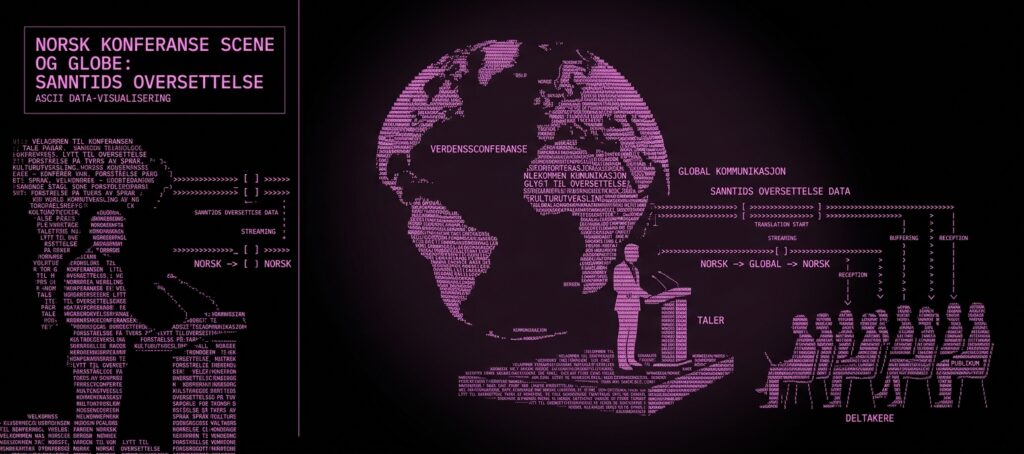
ONS (Offshore Northern Seas) drew 72,676 visitors and 1,100 exhibitors from 35 countries to Stavanger in August 2024, making it one of the largest energy conferences on the planet. Two months earlier, Nor-Shipping shattered its own records at NOVA Spektrum in Lillestrom with 63,698 attendees from 104 nations, a 23 percent jump over 2023. These are not events that can run on a single language. Norwegian event translation has become the backbone of a conference market that punches far above the weight of its 5.3 million native speakers, driven by industries like energy, maritime, aquaculture, and Arctic research, where Norway sets the global agenda.
What makes Norwegian uniquely complex for event organizers is a feature most people outside Scandinavia never learn about: Norway has two official written forms of the same language, Bokmal and Nynorsk, plus over 1,300 spoken dialects that Norwegians use proudly in every professional setting. There is no single “standard Norwegian” in speech. Add a tonal accent system that changes word meanings based on pitch, and you have a language that demands more from translation technology than its small speaker count would suggest.
Norway’s Conference Ecosystem: Small Country, Outsized Influence
Norway’s MICE industry is shaped by four pillar industries: oil and gas (and its transition to renewables), maritime and shipping, aquaculture and seafood, and Arctic science. Each generates a conference circuit with substantial international attendance.
Energy: The ONS Effect
The ONS conference in Stavanger is the undisputed anchor. Held biennially at Stavanger Forum, ONS 2024 hosted over 2,500 conference delegates, 4,050 attendees across its Net Zero Markets sessions on hydrogen, CCUS, batteries, solar, offshore wind, nuclear, and green shipping, and another 2,400 across its technical sessions (ONS, 2024 Facts and Figures). The event drew 195 accredited journalists from 15 countries. ONS 2026 is scheduled for August 24-27.
Complementing ONS, the Oslo Energy Forum has convened energy leaders for over 50 years, focusing in recent editions on accelerating the energy transition. The forum brings together stakeholders from across the energy value chain at Scandic Holmenkollen Park, with the 2025 theme “Overcoming the barriers: Accelerating the energy transition.”
Maritime: Nor-Shipping’s Record Run
Nor-Shipping 2025 marked the event’s 60th anniversary with record-breaking numbers: 1,012 exhibitors (a 13 percent increase), 23,761 square meters of exhibition space, and delegates from 104 countries (Nor-Shipping, 2025). The Ocean Leadership Conference, Tradewinds Shipowners Forum, and The LNG Conference run alongside the main exhibition at NOVA Spektrum in Lillestrom, just outside Oslo. The conference and seminar programme expanded by 38 percent compared to 2023.
Aquaculture: The World Meets in Trondheim
Aqua Nor, the world’s largest aquaculture technology exhibition, takes over Trondheim Spektrum every two years, drawing close to 25,000 visitors from over 75 countries and more than 700 exhibitors (Aqua Nor, 2025). The event recently signed a ten-year agreement with the Municipality of Trondheim, securing the city as the home of global aquaculture conferencing through 2035 and beyond. With Norway producing roughly 1.5 million tonnes of farmed salmon annually, the technical vocabulary at Aqua Nor (biomass estimation, sea lice management, recirculating aquaculture systems) demands interpreters with deep domain knowledge.
Arctic Research and Innovation
Arctic Frontiers, held annually in Tromso since 2007, celebrates its 20th anniversary in February 2026 with the theme “Turn of the Tide.” The conference brings together researchers, policymakers, industry leaders, and Indigenous communities to address challenges in the Arctic, covering seven interdisciplinary science and research themes from natural sciences to law and management (Arctic Frontiers, 2026). This is one of the few global conferences where Norwegian, English, Sami languages, and Russian may all be needed in the same session.
Further south, Oslo Innovation Week runs across 80+ individual events in more than 50 venues throughout Oslo’s city center, attracting over 16,000 attendees interested in renewable energy, circular economy, health tech, and ocean tech (Oslo Innovation Week, 2026). Nordic Edge Expo in Stavanger, scheduled for May 5-6, 2026, covers smart and sustainable cities, adding yet another internationally-oriented event to Norway’s already dense calendar.
The Two-Language Problem: Bokmal, Nynorsk, and 1,300 Dialects
Norwegian is not one language in the way most event organizers expect. Understanding its structure is essential for anyone planning multilingual events in Norway.
Two Written Standards, No Spoken Standard
Norway maintains two official written forms: Bokmal, used by roughly 87-90 percent of the population and rooted in the Dano-Norwegian that developed during Norway’s centuries-long union with Denmark, and Nynorsk, used by 10-15 percent of the population primarily in western Norway around Bergen (Sprakradet, Norwegian Language Council). In schools, 87 percent of students learn Bokmal while 11 percent learn Nynorsk as their primary written form.
Key takeaway for event organizers: Bokmal is the safe default for most business and technical events, particularly in Oslo, Stavanger, and Trondheim. But for events in western Norway (Bergen’s Grieghallen conference center, which seats up to 1,638 for conventions), Nynorsk may be expected or even required by local organizers. Most AI transcription systems train primarily on Bokmal, leaving Nynorsk underserved.
Dialects as Professional Language
Unlike most European countries where a standard spoken form dominates professional settings, Norway has no officially sanctioned spoken standard. Norwegians use their regional dialects in all circumstances, including board meetings, academic conferences, and parliamentary debates. According to Spraaksamlingene, there are still more than 1,300 distinct dialects in active use across Norway, traditionally grouped into four main families: Northern Norwegian (nordnorsk), Central Norwegian (trondersk), Western Norwegian (vestlandsk), and Eastern Norwegian (ostnorsk).
This is not a quaint cultural footnote; it is a technical challenge. A speaker from Bergen, a speaker from Tromso, and a speaker from Oslo are all speaking “Norwegian,” but the phonological differences can be substantial. AI speech recognition models trained on Oslo-area Norwegian may struggle with the tonal patterns and vocabulary of a Trondersk speaker from Trondheim or a Northern Norwegian speaker from Tromso.
The Tonal Accent Challenge
Norwegian is one of only a few European languages with a lexical pitch accent system. The language uses two distinct tonal patterns, Tone 1 and Tone 2, to differentiate words that are otherwise identical in spelling. The classic example: bonder (farmers) with Tone 1 versus bonner (beans) with Tone 2 (Talkpal, Norwegian Pitch Accent Guide). Research from the National Library of Norway and NTNU has shown that Norwegian ASR systems face particular challenges with the “complex phonetics and morphology of the different dialects, which makes it difficult for models to accurately transcribe the phonemes in the input speech to the correct spelling” (Boosting Norwegian ASR, arXiv 2307.01672, 2023).
For event translation, this means that generic speech-to-text engines tuned for other Germanic languages will produce higher error rates on Norwegian, particularly when speakers use strong regional accents with distinct tonal realizations.
Scandinavian Mutual Intelligibility: An Opportunity and a Complication
Norwegian, Swedish, and Danish are closely related North Germanic languages with varying degrees of mutual intelligibility. In practice, Norwegian speakers generally understand Swedish well and spoken Danish with more effort. Written Norwegian Bokmal and written Danish are extremely close, reflecting their shared linguistic history.
Pan-Nordic event insight: A keynote delivered in Norwegian may be largely comprehensible to Swedish attendees but could lose Danish participants who find spoken Norwegian easier to understand than spoken Danish (paradoxically, Danes often struggle most with inter-Scandinavian comprehension). Rather than assuming mutual intelligibility will carry the event, real-time translation across the Scandinavian languages ensures every attendee follows technical content accurately, not approximately.
Norwegian Business Culture and Event Norms
Norway’s business culture is shaped by janteloven, the Law of Jante, an unwritten cultural code that values humility, equality, and collective good over individual ambition. This has direct implications for how events run in Norway.
Flat Hierarchies at the Podium
Norwegian organizations operate with flat hierarchies where colleagues address each other by first name regardless of position (NLS Norway Relocation Group, 2026). At conferences, this translates into panels and sessions where junior professionals speak early and on equal footing with senior leaders. Interpreters and translation systems need to handle rapid, democratic dialogue rather than extended monologues from a single authority figure. Meetings tend to be “well-structured and focused, with an emphasis on achieving outcomes” (NLS Norway Relocation Group), so expect tight, efficient sessions rather than sprawling discussions.
Sustainability as a Non-Negotiable
Norway’s event industry reflects the country’s broader environmental commitments. Event organizers are expected to demonstrate sustainability in venue selection, catering, and logistics. Conferences like Nordic Edge Expo explicitly center on sustainability themes. For translation providers, this means that paper-based interpretation materials, disposable receivers, and fly-in interpreter teams may face resistance. Digital, device-based translation solutions align naturally with Norwegian expectations.
The Outdoor Factor
Norwegian business culture embraces the concept of friluftsliv (outdoor life). Conferences in Tromso may include Arctic excursions; events in Bergen might incorporate fjord-side networking; Stavanger events often pair with outdoor activities along the North Sea coast. Translation solutions need to work beyond the conference hall, on boats, in outdoor amphitheaters, and during walking meetings where traditional interpretation booths are impossible.
A Scenario: The Energy Transition Summit in Stavanger
Picture a three-day energy transition conference at Stavanger Forum, coinciding with ONS week. You have 800 attendees: 55 percent Norwegian-speaking (from across the dialect spectrum, including Oslo executives, Stavanger engineers, Trondheim researchers, and Tromso Arctic specialists), 30 percent English-speaking (UK, US, and international energy professionals), and 15 percent split between German, Dutch, and Danish delegates from North Sea partner nations.
Your plenary keynotes are delivered in Norwegian Bokmal and English. But your 20 parallel technical sessions include presenters who speak in their regional dialects, one session entirely in German on offshore wind partnerships, and a joint Norwegian-Danish panel on North Sea carbon capture. Traditional interpretation would require 8-10 interpreters covering Norwegian-English, Norwegian-German, Norwegian-Danish, and English-German pairs across multiple rooms, a staffing challenge in a small market where qualified energy-sector interpreters are scarce.
How Snapsight handles this: With real-time transcription capturing each session in its source language (dialect variation and all) and live translation delivered to each attendee’s device, the entire multilingual layer runs without physical interpretation booths or pre-booked interpreter teams. Snapsight’s AI processes Norwegian speech with dialect awareness, handles the Bokmal-Nynorsk distinction in written output, and delivers simultaneous translations into English, German, Danish, and Dutch. After the event, AI-generated summaries synthesize insights across all 20 technical sessions, creating a multilingual knowledge base from what would otherwise have been fragmented, single-language notes.
Across 627 events and 10,415 sessions in 75+ languages, Snapsight has refined its Norwegian language processing to handle the specific challenges (tonal accent recognition, dialect variation, energy and maritime technical vocabulary) that generic transcription tools miss. The system operates at 91 percent autonomy, meaning minimal human intervention even during complex multilingual sessions.
Key Venues for Norwegian Events
Norway’s conference infrastructure is modern and concentrated in a handful of cities:
- Stavanger Forum: The home of ONS, with exhibition and conference facilities that handle tens of thousands of attendees during energy week
- NOVA Spektrum, Lillestrom: Norway’s largest exhibition center, hosting Nor-Shipping and other major trade events just outside Oslo
- Trondheim Spektrum: Secured through 2035+ as the home of Aqua Nor and Nor-Fishing, central to the aquaculture conference circuit
- Grieghallen, Bergen: A 1,638-seat convention hall (expandable to 2,200) that hosts national and international congresses in western Norway
- Oslo Spektrum: A 9,700-seat arena in central Oslo used for large-scale conferences and corporate events
- Scandic Holmenkollen Park, Oslo: The traditional venue for the Oslo Energy Forum and executive-level events
Frequently Asked Questions
For most business and technical events, Bokmal alone is sufficient, as it is used by nearly 90 percent of the population and is the default in Oslo, Stavanger, and Trondheim. However, for events in western Norway (Bergen and surrounding regions) or events organized by institutions with Nynorsk as their official language form, providing Nynorsk captions demonstrates cultural awareness and may be expected. Snapsight can deliver transcription in both written standards.
Norwegian dialect variation is a genuine technical challenge for speech recognition. A speaker from Tromso sounds markedly different from a speaker from Bergen or Oslo, with differences in vocabulary, pronunciation, and tonal patterns. Standard ASR models trained primarily on Eastern Norwegian (Oslo-area speech) may produce elevated error rates on Northern or Western dialects. Snapsight’s models are trained on Norwegian speech data that includes dialect variation, improving accuracy across regional speakers.
While Norwegian, Swedish, and Danish share significant mutual intelligibility, relying on passive understanding for technical content is risky. Studies show that Danish speakers tend to have the most difficulty understanding the other Scandinavian languages, and technical or specialized vocabulary often does not transfer cleanly. For professional events, real-time translation between the Scandinavian languages ensures precision rather than approximation.
Oil and gas (and its transition to renewables) leads by a wide margin, anchored by ONS in Stavanger. Maritime and shipping follows, with Nor-Shipping drawing over 63,000 attendees. Aquaculture is the third major driver, with Aqua Nor in Trondheim serving as the global gathering point. Arctic research and climate science round out the top sectors, with events like Arctic Frontiers in Tromso bringing together international researchers who need Norwegian-English translation support.
Norwegian benefits from its close relationship with other well-resourced Scandinavian languages, which provides transfer learning advantages for AI models. However, the dialect diversity, dual written standards, and tonal accent system create challenges that generic translation tools often miss. Purpose-built event translation systems like Snapsight, which have processed thousands of sessions across Nordic events, deliver meaningfully better accuracy than general-purpose tools on Norwegian speech.