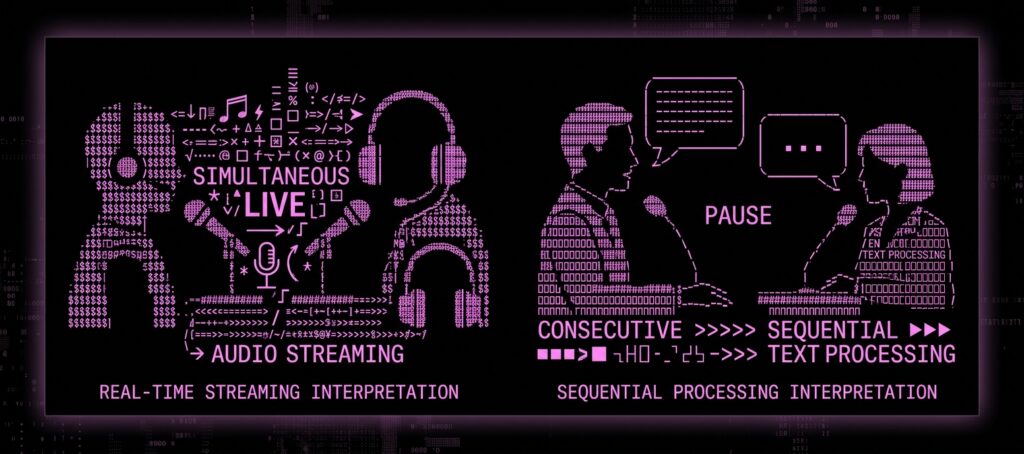
Simultaneous interpretation (SI) is the real-time translation of spoken language from one language to another, performed as the speaker talks, with the interpreter listening and speaking at the same time through a separate audio channel that listeners access via headsets, receivers, or digital devices. Unlike consecutive interpretation, where the speaker pauses to allow translation, simultaneous interpretation runs in parallel with the original speech, adding only 1-3 seconds of delay and allowing sessions to run at their natural pace without doubling the time.
The simultaneous interpretation equipment market is valued at approximately $1.5 billion in 2025 and is projected to reach $2.5-3.5 billion by 2032-2033, growing at 7-9% annually (Dataintelo, Verified Market Research, 2025). The United Nations, European Parliament, World Health Organization, and World Economic Forum all rely on simultaneous interpretation as the standard for multilingual proceedings.
Simultaneous Interpretation Defined
Simultaneous interpretation is one of the most cognitively demanding professional skills in the world. Interpreters listen to a source language, process the meaning, and produce the equivalent in a target language, all in real time with minimal delay. Research from the University of Geneva’s Faculty of Translation and Interpreting has shown that simultaneous interpreters engage more brain regions simultaneously than almost any other professional task.
The practice dates to the Nuremberg Trials (1945-1946), where it was used for the first time at a major international proceeding. The success of simultaneous interpretation at Nuremberg led to its adoption by the United Nations and, eventually, by conferences and events worldwide.
Key terminology:
- Source language: The language the speaker is using
- Target language: The language the interpreter is translating into
- Language pair: The combination of source and target languages (e.g., English-to-Spanish)
- Booth: The soundproof enclosure where interpreters work
- Relay interpretation: When an interpreter translates from a relay language rather than the original source, because no interpreter is available for the direct language pair
How Simultaneous Interpretation Works
Traditional On-Site Setup
Interpreter booths: ISO-standard soundproof booths (conforming to ISO 2603 for permanent installations or ISO 4043 for mobile booths) are positioned in or near the session room. Each booth accommodates two interpreters working one language pair.
Interpreter console: A specialized audio panel inside the booth that controls the interpreter’s microphone, headphone volume, channel selection, and mute function. Professional consoles (BOSCH, Sennheiser, Shure) comply with ISO 20109 standards.
Transmitters and receivers: The interpreted audio is transmitted via infrared (IR) or radio frequency (RF) transmitters. IR systems are more secure (the signal does not pass through walls) and are standard for diplomatic and corporate events. RF systems have longer range and are better for outdoor events.
Audio feed: Interpreters receive the source language audio directly from the venue’s mixing board, not from room speakers. Clean audio is essential for interpretation quality.
Remote Simultaneous Interpretation (RSI)
RSI uses internet-based platforms to connect remote interpreters with the event. See our detailed RSI guide for a complete breakdown.
AI-Powered Simultaneous Translation
AI translation platforms use machine learning models to perform the interpretation function without human interpreters. The technology processes speech, translates it, and outputs either text (captioned translation) or synthesized speech in the target language, all in real time.
Simultaneous Interpretation for Events: Why It Matters
Audience Reach
Without interpretation, a conference presented in English excludes 75% of the world’s population that does not speak English fluently. Providing interpretation in 2-3 additional languages can expand accessible attendance by 40-60%.
Session Efficiency
Simultaneous interpretation allows sessions to run at their natural pace. A 60-minute keynote remains 60 minutes. With consecutive interpretation, that same keynote takes 90-120 minutes. For multi-day conferences with packed agendas, this time saving is critical.
Compliance and protocol: Many international organizations and government bodies require simultaneous interpretation. UN proceedings use six official languages. The European Parliament interprets into 24 languages.
Attendee experience: Professional simultaneous interpretation delivered through high-quality equipment creates a seamless experience where language is not a barrier. Poor interpretation or the absence of interpretation signals to international attendees that they are an afterthought.
Types of Simultaneous Interpretation
By Delivery Method
- Booth-based on-site SI: Traditional setup with ISO-standard booths. Highest quality and reliability.
- RSI (Remote Simultaneous Interpretation): Interpreters work remotely via internet platform. Lower cost, greater language flexibility.
- Whispered interpretation (chuchotage): Interpreter sits next to one or two listeners and whispers the translation. No equipment required.
- AI-powered translation: Machine-generated translation as text or synthesized speech. Lowest cost, broadest language coverage, but lower accuracy for nuanced content.
By Language Configuration
- Direct interpretation: The interpreter translates directly between two languages. Highest accuracy.
- Relay interpretation: The interpreter translates from a relay language rather than the original source. Adds latency and compounds errors.
- Retour interpretation: An interpreter translates into a language that is not their native language. Less common and generally considered lower quality.
Simultaneous Interpretation Costs and Pricing
Interpreter Fees
- Common language pairs (English-Spanish, English-French, English-German): $600-$1,200 per interpreter per day
- High-demand pairs (English-Mandarin, English-Japanese, English-Korean): $800-$1,500 per interpreter per day
- Rare or specialized pairs: $1,000-$2,500+ per interpreter per day
- Standard team: 2 interpreters per language pair per day (switching every 20-30 minutes)
Equipment Costs (On-Site SI)
- Interpreter booths: $1,500-$5,000 per booth per day for rental, delivery, setup, and removal
- Receiver/headset units: $15-$25 per unit per day. For 200 receivers: $3,000-$5,000 per day.
- Transmitter system: $500-$1,500 per day (IR or RF)
- Sound technician: $500-$1,000 per day
Total Cost Examples
| Configuration | Cost Range |
|---|---|
| 2-day conference, 2 languages, on-site SI | $15,000-$35,000 |
| 3-day conference, 4 languages, on-site SI | $50,000-$120,000 |
| 2-day conference, 2 languages, RSI | $4,000-$12,000 |
| 3-day conference, 4 languages, RSI | $15,000-$40,000 |
| 3-day conference, 10 languages, AI translation | $1,000-$5,000 |
The cost gap between on-site SI and AI translation is 10-50x. This is why AI translation is expanding multilingual access to organizations and events that could never afford traditional interpretation.
How to Choose a Simultaneous Interpretation Solution
Decision Framework
- Accuracy requirements: High-stakes events need human interpreters. Informational events can use AI.
- Language count: 2-3 languages favor human interpreters. 5+ push toward RSI or AI. 10+ make AI the only practical option for most budgets.
- Event format: In-person events can use booth-based SI or RSI. Virtual and hybrid events work best with RSI or AI platforms.
- Budget: Under $5,000: AI translation. $5,000-$30,000: RSI for 2-4 languages. $30,000+: on-site SI for 2-4 languages.
- Content complexity: Technical, legal, or medical content requires interpreters with subject matter expertise. AI handles general content well but struggles with jargon.
Simultaneous Interpretation vs. Consecutive Interpretation
| Factor | Simultaneous | Consecutive |
|---|---|---|
| Speed | Real-time (1-3 second delay) | Speaker pauses after each phrase (doubles session time) |
| Equipment needed | Booths, receivers, audio system or RSI platform | None |
| Interpreter count | 2 per language pair | 1 per language pair |
| Best for | Conferences, multi-language events, sessions over 30 min | Small meetings, site visits, bilateral negotiations |
| Cost | Higher (equipment + 2 interpreters) | Lower (no equipment, 1 interpreter) |
| Audience size | Unlimited (via receivers or platform) | Limited (1-20 people typically) |
Choose simultaneous for events with more than 20 attendees, sessions longer than 30 minutes, or more than 2 languages. Choose consecutive for small bilateral meetings, site tours, and situations where equipment setup is impractical.
Simultaneous Interpretation and Event Technology
Technology is reshaping simultaneous interpretation in three ways.
AI augmentation of human interpreters. Some platforms now provide AI-assisted glossaries, real-time terminology suggestions, and automated relay that reduce cognitive load for human interpreters.
AI replacement for standard content. For informational sessions, product presentations, and training content, AI translation platforms deliver acceptable quality at a fraction of the cost. Snapsight operates in this space, providing real-time translation in 75+ languages across 627+ events and 10,415+ sessions, operating 91% autonomously.
Hybrid interpreter + AI models. The emerging best practice uses human interpreters for high-stakes sessions (keynotes, negotiations, press conferences) and AI translation for all other sessions. This maximizes quality where it matters most while ensuring that every session is accessible in every language.
Related Terms
- RSI (Remote Simultaneous Interpretation): The remote delivery method for simultaneous interpretation
- Live Event Transcription: Real-time speech-to-text, often paired with interpretation
- Live Captioning: Text display of spoken content, complementary to interpretation
- CART Services: Communication Access Realtime Translation for accessibility
- ADA Compliance for Events: Accessibility requirements that intersect with language access
- Hybrid Event Technology: Technology stack that incorporates interpretation services
Plan for two interpreters per language pair per day. Simultaneous interpretation is extremely cognitively demanding, and interpreters must switch every 20-30 minutes to maintain accuracy. A single interpreter working alone for more than 30 minutes will experience measurable accuracy degradation. For events longer than 8 hours per day, consider a third interpreter per language pair or structured breaks. For relay interpretation setups, you need the relay pair plus additional pairs for each target language.
Yes. RSI platforms (KUDO, Interprefy, Interactio) and built-in interpretation features in Zoom and Teams deliver simultaneous interpretation for virtual events. Virtual attendees select their language channel and hear the interpretation through their computer or phone audio. The technology works well when audio quality is good. The main challenge is ensuring speakers use proper microphones and stable internet connections, because interpreters cannot perform accurately with poor audio input.
Translation refers to written text (translating a document from one language to another). Interpretation refers to spoken language (converting speech from one language to another in real time or with minimal delay). Simultaneous interpretation is the real-time spoken version. The terms are often used interchangeably in casual conversation, but the professional distinction matters because the skills, training, and tools are different. Conference interpreters undergo specialized graduate training focused on simultaneous cognitive processing, not writing.
Book 4-8 weeks in advance for common language pairs (Spanish, French, German, Mandarin). Book 8-12 weeks for less common pairs or specialized subject matter. Book 3-6 months for large events requiring many language pairs or for events in high-demand periods (September-November, January-March conference seasons). Last-minute bookings (under 2 weeks) are possible for common languages but may require premium rates of 25-50% above standard fees.
For some use cases, yes. AI translation handles informational content, product presentations, and routine business discussions with sufficient accuracy for general comprehension. It excels at scaling across many languages simultaneously, something human interpretation cannot do affordably. However, AI still struggles with humor, cultural nuance, idiomatic expressions, and context-dependent meaning. For diplomatic proceedings, legal testimony, medical communications, and content where misinterpretation has serious consequences, human interpreters remain essential. The practical answer for most events: use AI for breadth (all sessions in all languages) and human interpreters for depth (keynotes and critical sessions).