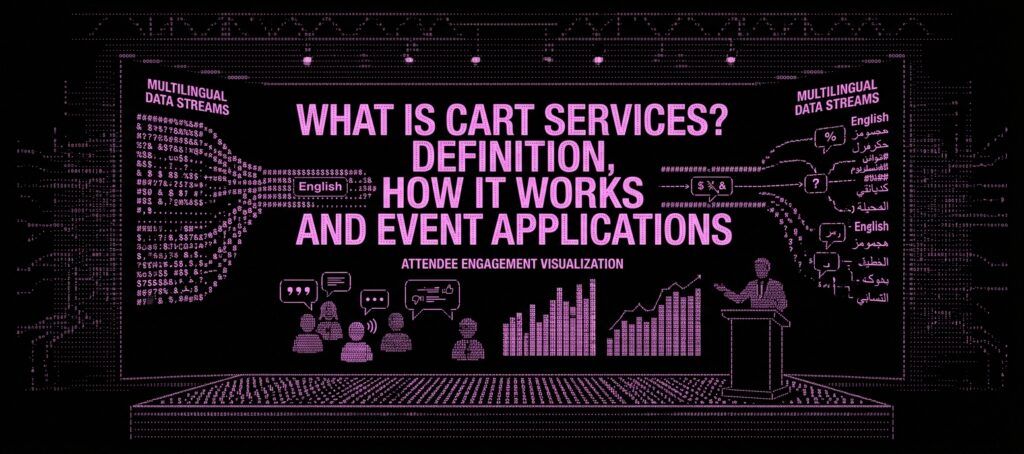
CART (Communication Access Realtime Translation) is a professional service in which a trained stenographer uses a stenotype machine and specialized software to convert spoken language into verbatim written text in real time, displaying it on a screen, monitor, laptop, or personal device for people who are deaf, hard of hearing, or who benefit from text-based access to spoken content. CART is recognized by the Americans with Disabilities Act as an effective accommodation for communication access and is the gold standard for accuracy in live captioning.
The term “Communication Access Realtime Translation” was coined by the National Court Reporters Association (NCRA) to distinguish this service from court reporting, even though both use the same stenographic technology. CART providers capture speech at speeds of 200-260+ words per minute with accuracy rates of 98-99%, significantly higher than AI-powered alternatives that average 80-90% under event conditions. For attendees who rely on text as their primary mode of following spoken content, this accuracy difference is the difference between usable and unusable communication access.
CART Services Defined
CART is one of several communication access services available for events. Understanding how it fits within the broader landscape helps event professionals make informed decisions.
- CART uses stenographic technology to produce verbatim text in real time. A CART provider types on a specialized keyboard that captures phonetic shorthand, and software translates that shorthand into readable text.
- Sign language interpreting converts spoken language into visual sign language (ASL in the United States). It serves culturally Deaf individuals who use sign language as their primary language.
- Assistive listening devices (FM systems, infrared systems, hearing loops) amplify audio for people with residual hearing.
- AI captioning uses machine learning to perform automatic speech-to-text conversion. It is faster to deploy and less expensive but significantly less accurate.
According to the National Association of the Deaf (NAD), CART is the preferred accommodation for many individuals who are deaf or hard of hearing, particularly those who do not use sign language. The NAD emphasizes that CART provides “access to the spoken word” in a way that other accommodations cannot replicate for this population.
Regulatory Recognition
- ADA: CART is listed as an appropriate auxiliary aid and service for effective communication under Title II and Title III
- Section 504/508: Federal agencies must provide CART when requested as a reasonable accommodation
- FCC: CART is the industry benchmark for real-time captioning quality
- State laws: Many states explicitly name CART as a required accommodation in educational, government, and public event settings
How CART Services Work
The Stenographic Process
CART providers use a stenotype machine, a specialized keyboard with 22 keys that are pressed in combinations (chords) to represent sounds, syllables, and whole words. This approach allows trained operators to capture speech at speeds exceeding natural spoken language (average conversational speed is 150 words per minute; CART providers type at 200-260+ words per minute).
Computer-aided transcription (CAT) software translates the shorthand into readable English in real time, applying the provider’s personal dictionary and automated formatting rules (punctuation, capitalization, paragraph breaks).
Delivery Methods
On-Site CART
Provider is physically present at the event. Audio comes through a direct feed from the venue’s sound system. Text is displayed on a laptop, large monitor, or projected screen.
Remote CART
Provider works from a remote location, receiving audio through a phone line, internet stream, or platform integration. Text is delivered via a web-based viewer on personal devices. This has become the standard delivery method since 2020.
Broadcast CART: Used for live television, webinars, and large-scale livestreams. The CART output is encoded as closed captions within the video stream.
Quality Requirements
- Clean audio feed: Direct from the mixing board or a dedicated microphone near the speaker
- Speaker pacing: Extremely rapid speech or overlapping speakers reduce accuracy
- Subject matter preparation: Providers need event materials at least 48-72 hours before the event to build custom dictionary entries
- Backup plan: A second CART provider or AI captioning fallback in case of technical issues
CART Services for Events: Why They Matter
Accessibility Compliance
CART is the most reliable method for meeting ADA communication access requirements at events. ADA-related lawsuits exceeded 6,000 in the first three quarters of 2025, a 37% increase over the prior year. Settlements for accessibility violations average $125,000 or more. For event organizers, proactive CART provision is both the ethical standard and the lower-risk legal strategy.
Accuracy for Dependent Users
For attendees who rely on captions as their sole access to spoken content, accuracy is not a preference. It is a necessity. A caption error rate of 10-15% (common with AI captioning) means the attendee misses or misunderstands roughly one word in seven. Over an hour-long session, this produces hundreds of comprehension gaps. CART’s 98-99% accuracy rate means attendees can follow spoken content with near-perfect fidelity.
Professional Standards
CART is a credentialed profession. The NCRA offers the Certified Realtime Reporter (CRR) credential, requiring demonstrated proficiency at 180 words per minute with 96%+ accuracy. The Certified CART Provider (CCP) credential adds additional requirements specific to communication access settings.
Types of CART Service Configurations
- Individual CART: Serves a single attendee or small group with a laptop. Best for small meetings, classroom settings. Cost: $125-$250/hour (remote), $150-$300/hour (on-site).
- Open CART (Large Screen Display): Text displayed on a large screen visible to the entire audience. Best for conference sessions, keynotes. Same provider rate plus $500-$1,500/day for display equipment.
- Remote CART with Web Viewer: Text delivered through a web-based viewer on personal devices. Best for virtual events, hybrid events. Minimal infrastructure cost.
- Multi-Track CART: Separate CART providers cover each track simultaneously. Best for multi-track conferences. One provider per track, $125-$300/hour per track.
CART Services Costs and Pricing
Provider Rates
- Remote CART: $125-$250 per hour
- On-site CART: $150-$300 per hour (plus travel and accommodation)
- Referral service/agency rate: $200-$350 per hour (agencies mark up 20-40%)
- Minimum engagement: Most providers require a 2-hour minimum per booking
Total Cost Examples
| Configuration | Cost Range |
|---|---|
| Half-day meeting (4 hours, remote CART) | $500-$1,000 |
| Full-day conference session (8 hours, 2 providers) | $2,000-$4,000 |
| Two-day conference (single track, remote) | $4,000-$8,000 |
| Three-day conference (3 tracks, remote) | $18,000-$36,000 |
Cost Factors
- Rush scheduling (under 1 week notice): 25-50% premium
- Specialized subject matter (legal, medical, technical): 10-25% premium
- Travel and accommodation (on-site, out-of-market): $500-$1,500 additional per day
- Evenings/weekends: 25-50% premium
- Transcript delivery (cleaned post-event): $50-$200 per hour of content
CART is the most expensive captioning method. AI captioning costs $50-$500 per event, making it 5-50x less expensive than CART. The cost difference explains why many organizations use AI captioning as a default with CART available upon specific request.
How to Choose a CART Provider
Finding Qualified Providers
- NCRA directory: The National Court Reporters Association maintains a searchable database of certified CART providers at ncra.org
- Referral agencies: Companies like Caption First, Alternative Communication Services, and Inclusive Communication Services connect organizations with vetted providers
- State registries: Many states maintain lists of approved CART providers
- Professional networks: Ask other event organizers for provider recommendations
Evaluation Criteria
- Credentials: Look for CRR (Certified Realtime Reporter) or CCP (Certified CART Provider) certification from NCRA.
- Subject matter experience: A provider experienced in your industry will have a pre-built dictionary with relevant terminology.
- Technology setup: Can they integrate with your event platform? What is their backup plan?
- Accuracy commitment: Certified providers should be comfortable committing to 96%+ accuracy.
- Preparation process: Good providers will request event materials 48-72 hours in advance. Providers who do not ask for materials may deliver lower accuracy.
Red Flags
- No NCRA certification or equivalent credential
- Unwilling to provide references from similar events
- No backup plan for equipment failure or provider illness
- Cannot accommodate preparation materials or custom dictionary building
- Below-market rates (suggesting less experienced providers)
CART Services vs. AI Captioning
| Factor | CART | AI Captioning |
|---|---|---|
| Accuracy | 98-99% | 70-90% (event conditions) |
| Cost per hour | $125-$300 | $5-$50 |
| Languages | 1 per provider | 30-100+ simultaneously |
| Scalability | 1 provider per track | Unlimited concurrent tracks |
| Speaker identification | Yes | Limited or absent |
| ADA recognition | Explicitly recognized | Accepted if accuracy meets standard |
The practical recommendation for events: Offer AI captioning as a default feature for all sessions (universal baseline accessibility). Provide human CART upon request for attendees who need higher accuracy. Budget for 1-2 CART providers based on anticipated accommodation requests.
CART Services and Event Technology
CART providers increasingly work within broader event technology ecosystems rather than as standalone services. Modern event platforms (Zoom, Teams, Webex, Cvent, Bizzabo) support CART integration through APIs that ingest the stenographic text stream and display it within the platform’s native captioning interface.
AI-powered event content intelligence platforms like Snapsight complement CART by extending text-based access beyond what human stenography can deliver. While CART provides high-accuracy English captioning for individual sessions, platforms like Snapsight provide AI-powered text in 75+ languages across every session simultaneously, processing 10,415+ sessions across 627+ events. The combination of human CART for precision and AI for breadth creates the most comprehensive accessibility approach.
The future of CART is not replacement by AI but integration. Human CART providers focus on the sessions and attendees where accuracy matters most. AI captioning covers everything else. Together, they deliver universal access that neither could achieve alone.
Related Terms
- Live Captioning: The broader category of real-time text display, including CART and AI methods
- Live Event Transcription: Real-time speech-to-text that may or may not meet CART standards
- ADA Compliance for Events: Legal framework driving CART adoption
- Simultaneous Interpretation: Real-time spoken translation, a complementary service to CART
- RSI (Remote Simultaneous Interpretation): Remote delivery of interpretation, similar to remote CART delivery
- Hybrid Event Technology: Technology ecosystem where CART integrates with virtual and in-person components
Provide CART when: an attendee specifically requests it (ADA compliance requires honoring reasonable accommodation requests), the event is subject to ADA Title II (government-affiliated), or when deaf or hard-of-hearing attendees will rely on captions as their sole communication access. Provide AI captioning as a default baseline for all sessions and upgrade to CART where needed. Many organizations include an accessibility request field on their registration form, asking attendees to specify needs at least two weeks before the event.
Contact a referral agency (Caption First, ACS Captions, Inclusive Communication Services) as they maintain networks of available providers. Remote CART has more availability than on-site because providers do not need travel time. For events less than one week away, expect a 25-50% rush premium and reduced availability for specialized subject matter. As a backup, arrange AI captioning (which can be activated in minutes) in case a CART provider cannot be secured in time.
Yes, but the provider pool is much smaller. CART is most widely available in English. Some providers offer Spanish, French, or other major languages, but finding certified CART providers in less common languages is difficult. For multilingual accessibility, the practical approach is human CART in the primary event language and AI captioning in additional languages.
Both use stenotype machines and the same core skill set. Court reporters produce official legal records of proceedings and are certified for that purpose. CART providers specialize in communication access for deaf and hard-of-hearing individuals in non-legal settings (events, classrooms, meetings). Many professionals hold both certifications. The key difference is the output: court reporters produce a permanent legal transcript. CART providers produce a real-time text display for immediate comprehension. CART output may or may not be saved as a permanent record depending on the engagement terms.
Use historical data and registration demographics. If this is your first event offering CART, budget for 1-2 CART providers covering your main sessions and include an accessibility request field on registration. The CDC reports that 15% of American adults have hearing loss, but only a fraction will request CART specifically (most use assistive listening devices or manage without accommodation). For a 1,000-person conference, plan for 2-5 CART requests. As your accessibility program matures, historical request rates will guide future budgets.