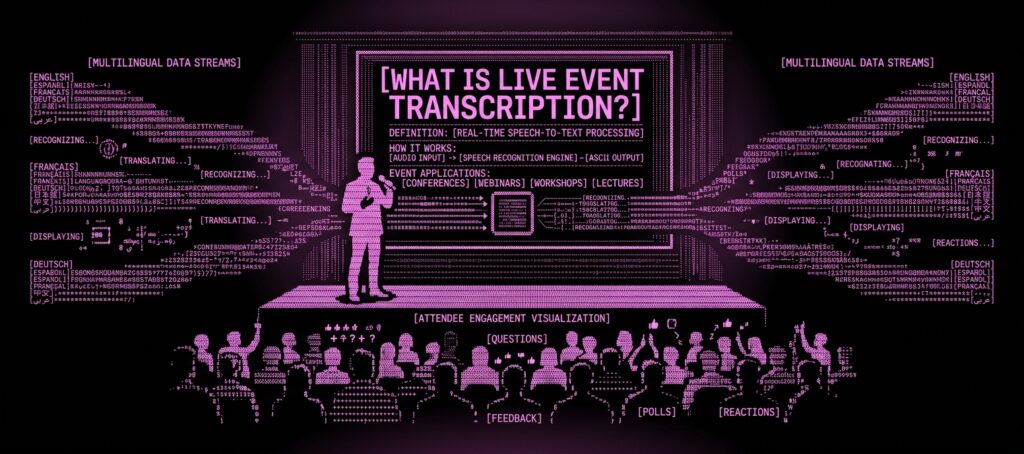
Live event transcription is the real-time conversion of spoken content into written text during conferences, meetings, webinars, and other events, delivered to attendees as the speakers talk. Unlike post-event transcription, which processes recordings after the fact, live transcription operates in real time with a delay of just 1-5 seconds, providing immediate text output that attendees can read on screens, devices, or within an event platform for accessibility, comprehension, and content capture.
The technology has moved from a niche accessibility accommodation to a standard event feature. The AI transcription market is projected to grow from $3.86 billion in 2025 to $29.45 billion by 2034, a 25.6% compound annual growth rate that reflects how quickly automated transcription is becoming embedded in every communication platform (Market.us, 2025). For events specifically, live transcription serves three audiences simultaneously: attendees who are deaf or hard of hearing (accessibility), non-native speakers who comprehend better with text support (inclusion), and all attendees who benefit from searchable, archivable session records (content value).
Live Event Transcription Defined
Live event transcription converts speech to text in real time during a live event. The output appears on screens, devices, or embedded within an event platform within seconds of the words being spoken. It differs from three commonly confused services:
- Post-event transcription produces text from recordings after the event ends. Turnaround is hours to days. Accuracy is higher because editors can review and correct.
- Live captioning is a closely related term, often used interchangeably with live transcription. In practice, captioning typically refers to text displayed as an overlay on video (like TV captions), while transcription refers to a running text document. The underlying technology is the same.
- CART (Communication Access Realtime Translation) is a specific form of live transcription performed by certified stenographers using specialized equipment. CART is the gold standard for accuracy and is the preferred accommodation under the ADA.
How Live Event Transcription Works
Human Transcription (CART/Stenography)
A trained stenographer uses a stenotype machine to capture speech phonetically at speeds up to 250 words per minute. Software converts the phonetic shorthand into readable text, which is displayed to attendees on screens, laptops, or personal devices.
- Accuracy: 98-99% in ideal conditions
- Latency: 2-4 seconds
- Languages: Typically English only per provider. Multilingual events require separate stenographers for each language.
- Setup: Stenographer needs a clear audio feed (direct from the mixing board, not ambient room audio) and a stable internet connection for remote CART delivery
AI-Powered Transcription
Machine learning models process audio in real time, converting speech to text using automatic speech recognition (ASR) technology. Providers include platforms like Otter.ai, Rev, Verbit, and event-specific solutions.
- Accuracy: Varies significantly. In controlled conditions (clear audio, single speaker, standard accent), top platforms achieve 90-95%. Under real-world event conditions (multiple speakers, accents, background noise, technical terminology), accuracy drops to 75-90%. One independent study found AI transcription platforms averaged 61.92% accuracy in uncontrolled real-world conditions (Sonix, 2025).
- Latency: 1-3 seconds
- Languages: Multilingual support varies. Some platforms handle 30-100+ languages automatically.
- Setup: Audio input via API integration, direct microphone feed, or platform SDK. No specialized human operator required for basic operation.
Hybrid Transcription
Combines AI transcription with human editors who correct errors in real time. The AI handles the initial speech-to-text conversion, and one or more human editors review the output, fixing names, technical terms, and recognition errors as they occur.
- Accuracy: 95-98%, approaching human CART quality
- Latency: 3-8 seconds (additional delay for human review)
- Languages: Primary language only (human editors work in one language)
- Setup: AI platform plus human editors who need clear audio and familiarity with the subject matter
The accuracy gap between methods matters more for some events than others. For accessibility compliance at a government event, 98-99% accuracy from human CART may be legally required. For a corporate kickoff where transcription is a nice-to-have, 85-90% from AI is often sufficient. For a multilingual conference where transcription in 10 languages is needed, AI is the only practical option.
Live Event Transcription for Events: Why It Matters
Accessibility Compliance
Under the ADA and Section 508, event organizers must provide effective communication for attendees who are deaf or hard of hearing. The April 2026 ADA Title II deadline requires WCAG 2.1 Level AA compliance for digital content. See our ADA Compliance for Events guide.
Comprehension and Engagement
Text support improves comprehension even for attendees without hearing disabilities. Non-native speakers benefit significantly from seeing words on screen while hearing them spoken. 73% of attendees expect conferences to use modern event technology (Bizzabo, 2026).
Content Capture and Repurposing
This is where live transcription delivers ROI beyond the event day. Every transcribed session becomes a text asset that can be searched, summarized, excerpted, translated, and repurposed into blog posts, social media content, white papers, and training materials. Without transcription, event content exists only in attendee memory and whatever notes they managed to take.
Searchability
Transcripts make event content searchable. Attendees can find specific topics, speaker quotes, or data points without scrubbing through hours of video. For organizations that run recurring events, searchable transcripts create institutional memory, a knowledge base of everything discussed across multiple events and years.
Types of Live Event Transcription
By Delivery Method
- On-screen display: Transcription text appears on large screens in the session room, similar to teleprompter text. Best for in-person accessibility.
- In-platform display: Text appears within the virtual event platform or video player. Standard for virtual and hybrid events.
- Personal device delivery: Attendees access transcription on their own phone, tablet, or laptop via a web link or event app. Allows individual control over text size, scrolling, and language preferences.
- Closed captioning overlay: Text displayed as captions over the video feed. Best for broadcast-style sessions.
By Scope
- Verbatim transcription: Every word captured as spoken, including filler words, false starts, and repetitions. Required for legal compliance and official records.
- Clean/edited transcription: Light editing removes filler words, corrects grammar, and improves readability while preserving the speaker’s meaning. Preferred for content repurposing.
- Intelligent transcription: AI identifies speakers, adds punctuation, paragraph breaks, and formatting. Some systems add topic headings and highlight key points automatically.
Live Event Transcription Costs and Pricing
Human CART/Stenography
- On-site CART: $150-$300 per hour. Two CART providers recommended for sessions longer than one hour.
- Remote CART: $125-$250 per hour. Lower cost because travel and accommodation are eliminated.
- Minimum engagement: Most CART providers require a 2-hour minimum.
- Two-day conference (8 hours/day): $2,000-$4,800 for single-track coverage
AI Transcription Platforms
- Per-event pricing: $100-$1,000 per day depending on the platform, hours of audio, and attendee count
- Per-minute pricing: $0.006-$0.05 per minute of audio. A full day (8 hours) costs $3-$24 at the low end.
- Subscription pricing: $100-$500 per month for unlimited transcription (Otter.ai Business, Rev, Verbit plans)
- Enterprise event pricing: $500-$5,000 per event for platforms with event-specific features (speaker identification, custom vocabulary, branded display)
Hybrid (AI + Human Editors)
- Rate: $0.10-$0.50 per minute of audio for real-time corrected output
- Two-day conference: $500-$2,000 depending on number of tracks
AI transcription costs are 70-90% less than human CART for equivalent coverage. A multilingual conference needing transcription in five languages might spend $15,000-$25,000 on human providers or $1,000-$5,000 on AI-powered transcription. The trade-off is accuracy: if your event has attendees who rely on captions as their primary mode of communication, human CART is worth the premium.
How to Choose a Live Event Transcription Solution
Key Evaluation Criteria
- Accuracy under real conditions: Request a live demo with audio that matches your event conditions (multiple speakers, accents, technical terminology, ambient noise). Lab accuracy numbers are meaningless for events.
- Custom vocabulary: Can the platform learn speaker names, company names, and industry jargon specific to your event? This alone can improve accuracy by 5-15%.
- Speaker identification: Does the system label who is speaking? This is essential for usable transcripts and content repurposing.
- Language support: How many languages are supported? What is the accuracy for non-English languages? AI accuracy varies significantly across languages.
- Integration: Does the transcription service integrate with your event platform (Zoom, Teams, Cvent, Bizzabo, Hopin)? Can it output to on-screen displays for in-person sessions?
- Output formats: Can you export transcripts as text, SRT (subtitle files), Word documents, or searchable archives?
- Real-time editing: Can an operator correct errors as they happen? This is particularly important for speaker names and technical terms.
Live Event Transcription vs. Post-Event Transcription
The choice between live and post-event transcription depends on your primary use case.
Choose live transcription when:
- Accessibility compliance requires real-time text for deaf or hard-of-hearing attendees
- You want to provide text support for non-native speakers during the session
- Attendees need to search or reference content while the event is still happening
- You are running a virtual or hybrid event where captioning is a standard expectation
Choose post-event transcription when:
- Maximum accuracy is the priority and real-time display is not needed
- Budget is limited and you only need transcripts for archival purposes
- You plan to heavily edit transcripts before publishing (white papers, reports)
- The event is not subject to accessibility compliance requirements
Many organizations use both. Live transcription provides real-time access during the event, and post-event transcription (often generated by editing the live output) produces polished, publication-ready content.
Live Event Transcription and Event Technology
Live transcription is evolving from a standalone service into a component of broader event content intelligence. The shift matters because transcription by itself produces raw text. What event professionals actually need is structured, actionable content.
AI-powered event intelligence platforms like Snapsight represent this evolution. Rather than simply converting speech to text, Snapsight processes event content across 75+ languages simultaneously, generating transcripts, translations, summaries, and cross-session insights. Having processed 10,415+ sessions across 627+ events, the platform operates 91% autonomously, meaning event teams do not need to manage the transcription process during the event.
The shift from “transcription as accommodation” to “transcription as intelligence layer” is the most significant trend in the space. When transcription feeds into AI analysis, every session becomes searchable, translatable, and actionable. 95% of event professionals expect AI usage in events to increase (EventsAir, 2026).
Related Terms
- CART Services: Communication Access Realtime Translation, human stenography for live captioning
- Live Captioning: Real-time text display of spoken content, often used interchangeably with live transcription
- ADA Compliance for Events: Legal requirements driving transcription adoption
- RSI (Remote Simultaneous Interpretation): Real-time spoken translation, a complementary service to transcription
- Event Analytics: Data tools that use transcription output for content analysis
- Hybrid Event Technology: Technology stack where transcription is a key component
Accuracy depends heavily on conditions. In controlled environments with clear audio and a single speaker, top AI platforms achieve 90-95% accuracy. At real events with multiple speakers, accents, background noise, and domain-specific terminology, accuracy typically drops to 75-90%. One study found average real-world accuracy of 61.92% across platforms. Custom vocabulary training, high-quality audio input (direct from the mixing board rather than ambient microphones), and hybrid AI-plus-human approaches significantly improve results. For critical accessibility applications, human CART at 98-99% accuracy remains the standard.
It depends on the event type and organizer. Government-affiliated events must provide effective communication under ADA Title II, and transcription is one accepted method. Private events under ADA Title III must provide reasonable accommodations when requested. The new April 2026 ADA Title II rules explicitly require WCAG 2.1 Level AA compliance for digital content, which includes captioning for video. Virtual and hybrid events streamed as video programming may also fall under FCC captioning requirements.
Human CART providers typically work in one language. For multilingual events, you need either separate CART providers per language (expensive and logistically complex) or an AI platform with multilingual support. AI-powered platforms can transcribe and translate in dozens of languages simultaneously from a single audio feed. This is where AI transcription has a clear advantage over human services: a 10-language event that would require 20 CART providers can be served by a single AI platform.
Four factors have the most impact: audio quality (use direct microphone feeds, not ambient room audio), custom vocabulary (pre-load speaker names, company names, and technical terms into the platform), speaker pacing (brief speakers on speaking clearly and at moderate pace), and environmental noise (minimize background noise in session rooms). These steps can improve AI accuracy by 10-20 percentage points.
Best practice is to retain transcripts as searchable archives that become more valuable over time. Immediate uses include on-demand content for attendees who missed sessions, social media excerpts, blog posts, and executive summaries. Longer-term uses include trend analysis across multiple events, training materials, compliance documentation, and institutional knowledge bases. AI-powered platforms can generate these derivative outputs automatically from the raw transcript.