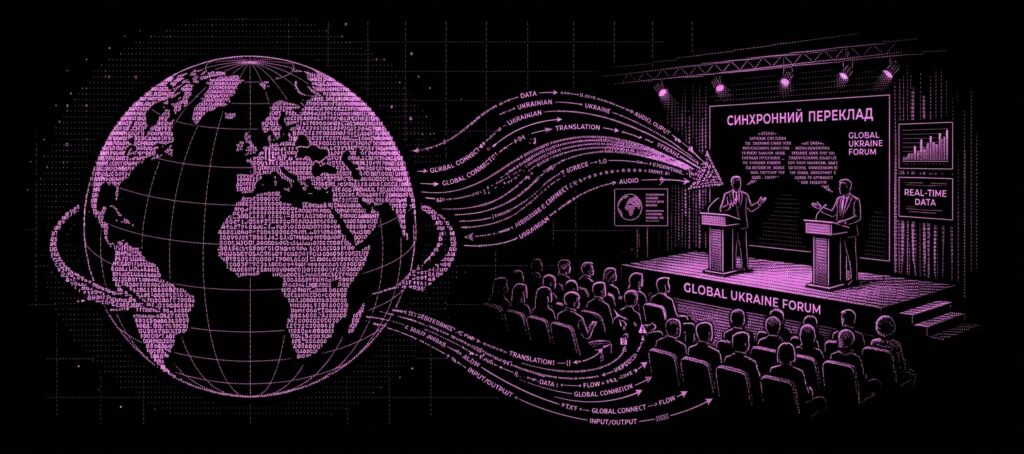
The Ukraine Recovery Conference in Rome drew more than 6,000 delegates in July 2025 and produced agreements worth over 3.5 billion euros, a fourfold increase in attendance from the inaugural Lugano conference just three years earlier (URC, 2025). The 2026 edition moves to Warsaw, where it may become the first held in a postwar setting. At Brave1 Defense Tech Valley in Lviv, international investors pledged over $100 million to Ukrainian defense startups across two days in September 2025, with more than 5,000 participants from over 50 countries (Kyiv Post, 2025). And at Ukraine House Davos, now in its eighth year running alongside the World Economic Forum, senior government officials and global business leaders convene each January to discuss reconstruction, energy resilience, and strategic investment (UMAEF, 2026).
Ukrainian event translation is not a niche requirement. It is the linguistic backbone of one of the most consequential conference circuits in the world right now, one where reconstruction budgets, defense partnerships, and agricultural trade worth billions of dollars are negotiated across Ukrainian, English, Polish, German, and French. For event organizers working in this space, understanding the Ukrainian language’s specific challenges is not optional. It is the difference between a conference that builds trust and one that creates confusion at exactly the wrong moment.
A Conference Landscape Shaped by War, Recovery, and Global Solidarity
Ukraine’s events industry has undergone a transformation unlike any other in recent memory. Before 2022, the country’s conference circuit was growing steadily, anchored by tech events in Lviv and Kyiv and agricultural trade shows in Odesa. The full-scale invasion upended that trajectory, but it also created an entirely new category of high-stakes international conferences that did not exist before.
The Recovery and Reconstruction Circuit
The Ukraine Recovery Conference (URC) has become the flagship event in this space. Launched in Lugano, Switzerland in 2022, it has rotated through London (2023), Berlin (2024), and Rome (2025), growing from roughly 1,000 delegates to over 6,000. At URC 2025, the European Flagship Fund for the Reconstruction of Ukraine was launched with an initial 200 million euro commitment and a target of 500 million euros by 2026 (European Parliament Think Tank, 2025).
ReBuild Ukraine, an international exhibition and conference focused on construction, energy, and infrastructure, runs annually in Kyiv. The November 2025 edition brought together recovery projects, materials suppliers, technology providers, and investors (ReBuild Ukraine, 2025).
Defense Technology: A New Conference Vertical
Ukraine’s defense tech sector has emerged as a globally significant conference vertical. Brave1, the government’s defense innovation cluster, organized the Defense Tech Valley summit in Lviv in September 2025, attracting 5,000 participants from over 50 countries. Ukrainian defense tech startups raised $105 million in investment commitments at the event alone (Resilience Media, 2025). The NATO-Ukraine Defence Innovators Forum launches in spring 2026 under the new UNITE programme.
These events are inherently multilingual. A Ukrainian drone manufacturer pitching to a German defense procurement team, a British investor evaluating a Kyiv-based cybersecurity startup, a Polish construction firm bidding on energy infrastructure: every session operates across at least two languages, often three or four.
Technology and Business Conferences
- IT Arena (Lviv): Ukraine’s premier technology conference, 5,000+ attendees annually at Arena Lviv stadium. Five stages: Business, Tech, Product, Defense, and Startup. Speakers from Google, Microsoft, Uber, and Airbnb alongside leading Ukrainian companies (Ukrinform, 2025). 2026 edition runs in September.
- Kyiv International Economic Forum (KIEF): 11th edition in October 2025, “Ukraine 2.0: The Power of People,” 1,000+ leaders, 15 panel discussions, 100+ speakers. 2026 edition moves to Parkovyi Congress Center.
- Kyiv International Cyber Resilience Forum (KICRF): Annual event reflecting the centrality of cybersecurity to Ukraine’s national strategy.
Agriculture: Ukraine’s Enduring Export Powerhouse
Despite the war, Ukraine remained the world’s leading sunflower oil exporter in 2024, with $5.12 billion in export volume representing 36.8% of global exports (Agroreview, 2025). Grain exports for 2024/2025 were projected at 40.3 million tonnes, including 16.2 million tonnes of wheat and 20.5 million tonnes of corn (Kyiv Post, 2024).
| Event | Focus | Location & Timing |
|---|---|---|
| Grain Ukraine (10th anniversary) | Agri-food, banking, technology | Odesa, May 2025 |
| Black Sea Grain Kyiv | Grain trade | Kyiv, April 2026 |
| Grain Tech Expo | Agricultural technology | Kyiv International Exhibition Centre, February 2026 |
The Diaspora Conference Circuit
Ukraine’s wartime diaspora has created a parallel conference ecosystem across Europe and North America. Ukraine House Davos, co-organized by UMAEF, the Victor Pinchuk Foundation, and Horizon Capital, runs its eighth edition in January 2026 alongside the World Economic Forum, with panels on peace, defense industry, energy investment, and reconstruction (UMAEF, 2026).
Polish cities, particularly Warsaw and Krakow, now host a growing number of Ukrainian business and reconstruction events, a natural development given the significant Polish-Ukrainian professional overlap. Toronto, home to Canada’s 1.4 million-strong Ukrainian diaspora, and Berlin, a hub for Ukrainian tech professionals who relocated after 2022, both sustain regular diaspora conference programming.
The Ukrainian Language: What Event Organizers Must Understand
Ukrainian is an East Slavic language with approximately 41 million native speakers worldwide, of whom roughly 37.5 million live in Ukraine (Ethnologue, 2024). It is the sole official state language of Ukraine. But the linguistic picture is considerably more complex than that headline number suggests.
The Ukrainian-Russian Distinction: A Non-Negotiable Sensitivity
This is the single most important point for any event professional working with Ukrainian audiences. Ukrainian and Russian are separate languages. They share East Slavic roots and Cyrillic script, but they are mutually intelligible only at a basic conversational level, roughly comparable to the difference between Spanish and Portuguese. Vocabulary overlap is estimated at 62%, with significant divergence in grammar, phonology, and technical terminology.
Never assume that Russian interpretation is acceptable for a Ukrainian-language event. Providing Russian instead of Ukrainian translation at a reconstruction conference, a defense tech summit, or a diaspora gathering would be received not merely as a logistical error but as a political affront. Since 2019, Ukraine’s language law mandates Ukrainian in over 30 spheres of public life. In 2025, the Verkhovna Rada removed Russian from the list of minority languages protected under the European Charter (Kyiv Independent, 2025).
Surzhyk: The Mixed Speech Challenge
Surzhyk refers to a Ukrainian-Russian mixed speech variety used informally by millions of Ukrainians, particularly in central and eastern regions. It blends Ukrainian grammar with Russian vocabulary (or vice versa) in patterns that vary by speaker and region. For event translation, Surzhyk presents a real challenge: speakers at agricultural trade shows or regional business events may switch between Ukrainian, Russian loanwords, and Surzhyk mid-sentence. AI transcription systems must be trained to handle this code-switching without defaulting everything to Russian, a mistake that off-the-shelf ASR tools frequently make.
Grammatical Complexity
| Feature | Detail | Impact on Translation |
|---|---|---|
| Seven grammatical cases | Nominative, genitive, dative, accusative, instrumental, locative, vocative | A single technical term appears in 7 different forms |
| Three genders, two numbers | Adjectives, pronouns, and numerals all decline to match | Complex agreement rules for ASR systems |
| Active vocative case | Unlike most Slavic languages where it is archaic | Matters for formal event address and titles |
| 33-letter Cyrillic alphabet | Differs from Russian Cyrillic in key characters (i, yi, ye) | Displaying Russian Cyrillic instead of Ukrainian is immediately visible |
Low-Resource Language Status in AI
Despite 41 million speakers, Ukrainian remains classified as a relatively low-resource language for NLP and ASR applications. Training corpora are smaller than those for Russian, and many commercial speech recognition systems historically treated Ukrainian as a Russian variant rather than an independent language. Event organizers should verify that any AI translation provider has dedicated Ukrainian language models, not repurposed Russian ones.
Running a Multilingual Ukrainian Event: A Practical Scenario
Consider a three-day reconstruction investment conference in Warsaw, co-organized by a European development bank and a Ukrainian government ministry. Attendance: 1,200 delegates, 40% Ukrainian-speaking, 35% English-speaking, 15% Polish-speaking, 10% German and French. The program includes ministerial addresses in Ukrainian, investor panels in English, bilateral meetings in multiple language combinations, and a trade exhibition floor where Ukrainian construction firms pitch to European buyers.
Traditional Interpretation
- Ukrainian-English, Ukrainian-Polish, Ukrainian-German teams needed
- Main plenary + 6 breakout rooms simultaneously
- Interpreter demand surged since 2022, qualified pool limited
- Budget: $60,000+ (if interpreters are even available)
AI-Powered (Snapsight)
- All language pairs covered simultaneously
- Dedicated Ukrainian models, native Cyrillic rendering
- Clean separation from Russian (critical for Surzhyk speakers)
- 10,415+ sessions across 627+ events, 91% autonomy
For Russian-language sessions that may appear on the same program (a reality at some international forums), Snapsight processes each language independently, ensuring that Ukrainian and Russian content are never conflated in transcription or translation outputs.
Key Industries Driving Ukrainian Event Translation Demand
| Industry | Key Data | Translation Requirements |
|---|---|---|
| Defense & Security Tech | $105M+ invested at single summit | Ukrainian-English, Ukrainian-German, Ukrainian-Polish |
| Agriculture & Food Trade | Top-3 grain exporter, #1 sunflower oil | Ukrainian-English baseline, plus Arabic and Turkish |
| IT & Software | 22.4B hryvnias in H1 2025 (top 6 firms) | Ukrainian-English for tech conferences and client summits |
| Energy & Infrastructure | Multi-billion-dollar grid reconstruction | Multi-language for international donor coordination |
| Diplomacy & International Relations | URC, Ukraine House Davos, bilateral forums | Highest linguistic stakes: accuracy affects agreements |
Technical vocabulary is actively evolving: Since 2022, deliberate efforts have been underway to create Ukrainian-language terminology where Russian loanwords previously dominated, particularly in defense, IT, and agricultural sectors. Event interpreters and translation systems must stay current with this evolving lexicon.
Rates for qualified Ukrainian-English interpreters have increased significantly since 2022 due to surging demand. In Western European cities, expect to pay 800-1,200 euros per interpreter per day, with a minimum of two interpreters per language pair for sessions exceeding two hours. Ukrainian-Polish and Ukrainian-German pairs are scarcer and command premium rates. For a three-day conference with multiple parallel sessions, traditional interpretation can easily exceed 50,000-70,000 euros, a cost that AI-powered solutions like Snapsight can reduce dramatically while covering more language pairs simultaneously.
This depends entirely on the system. Generic speech recognition tools that were trained primarily on Russian corpora frequently misidentify Ukrainian as Russian or produce hybrid outputs that satisfy neither language. Snapsight uses dedicated Ukrainian language models that recognize Ukrainian phonology, grammar, and Cyrillic orthography as distinct from Russian. This is not a technical nicety: at Ukrainian government and diaspora events, conflating the two languages is a serious cultural and political error.
Surzhyk is a continuum of Ukrainian-Russian mixed speech used informally across much of central and eastern Ukraine. Speakers may blend Ukrainian syntax with Russian vocabulary or vice versa, often unconsciously. At events, particularly agricultural trade shows and regional business conferences, some speakers shift into Surzhyk during informal remarks or Q&A. Effective AI transcription must handle this code-switching gracefully, maintaining Ukrainian as the primary output language while correctly processing Russian-origin terms.
It depends on the community and the event. In Canada (1.4 million Ukrainian Canadians), many diaspora events operate bilingually in Ukrainian and English, especially cultural and community gatherings. In Warsaw and Berlin, where post-2022 Ukrainian professionals have concentrated, events increasingly default to Ukrainian with English interpretation for international participants. For investment and reconstruction conferences targeting diaspora investors, providing Ukrainian translation signals respect for the community and increases engagement, even when most attendees are fluent in English.
Increasingly, yes. The URC series (Lugano, London, Berlin, Rome, Warsaw) operates with Ukrainian as a working language alongside English. Ukraine House Davos programs in both languages. Defense tech forums across NATO member states include Ukrainian-language presentations. And the growing circuit of Rebuild Ukraine trade shows in European cities requires Ukrainian for exhibitors and buyers. Any event focused on Ukrainian reconstruction, investment, or partnership should plan for Ukrainian-English interpretation as a baseline.