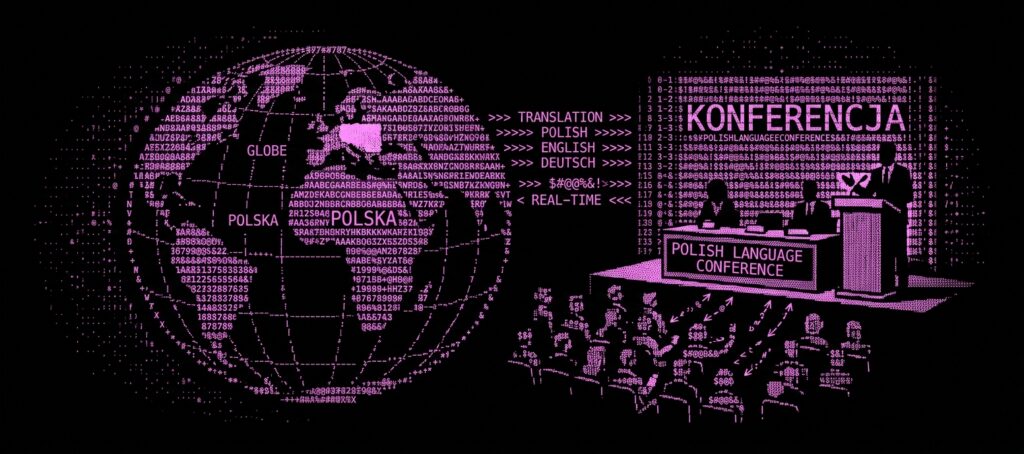
Poland reached its highest-ever position in the ICCA rankings in 2023, climbing to 17th globally with 179 international association meetings hosted that year, a jump of six places from the previous ranking (ICCA, 2023 Country Rankings). Warsaw was named Best Destination in New Europe at Conventa 2025. And with nearly half a million professionals employed in the country’s business services sector alone (ABSL, Q1 2025), Poland’s conference calendar is no longer a Central European curiosity. It is a fixture of the global MICE circuit.
Yet Polish event translation remains one of the most underestimated challenges in European conference logistics. With seven grammatical cases, consonant clusters that stump even seasoned interpreters, and a gendered noun system that affects every adjective, verb, and number in a sentence, Polish is not a language you handle with general-purpose translation tools. Event organizers who treat it as “just another European language” learn that lesson the hard way, usually during a live keynote in Katowice.
Poland’s Conference Boom: From Post-EU Accession Growth to Global MICE Contender
Poland’s emergence as a conference powerhouse did not happen by accident. Since EU accession in 2004, the country has invested heavily in world-class event infrastructure. The result is a network of venues that rival anything in Western Europe, at significantly lower operating costs.
The Venues Reshaping Poland’s Event Map
ICE Krakow Congress Centre is the flagship. Located in the heart of Krakow, it has become a magnet for international congresses, from the ABSL Summit (1,500 attendees, hosted for three consecutive years through 2025) to the IEEE Radar Conference and the EFEE 13th World Conference on Explosives and Blasting (ICE Krakow, 2025 Calendar). The Open Eyes Economy Summit drew 6,000 participants in its tenth anniversary edition in November 2025, combining in-person and online audiences at ICE Krakow (OEES, 2025).
MCK Katowice (International Congress Centre) anchors the Silesian conference scene. It is home to the European Economic Congress, Poland’s largest business event. The 2025 edition drew 17,000 participants onsite and online, with over 1,200 speakers across nearly 180 thematic sessions (EEC Poland, 2025). The 18th edition runs April 22-24, 2026, alongside events at the adjacent Spodek Arena.
MTP Poznan Expo (Miedzynarodowe Targi Poznanskie) is one of Poland’s oldest and most versatile exhibition grounds. It hosts ITM Industry Europe, the largest industrial fair in this part of Europe, covering 36,000 square meters with over 900 exhibitors (ITM Europe, 2025), as well as Impact CEE, Central and Eastern Europe’s premier technology conference, returning for its 11th edition on May 13-14, 2026 (Impact CEE, 2026).
EXPO XXI Warsaw serves the capital’s growing corporate and association event market, while the Radisson Blu Hotel in Sopot hosts the European Forum for New Ideas (EFNI), organized since 2011 by the Polish Confederation Lewiatan in cooperation with BusinessEurope. EFNI’s 2025 edition gathered over two thousand business and political leaders across three days in October (EFNI, 2025).
Key Conferences Driving Polish Translation Demand
| Conference | Location | Size | Industry |
|---|---|---|---|
| European Economic Congress (EEC) | Katowice (MCK) | 17,000 participants | Economy, energy, policy |
| Impact CEE | Poznan (MTP Expo) | 5,000+ | Technology, startups |
| ABSL Summit | Krakow (ICE) | 1,500 | Business services, outsourcing |
| Open Eyes Economy Summit | Krakow (ICE) | 6,000 | Economics, sustainability |
| European Forum for New Ideas (EFNI) | Sopot | 2,000+ | EU policy, competitiveness |
| ITM Industry Europe | Poznan (MTP Expo) | 900+ exhibitors | Manufacturing, automation |
| Cavaliada Tour | Poznan, Warsaw, Lublin | Major consumer event | Equestrian |
These events attract mixed Polish-English audiences by default. A keynote at the European Economic Congress might feature Poland’s Deputy Prime Minister speaking in Polish, followed by a panel with the former ECB President (Mario Draghi keynoted the ABSL Summit 2025) speaking in English. The translation challenge is not occasional: it is structural.
The Industries Behind Poland’s Event Surge
IT and Business Services
Poland’s business services sector is the engine behind much of its conference growth. As of Q1 2025, the country hosts 2,081 business service centers run by 1,258 investors from 50 nations, employing 488,700 professionals, a 6.2% year-on-year increase (ABSL, 2025). The sector contributes 5.7% of GDP, with exports reaching $42.3 billion in 2024.
New centers opened between January 2024 and March 2025 were predominantly in IT (42.6%) and R&D (26.2%), creating 5,400 jobs. Poland has the largest tech talent pool in Eastern Europe, with over 650,000 software developers (Alcor BPO, 2025). This workforce fuels events like Impact CEE and the ABSL Summit, where Polish-English translation is essential for connecting local talent with international leadership.
Automotive and Manufacturing
Poland’s automotive sector accounts for 11.1% of total production value, making it the country’s second-largest industry after food processing (Polish Investment and Trade Agency, 2025). Polish factories produced 332,043 vehicles in 2024, up 7.6% year-on-year. The country ranks as the seventh-largest exporter of automotive parts globally, employing approximately 205,000 people.
The electromobility shift is accelerating this growth: LG Energy Solution’s Polish operations produced batteries worth over EUR 5 billion in 2024. Events like ITM Industry Europe and the concurrent Modernlog, Subcontracting, and FOCAST fairs draw a heavily mixed-language audience of Polish manufacturers and international OEM buyers.
Energy Transition
Poland’s coal-dependent energy mix is undergoing rapid transformation, attracting significant international attention. The European Economic Congress dedicates substantial programming to energy transition topics, and the presence of EU policymakers and international energy firms at these sessions makes Polish-English interpretation non-negotiable.
Pharmaceuticals and Life Sciences
Krakow has emerged as a pharma and biotech hub, with a growing number of clinical research organizations and pharmaceutical manufacturers establishing operations in the Malopolska region. Medical congresses at ICE Krakow, including events like the Polish Arthroscopy Society Congress, require precise technical translation between Polish and English.
Why Polish Is Harder to Translate Than You Think
Polish belongs to the West Slavic language family, alongside Czech and Slovak. It has approximately 43 million native speakers worldwide (Ethnologue, 2024), with significant diaspora communities in the United States (estimated 9-10 million Polish Americans), the United Kingdom (approximately 900,000), and Germany (over 2 million). It is the sixth most spoken language in the European Union.
But speaker count does not capture why Polish is a formidable translation challenge at events.
Seven Grammatical Cases
Polish uses seven cases: Nominative, Genitive, Dative, Accusative, Instrumental, Locative, and Vocative, each with distinct noun, adjective, and pronoun endings. The case system affects not just nouns but every element that agrees with them: adjectives, numerals, and even surnames.
For real-time event interpretation, this means an interpreter must process case endings at speed while maintaining the meaning of complex sentences. A simple English phrase like “We discussed the report with the director” becomes a case-inflected chain in Polish where “report” and “director” each take different endings depending on their grammatical role, and the adjectives describing them must match.
Consonant Clusters
Polish is famous for consonant sequences that have no equivalent in English or Romance languages. Words like “szczegolowy” (detailed), “bezwzgledny” (ruthless), or the tongue-twisting city district name “Szczebrzeszyn” present real challenges for automated speech recognition and real-time captioning systems. The clusters “szcz,” “chrz,” “strz,” and “prz” appear routinely in business and technical vocabulary.
For AI-powered transcription, these clusters require language models specifically trained on Polish phonetics. General-purpose speech recognition tools trained primarily on English consistently struggle with Polish consonant density.
Key takeaway: Polish’s seven grammatical cases, dense consonant clusters, and gendered noun system make it one of the most challenging European languages for real-time event translation. AI systems must be specifically trained on Polish phonetics and morphology to produce reliable output.
Gendered Nouns and Name Declension
Every Polish noun has one of three genders (masculine, feminine, neuter), and this gender assignment ripples through the entire sentence. Adjectives, past-tense verbs, and numerals all change form based on the gender of the noun they modify.
More critically for events: Polish declines proper names, including foreign ones. An international speaker named “Johnson” becomes “Johnsona” in the genitive case, “Johnsonowi” in the dative, and “Johnsonem” in the instrumental. Event organizers who do not account for this in translated materials, including name badges, programs, and introductions, risk creating confusion or inadvertently offending speakers.
Special Characters
Polish uses the Latin alphabet but with nine additional characters: a with ogonek (the hook beneath), e with ogonek, c with acute, s with acute, z with acute, z with overdot, o with acute, l with stroke, and n with acute. Any captioning or transcription system that cannot render these characters correctly produces text that is at best hard to read and at worst unintelligible. “Zrodlo” is not “zrodlo”: the former, with the proper diacritics, means “source”; without them, it is gibberish.
Formality Registers
Polish distinguishes sharply between formal and informal address. The formal “Pan” (Mr./Sir) and “Pani” (Mrs./Madam) system is not optional in business contexts, and using the informal “ty” with a senior executive or government official at a conference would be a serious breach of protocol. Interpreters must track formality levels throughout a session, adjusting in real time based on who is speaking to whom.
Cultural Considerations for Event Organizers
Formal Address and Hospitality
Polish business culture values formality in initial interactions. Opening remarks at conferences typically use full titles, such as “Pan Doktor” or “Pani Profesor,” and interpreters must preserve these registers in translation. Polish hospitality at events is generous, with evening networking sessions that often include a formal dinner.
Catholic Holidays and Scheduling
Poland is a predominantly Catholic country. Major holidays including All Saints’ Day (November 1), Corpus Christi, and the extended Christmas/New Year period are effectively impossible for business events. The May 1-3 period is particularly tricky, as many Poles take the entire week off. The most popular conference months are late April, mid-to-late May, September, and October.
The Growing Startup Culture
While formal norms still dominate government and corporate events, Poland’s startup ecosystem, particularly in Warsaw, Krakow, and Wroclaw, operates with a more casual, English-friendly culture. Impact CEE in Poznan, for example, skews younger and more informal than the European Economic Congress in Katowice. Translation needs vary accordingly: startup pitch sessions may run predominantly in English with Polish subtitles, while policy panels at the same conference require full simultaneous interpretation.
A Practical Scenario: Multilingual at the European Economic Congress
Imagine you are managing translation for a three-day segment of the European Economic Congress in Katowice. Your program includes 40 thematic sessions across multiple halls in the MCK International Congress Centre and Spodek Arena. The audience of 13,500 onsite participants splits roughly 70% Polish-speaking and 30% international (English, German, and French). You have a Polish government minister delivering a keynote in Polish, followed by a panel with speakers from Germany, France, and Brussels who will present in English and French.
Traditional RSI would require 6-8 interpreters per language pair across multiple booths, with coverage for all 40 sessions over three days. At market rates for Polish-English and Polish-French simultaneous interpretation, you are looking at EUR 60,000-80,000 for the event, plus the logistical headache of staffing specialized interpreters who can handle energy policy, digital transformation, and EU regulatory vocabulary.
The Snapsight solution: Rather than staffing dozens of interpreters across three language pairs, Snapsight’s real-time transcription captures every session in its source language, then delivers live translation to each attendee’s device. The Polish minister’s keynote, heavy with policy terminology and formal register, is transcribed in Polish with full diacritic accuracy and simultaneously available in English, German, and French. After the event, AI-generated summaries synthesize insights across all 40 sessions, regardless of source language.
With 627 events and 10,415 sessions processed across 75+ languages, and 91% autonomous operation, Snapsight handles the scale and linguistic complexity that the Polish conference circuit demands.
Practical Guidance: Running Multilingual Events in Poland
Pre-Event Preparation
- Confirm diacritic support across all event technology: registration systems, badge printing, mobile apps, and captioning displays must render Polish characters correctly.
- Collect speaker names in Polish-declined forms for printed materials if your program includes Polish-language introductions.
- Brief international speakers on formality norms: Polish audiences expect formal address in opening remarks, even at tech conferences.
- Schedule around Catholic holidays and confirm venue availability well in advance for spring and autumn conference seasons.
During the Event
- Provide language selection on attendee devices so participants can switch between Polish, English, and other languages in real time.
- Monitor consonant-heavy terminology in AI transcription output. Polish technical vocabulary is dense, and quality checks during the first session can catch systematic errors early.
- Ensure interpreters or AI systems handle formal registers. A mistranslated “Pan Minister” to a casual “the minister” will be noticed.
Post-Event
- Generate multilingual summaries to serve both the Polish-speaking majority and international attendees.
- Archive transcripts with full Polish diacritics. Stripping special characters for database convenience makes the content unsearchable and unprofessional.
- Distribute AI-synthesized reports that pull insights across sessions, languages, and tracks.
For organizers working across Central Europe, the Czech event translation and German event translation guides cover neighboring markets where Polish-language attendees frequently appear.
Frequently Asked Questions
Market rates for professional Polish-English simultaneous interpretation in Poland range from EUR 800-1,200 per interpreter per day, with most conferences requiring two interpreters per booth for sessions longer than 30 minutes. A three-day event with four parallel tracks would typically require 8-12 interpreters, putting total interpretation costs at EUR 20,000-45,000 depending on session density and language pairs. AI-powered solutions like Snapsight can reduce these costs substantially while covering more sessions simultaneously.
AI transcription accuracy for Polish has improved significantly, but not all systems are equal. General-purpose speech-to-text tools trained primarily on English struggle with Polish consonant clusters like szcz and strz. Snapsight’s models are trained across 75+ languages with language-specific acoustic models, handling Polish phonetics and diacritics natively. The key is ensuring your chosen system has been specifically trained on Polish, not just included in a language list.
Standard Polish (based on the Warsaw dialect) is understood by Polish speakers worldwide, so separate dialect translation is not necessary. However, diaspora audiences, particularly second-generation Polish Americans, may have varying levels of Polish fluency and often prefer English with Polish subtitles rather than full Polish-language content. Understanding your audience’s actual language proficiency matters more than their heritage.
Avoid: New Year’s Day (January 1), Easter Monday, May Day (May 1), Constitution Day (May 3), Corpus Christi (variable, late May/June), All Saints’ Day (November 1), Independence Day (November 11), and the Christmas period (December 24-26). The May 1-3 period is particularly tricky, as many Poles take the entire week off. The most popular conference months are April (late), May (mid-to-late), September, and October.
Polish declines all nouns, including proper names. If your conference program refers to a speaker by someone or about someone, the name changes form: keynote by Dr. Muller becomes keynote dr. Mullera in Polish. This affects printed programs, mobile app speaker profiles, and session descriptions. Either produce Polish-language materials with correct declensions (requiring a native Polish speaker’s review) or keep materials in English with Polish interpretation provided separately.