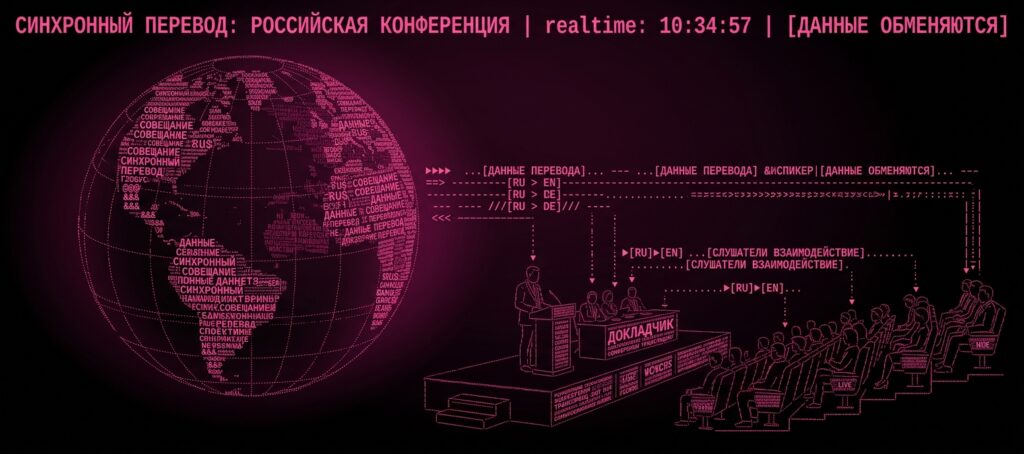
The St. Petersburg International Economic Forum drew over 21,800 participants from 139 countries in 2025 (TASS, 2025), making it one of the largest diplomatic and business gatherings anywhere in the world, and every plenary session, bilateral meeting, and panel discussion ran on Russian-English interpretation as its operational backbone. Russian event translation is not a niche requirement. It is the connective tissue for a conference circuit that spans eleven time zones, connects 255 million speakers across more than a dozen countries (Ethnologue, 2024), and powers industries from energy to aerospace to digital technology.
Yet Russian presents interpretation challenges that most event organizers underestimate. A Cyrillic script that demands specialized captioning infrastructure. Six grammatical cases that reshape word endings based on function, making real-time parsing demanding even for experienced interpreters. A formal register system where addressing a government minister and a startup founder in the same panel requires fundamentally different linguistic choices. And a geopolitical landscape that has redrawn the map of where Russian-language events happen, shifting gravity from Moscow toward Astana, Tashkent, and a growing constellation of CIS capitals.
This guide covers the full landscape: where Russian-language events are held, what makes interpretation into and out of Russian uniquely complex, and how modern AI translation technology is reshaping the economics of multilingual events across the post-Soviet space.
The Russian-Language Event Landscape: Bigger Than Russia
Speaker Population and Geographic Reach
Russian ranks as the world’s seventh most-spoken language by native speakers, with approximately 148 million native speakers and over 255 million total speakers worldwide (Ethnologue, 2024). But the real story for event professionals is not the raw number. It is the geographic and institutional spread.
Russian is an official language in Russia, Belarus, Kazakhstan, and Kyrgyzstan. It holds official or recognized status in parts of Moldova, Ukraine, and several other post-Soviet states. In Kazakhstan, 84.8% of the population aged 15 and older can read, write, and understand Russian fluently (Kazakhstan Census, 2009), and it functions as the primary language of business in cities like Almaty and Astana. In Uzbekistan, Russian remains widely used in government, business, and higher education, particularly in Tashkent. Across the Commonwealth of Independent States (CIS), over 79 million people outside Russia itself spoke Russian as of 2019 (Statista, 2019).
Key insight: A “Russian-language event” could be held in Moscow, St. Petersburg, Yekaterinburg, Astana, Tashkent, Minsk, Bishkek, or Yerevan, each with different infrastructure, different attendee profiles, and different secondary language needs.
The Shifting Geography of Russian-Language Events
The international events landscape involving Russian has undergone significant transformation since 2022. Many Western organizations have paused participation in Russia-hosted events, and several global conferences have relocated or restructured their CIS programming. This is the honest reality that event professionals must navigate.
However, the demand for Russian-language event services has not diminished. It has redistributed. Three trends define the current landscape:
- Russia’s domestic circuit remains enormous. SPIEF continues to attract delegates from over 130 countries. Russian Energy Week in Moscow drew more than 7,000 participants from 100 countries in 2025 (TASS, 2025). Innoprom, Russia’s flagship industrial exhibition in Yekaterinburg, expects 52,000 visitors from 66 countries for its 2026 edition (Innoprom, 2026). These events now draw more heavily from Asia, the Middle East, Africa, and Latin America, creating new language pair demands like Russian-Arabic, Russian-Mandarin, and Russian-Hindi alongside the traditional Russian-English.
- CIS capitals are emerging as independent event hubs. Kazakhstan has positioned Astana as a major international forum destination, hosting events like the Astana International Forum and the World Nomad Games. Uzbekistan is investing heavily in Tashkent’s conference infrastructure, with events like the Cyber Security Summit Central Eurasia and FIRST Regional Symposium for Central Asia choosing Tashkent as their 2026 venue.
- Diaspora-driven events continue worldwide. Russian-speaking professional communities in Berlin, Tel Aviv, Dubai, New York, and London generate demand for Russian-language tracks at technology conferences, medical congresses, and business forums. These are not Russia-hosted events; they are international events that need Russian interpretation to serve a significant portion of their audience.
Major Events Requiring Russian Translation
Flagship Forums
St. Petersburg International Economic Forum (SPIEF) is the anchor event of the Russian conference calendar. Held annually at ExpoForum in St. Petersburg, SPIEF 2025 brought together 21,800 participants from 139 countries over four days (TASS, 2025). The 2026 edition is scheduled for June 3-6. Working languages include Russian, English, and increasingly Arabic and Mandarin. The forum’s business program typically features over 100 sessions running in parallel, each requiring real-time interpretation, a logistical challenge that has historically demanded teams of 40 or more interpreters.
Russian Energy Week is held at Moscow’s Central Exhibition Hall Manezh, with the 2025 edition drawing 7,000 participants from 100 countries (TASS, 2025). The forum’s 60-plus sessions and panel discussions cover the global energy transition, oil and gas technology, and nuclear energy cooperation, all domains requiring highly specialized Russian technical vocabulary that general-purpose interpreters struggle with.
Innoprom is Russia’s leading industrial trade fair, held annually in Yekaterinburg at the International Exhibition Center Ekaterinburg Expo. The 2026 edition expects 52,000 visitors from 66 countries, with over 100 business program events (Innoprom, 2026). Each year features a partner country (recent partners include UAE, India, and Turkey), adding a third language layer to the already complex Russian-English interpretation needs.
Industry-Specific Events
MAKS International Aviation and Space Salon, held biennially in Zhukovsky near Moscow, is one of the world’s premier aerospace exhibitions. It brings together defense contractors, aviation engineers, and space industry professionals from across the CIS and partner nations. The technical vocabulary demands, covering aerodynamics, propulsion systems, and satellite technology in Russian, make this one of the most challenging interpretation assignments in the global events calendar.
Neftegaz at Crocus Expo in Moscow is a major international exhibition for oil and gas equipment and technologies. Crocus Expo itself hosts more than 350 events annually with over 10 million visitors per year (Crocus Expo, 2025), making it one of the busiest exhibition complexes in Europe.
Emerging CIS Events
The conference scene in Central Asia and the Caucasus is growing rapidly, with Russian serving as the lingua franca for cross-border business:
- Astana International Forum, Kazakhstan’s flagship diplomatic gathering
- Cyber Security Summit Central Eurasia, Tashkent 2026, drawing cybersecurity professionals from across the CIS
- FIRST Regional Symposium for Central Asia, Tashkent, February 2026
- Digital Almaty Forum, Kazakhstan’s technology and innovation summit
These events typically operate in Russian and a local language (Kazakh, Uzbek), with English as an additional working language, creating three-way interpretation requirements.
Why Russian Interpretation Is Uniquely Challenging
The Cyrillic Script Problem
Russian uses the Cyrillic alphabet: 33 characters that share almost no visual overlap with the Latin script used in English, French, or Spanish. For event captioning and live subtitling, this creates a fundamental infrastructure challenge. Display systems must support Cyrillic rendering, font sizes need adjustment (many Cyrillic characters are visually denser than their Latin equivalents), and any automated speech-to-text system must handle Cyrillic output natively, not as a transliteration afterthought.
For live captioning at conferences, the Cyrillic challenge extends to technical terminology. Russian technical discourse frequently borrows English terms but renders them in Cyrillic transliteration, creating a hybrid vocabulary that AI transcription systems must learn to handle without defaulting to one script or the other.
Six Cases and Complex Grammar
Russian is a highly inflected language with six grammatical cases (nominative, genitive, dative, accusative, instrumental, and prepositional), each of which changes the ending of nouns, adjectives, and pronouns. A single Russian noun can have twelve different forms based on case and number.
For simultaneous interpretation, this means interpreters cannot begin translating a Russian sentence until they understand the grammatical role of each element, which often is not clear until the speaker reaches the verb at the end of the clause. Russian word order is flexible (subject-object-verb, subject-verb-object, and other arrangements are all grammatically valid), and meaning is carried by inflection rather than position. This creates a processing lag that is more pronounced than in languages with fixed word order like English or Mandarin.
The practical impact: Russian simultaneous interpretation requires interpreters who can hold longer chunks of speech in working memory before producing output. At fast-paced panel discussions where speakers interrupt each other, this cognitive load increases substantially.
Formal and Informal Registers
Russian distinguishes sharply between formal and informal speech. The pronoun system alone carries weight that English lacks: “you” in Russian is either “ty” (informal, singular) or “Vy” (formal, used in business and official contexts). Using the wrong register at a government forum or a meeting with senior executives is not merely awkward. It is a professional transgression.
At events where a government minister, a tech startup founder, and an academic researcher share the same stage, the interpreter must shift registers constantly, matching each speaker’s expected level of formality. This is a skill that requires deep cultural fluency, not just linguistic ability.
Technical Vocabulary Gaps
Russian technical vocabulary in emerging fields (artificial intelligence, blockchain, SaaS, fintech) is in a state of flux. Some terms have established Russian equivalents; others are used in their English form (rendered in Cyrillic); still others have multiple competing Russian translations depending on the speaker’s background and industry. An interpreter at a Russian tech conference must navigate this vocabulary instability in real time, making judgments about which term the audience will understand.
In contrast, established fields like energy, aerospace, and heavy industry have robust, standardized Russian technical vocabularies, but these are highly specialized. An interpreter who excels at diplomatic summits may be entirely unprepared for the technical demands of Neftegaz or MAKS.
Regional Event Hubs
| City | Key Venues | Notable Events | 2026 Conferences |
|---|---|---|---|
| Moscow | Crocus Expo, Expocentre, WTC Moscow, Manezh Hall | Russian Energy Week, Neftegaz | 205 international conferences |
| St. Petersburg | ExpoForum, Manezh | SPIEF, RIEF | 76 international conferences |
| Yekaterinburg | Ekaterinburg Expo | Innoprom | 52,000 expected visitors |
| Sochi | Olympic Park, conference hotels | Russian Investment Forum | Year-round events |
Emerging CIS Hubs
- Astana, Kazakhstan has invested billions in conference infrastructure, including the Astana EXPO complex (built for Expo 2017) and the Congress Center. The city’s positioning as a neutral diplomatic venue between Russia, China, and the West gives it a unique role in the CIS events circuit.
- Tashkent, Uzbekistan is rapidly building its events infrastructure, with the Tashkent City Congress Hall and Inha University facilities hosting an increasing number of international conferences. Uzbekistan’s economic liberalization under President Mirziyoyev has accelerated this trend.
- Almaty, Kazakhstan remains the business capital of Central Asia, with the Almaty Towers Congress Center and the Atakent International Exhibition Centre serving as primary venues for trade shows and corporate events.
A Practical Scenario: The Three-Country Energy Summit
Imagine you are organizing a two-day energy cooperation summit in Astana, Kazakhstan. The event brings together 800 participants: government energy officials from Russia, Kazakhstan, and Uzbekistan; executives from Russian energy companies; representatives from Chinese and Indian firms exploring Central Asian partnerships; and a delegation from the International Energy Agency.
Your working languages are Russian, Kazakh, English, and Mandarin. The opening plenary features speeches by ministers from three countries, each speaking in their native language. Breakout sessions cover topics like pipeline infrastructure (with deeply technical Russian and Kazakh vocabulary), LNG export strategy (requiring Russian-English and Russian-Mandarin interpretation), and regulatory harmonization across the CIS (where legal terminology in Russian differs significantly from country to country).
Traditional interpretation staffing for this event would require 16 to 20 interpreters across four language pairs, including specialized energy interpreters for the technical sessions. Staffing Russian-Mandarin energy interpreters in Astana could take months of advance planning and significant travel costs. A realistic budget for human interpretation alone: $60,000 to $80,000 for the two-day event.
How Snapsight changes this: Rather than staffing interpreter teams for every language pair and every breakout room, Snapsight’s real-time transcription captures each session in its source language and delivers live translation to every attendee’s device in their preferred language. The Russian minister’s speech, laden with energy sector terminology, is transcribed in Russian and simultaneously available in English, Mandarin, and Kazakh. After the summit, the Analyst Agent synthesizes insights across all sessions, producing executive briefings that capture key decisions, commitments, and action items regardless of which language they were originally spoken in.
With 627 events and 10,415 sessions processed across 75+ languages, Snapsight handles the Cyrillic script natively, manages Russian’s complex grammar for accurate transcription, and operates at 91% autonomy, meaning your team focuses on the event itself, not on managing translation technology.
Cultural Context for Event Organizers
Business Formality and Relationship Building
Russian business culture places significant weight on personal relationships, a concept often described as “svyazi” (connections). At conferences and forums, the formal business program is important, but the real relationship building happens in the margins: during coffee breaks, evening receptions, and especially over meals.
- Formal titles matter. Russian professionals expect to be addressed by name and patronymic (first name plus a derivative of the father’s name) in formal contexts. Using first names only is reserved for established relationships.
- Toast culture is real. At event dinners and receptions, toasts are a structured social ritual, not casual remarks. The first toast is typically to the event or its purpose; subsequent toasts follow an understood hierarchy.
- Business cards are exchanged formally. While digital networking has grown, physical business card exchange remains standard at Russian events, particularly with government officials and senior executives.
- Decision-making is hierarchical. At panels and roundtables, the most senior person typically speaks last and definitively. Interpretation must preserve this dynamic.
Calendar and Scheduling Considerations
Russian public holidays create scheduling gaps that event organizers must account for. The extended New Year holiday (December 31 through approximately January 8) effectively shuts down business activity. Victory Day (May 9) is deeply significant and events should not be scheduled against it. Russia Day (June 12) and other national holidays also affect availability.
In CIS countries, additional holidays apply: Nauryz (March 21-23) in Kazakhstan, Navruz (March 21) in Uzbekistan, and various national independence days across the region. An event targeting a pan-CIS Russian-speaking audience must navigate a complex holiday calendar.
The Technology Shift in Russian Event Translation
The traditional model for Russian conference interpretation relies on specialized agencies that maintain pools of Russian interpreters, overwhelmingly based in Moscow, St. Petersburg, or Geneva. For events in these cities, staffing is manageable. For events in Yekaterinburg, Sochi, Astana, or Tashkent, the logistics become significantly more complex and expensive, often requiring interpreter travel and accommodation costs that double the interpretation budget.
AI-powered translation platforms are changing this calculus. For Russian specifically, the technology advantages are significant:
Cyrillic-Native Processing
Unlike human captioners who may struggle with speed in Cyrillic, AI transcription systems process Cyrillic text at the same speed as Latin script, producing real-time captions that Russian-speaking attendees can follow comfortably.
Technical Vocabulary Adaptation
AI systems can be trained on domain-specific terminology, handling the energy, aerospace, or IT vocabulary that would require a specialized human interpreter. This is particularly relevant for Russian, where the gap between a general interpreter and a domain specialist is wider than in many other languages.
Emerging Language Pairs
As Russian-language events increasingly draw participants from China, India, and the Middle East, language pairs like Russian-Mandarin, Russian-Hindi, and Russian-Arabic are in growing demand, but the pool of human interpreters for these pairs is extremely small. AI translation handles these pairs without the staffing constraints.
CIS Scalability
For events in Astana, Tashkent, or Bishkek, where professional interpreter pools are thin, AI translation eliminates geographic dependency entirely. A conference in Tashkent gets the same translation quality as one in Moscow or Geneva.
For organizers exploring this shift, our event translation hub provides a comprehensive overview of how AI-powered translation works across all 75+ languages Snapsight supports, including detailed comparisons with traditional interpretation approaches.
Connecting Across the Region
Russian’s role as a lingua franca across the CIS creates natural connections with other languages in the region. Event organizers working with Russian-speaking audiences will often encounter:
- Ukrainian: While a distinct language with its own Cyrillic script variant, Ukrainian and Russian share enough mutual intelligibility that events in Ukraine historically operated bilingually. Current political realities have changed this dynamic significantly, but the linguistic connection remains relevant for event planners working with both communities.
- Kazakh: Kazakhstan’s state language, now transitioning from Cyrillic to Latin script. Events in Kazakhstan typically require both Russian and Kazakh, particularly for government and public-sector conferences.
Frequently Asked Questions
Traditional Russian-English simultaneous interpretation typically costs between $1,200 and $2,500 per interpreter per day, depending on specialization and location. A standard two-day conference with parallel tracks may require 6-8 interpreters (working in pairs for each room), bringing the interpretation budget to $15,000-$40,000 before equipment rental. Events outside major interpretation hubs like Moscow or Geneva face additional travel and accommodation costs. AI-powered alternatives like Snapsight can reduce these costs by 60-80% while supporting additional language pairs that would be prohibitively expensive to staff with human interpreters.
Modern AI transcription has made significant advances in handling Russian’s six grammatical cases, flexible word order, and complex verb aspect system. For conference-quality transcription, accuracy rates for Russian have improved substantially, particularly when the system has been trained on domain-specific vocabulary. Snapsight’s transcription engine processes Russian at native Cyrillic output, handling the language’s inflectional complexity without the latency issues that affect human captioners working at high speed.
Russian-English remains the dominant pair, accounting for the majority of interpretation work at international Russian-language events. However, demand for Russian-Mandarin, Russian-Arabic, and Russian-Hindi has increased substantially since 2022, reflecting the reorientation of Russia’s international partnerships. For CIS events, Russian-Kazakh and Russian-Uzbek are essential pairs. Snapsight’s support for 75+ languages means all these pairs, including the harder-to-staff combinations, are available without the lead time and cost of sourcing specialized human interpreters.
Events in Kazakhstan, Uzbekistan, Kyrgyzstan, and other CIS states typically require bilingual or trilingual support: Russian as the business lingua franca, the local state language for official proceedings, and English for international participants. The key is understanding your audience composition. In Almaty, Russian may suffice for business sessions, while government-facing sessions in Astana increasingly require Kazakh. Snapsight handles multi-language events natively, allowing each session to be transcribed in its source language and translated into all required target languages simultaneously.
Russian-language event translation demand has shifted geographically, not declined in volume. While some Western-hosted events have reduced their Russian-language tracks, events across the CIS, the Middle East, Africa, and Asia have increased their Russian-language programming. Russia’s own domestic conference circuit, including SPIEF, Russian Energy Week, and Innoprom, continues to draw large international attendance. The net effect is a redistribution toward new regions and new language pairs, not a reduction in overall demand.