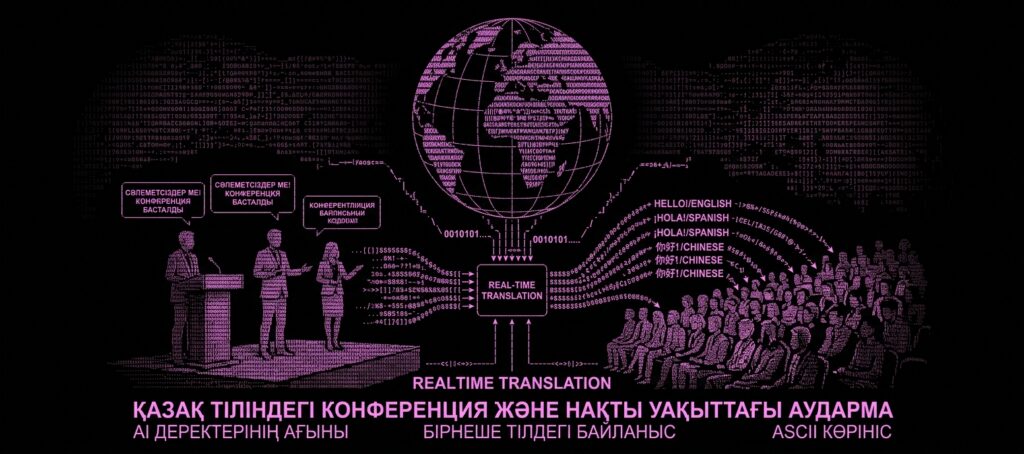
When the 7th Digital Almaty Forum drew over 40,000 attendees in January 2025 under the banner “Industrial AI: Technologies for a New Era,” the event ran across Kazakh, Russian, and English, three languages that every major conference in Kazakhstan must now navigate simultaneously (Astana Hub, 2025). Kazakhstan is not a peripheral market for event translation. It is Central Asia’s dominant conference economy, the world’s largest uranium producer, home to the Astana International Financial Centre managing forums with investors overseeing $1.5 trillion in assets, and the host of EXPO 2017’s legacy infrastructure that now serves as one of the region’s most advanced congress venues. Kazakh event translation is the gateway to a country that sits at the crossroads of Chinese, Russian, and Western business interests, and increasingly demands that its own language lead the conversation.
Kazakh is spoken by approximately 13 million people worldwide, with the vast majority in Kazakhstan, and significant communities in China’s Xinjiang region (nearly 2 million speakers), Uzbekistan, Mongolia, and Russia (Ethnologue, 2024). It is a Turkic language closely related to Kyrgyz and Karakalpak, and it is currently undergoing a historic script transition from Cyrillic to Latin, a process that directly impacts every aspect of event captioning, signage, and written materials for conferences held in Kazakhstan.
Why Kazakhstan’s Conference Circuit Demands Specialized Translation
Kazakhstan’s MICE industry has been reshaped by two forces: EXPO 2017’s infrastructure legacy and the country’s strategic positioning between Russia, China, and Europe. The result is a conference circuit that is genuinely trilingual, technically demanding, and growing rapidly.
The Energy and Mining Conference Ecosystem
Kazakhstan holds the world’s largest uranium reserves, is the top global uranium exporter, and is transitioning toward nuclear power generation targeting 2.4 GW by 2035 (World Nuclear Association, 2025). The country’s oil sector, anchored by mega-projects like Kashagan and Tengiz in the Caspian Basin, generates a year-round conference circuit.
| Event | Focus | Scale |
|---|---|---|
| KAZENERGY Forum (16th edition) | Flagship energy dialogue, Palace of Independence, Astana | Central Asia and Caspian region |
| Argus Kazakhstan Oil & Gas | Crude, LPG, petrochemical markets | Ritz-Carlton Almaty, former Soviet Union executives |
| MINEX Kazakhstan 2025 | Mining investment, digitalization, geology | 500+ delegates from 30 countries, 100+ speakers |
| Mining Congress Qazaqstan | Mining sector leadership | 200+ senior executives from Central Asia |
Every one of these events operates in a trilingual environment: Kazakh, Russian, and English, with technical vocabularies that span petroleum engineering, nuclear physics, and mineral extraction.
Finance and Investment Forums
The Astana International Financial Centre (AIFC) has transformed Kazakhstan’s capital into a regional financial hub operating under English common law. The 8th Astana Finance Days in September 2025, themed “Where Capital Shapes the Future,” drew over 5,000 participants and featured representatives of asset managers overseeing a combined $1.5 trillion (AIFC, 2025). The AIFC also hosts the Islamic Finance and Business Forum, which gathered 200+ participants from Kazakhstan, Central Asia, and the CIS in 2025.
Technology and Digital Transformation
Digital Almaty, now rebranding as Digital Qazaqstan for 2026, has established itself as Central Asia’s premier technology forum. The 2025 edition brought together 220 companies spanning mining, metallurgy, oil and gas, AI, robotics, fintech, and medtech, with content delivered across Kazakh, Russian, and English tracks (Astana Hub, 2025).
The Astana International Forum, held annually at the end of May under the tagline “Connecting Minds, Shaping the Future,” covers foreign policy, energy, climate, and economics. This is a diplomatic-grade event where translation accuracy is not optional; it is protocol.
The Kazakh Language: What Makes It Uniquely Challenging for Events
An Agglutinative Turkic Language
Kazakh is agglutinative, meaning single words can carry meaning that requires an entire phrase in English. A Kazakh verb can incorporate tense, mood, negation, and person through a chain of suffixes. The word “barmadynyzdarbyz” translates roughly as “those of us who did not go.” For real-time transcription, this means the AI must parse long compound words accurately, recognizing morpheme boundaries that affect meaning. A single misidentified suffix can reverse the meaning of a sentence.
Kazakh also features vowel harmony, a phonological system where all vowels in a word must belong to the same harmonic class (front or back). Vowel harmony affects how suffixes attach to stems, and a transcription system that does not account for it will generate malformed words that Kazakh speakers immediately recognize as errors.
The Script Transition: Cyrillic to Latin
The single most consequential challenge for Kazakh event translation in 2026: Kazakhstan is in the middle of a multi-decade transition from Cyrillic to Latin script. President Tokayev has emphasized that “Latinization should not be rushed” and that the project “should not be a mere mechanical switch from Cyrillic to Latin” (The Diplomat, 2024). The original 2025 target has been extended to 2031, with a phased approach now underway. The new Latin alphabet consists of 31 letters, using diacritics including macrons, umlauts, breves, and cedillas.
For event organizers, this creates a concrete problem: your Kazakh-language materials (slide decks, signage, printed programs, digital captions) must function in both scripts. Older attendees and government officials from certain ministries may prefer Cyrillic. Younger professionals and tech-sector attendees increasingly use Latin. A conference that only provides captions in one script risks alienating a significant portion of its Kazakh-speaking audience.
The Kazakh-Russian Bilingual Reality
Kazakhstan is functionally bilingual. Russian remains the language of interethnic communication and is widely used in business, particularly in the northern cities and among the urban professional class. This bilingualism creates a translation challenge that goes beyond language pairs. A Kazakh speaker at a conference may switch between Kazakh and Russian mid-sentence, a practice called code-switching that is pervasive in Central Asian professional contexts. Any transcription or interpretation system must handle this seamlessly rather than treating each utterance as belonging to a single language.
Formal Registers and Diplomatic Protocol
Kazakh has a complex honorific and register system rooted in nomadic social hierarchy. Formal speech used at government forums, diplomatic summits like the Astana Process, and presidential addresses differs substantially from the conversational Kazakh used in breakout sessions or networking events. The level of formality affects vocabulary, verb forms, and forms of address. An interpreter who handles a tech startup pitch will not automatically be qualified for a Foreign Investors Council session.
Conference Infrastructure: Where Events Happen in Kazakhstan
Astana: The Purpose-Built Capital
- EXPO Congress Center: 43,200 sqm across three floors, main hall seating 2,102, eight conference halls (100-600 capacity each), built-in simultaneous translation rooms
- Palace of Independence: Government-grade conference space, hosts KAZENERGY and major forums
- Advantage: Flagship venues designed from the ground up for large international events
Almaty: The Commercial Capital
- Atakent Exhibition Centre: Long-established trade show venue, hosted 30th Mining and Metals Central Asia
- Ritz-Carlton Almaty: Premium conferences like Argus oil and gas forum
- Focus: More commercial and industry-oriented than Astana’s diplomatic events
A Scenario: The Energy Transition Summit
You are organizing a 2-day energy transition summit at the EXPO Congress Center in Astana. The event brings together 800 attendees: Kazakh government officials from the Ministry of Energy, executives from KazMunayGas and Kazatomprom, international investors from London and Dubai, Chinese energy companies expanding into Central Asian renewables, and Russian pipeline operators.
Your speaker roster includes a Kazakh deputy minister delivering a keynote in formal Kazakh, a British renewable energy CEO presenting in English, a Chinese solar panel manufacturer presenting in Mandarin with English slides, and a panel discussion where three Kazakh energy executives will freely code-switch between Kazakh and Russian while referencing English-language technical standards.
| Requirement | Traditional RSI | AI-Powered (Snapsight) |
|---|---|---|
| Language pairs | Kazakh-English, Russian-English, Kazakh-Russian, Mandarin-English | All pairs handled simultaneously |
| Interpreter staffing | 8-10 interpreters minimum | Zero interpreter staffing |
| Estimated cost (2-day) | $35,000+ | Significant reduction |
| Code-switching handling | Trips up single-language interpreters | Real-time detection and processing |
| Post-event intelligence | Not included | Cross-language executive briefs |
With 627 events and 10,415 sessions processed across 75+ languages, Snapsight operates at 91% autonomy, meaning your team focuses on the diplomatic nuances of hosting Kazakh government officials, not on babysitting translation technology.
Cultural Context for Event Organizers
Dastarkhan: The Table as Protocol
Kazakh hospitality is anchored in the tradition of dastarkhan, the ceremonial spread of food that accompanies every significant gathering. At conferences in Kazakhstan, meal events are not afterthoughts. They are integral to relationship-building and often where the most important conversations happen. Event organizers should budget time and attention for these gatherings, and translation support should extend beyond the formal sessions into networking meals where deals are actually discussed.
Calendar Awareness
- Nauryz (March 21-23): Kazakh New Year, a major national holiday. Scheduling events during Nauryz week will significantly reduce local attendance.
- Ramadan: Affects scheduling for events with attendees from across Central Asia and the Middle East.
- Nomadic heritage: Kazakhstan’s nomadic heritage shapes how professionals approach networking and consensus-building. Seating arrangements, speaking order, and forms of address at formal events follow protocols that reflect tribal (“zhuz”) traditions.
For event organizers working across the broader Central Asian and post-Soviet conference circuit, Kazakh events frequently overlap with Russian-language events, particularly in Kazakhstan’s northern cities and at bilingual forums. Kazakhstan’s Turkic linguistic identity also connects its event landscape to Turkish-language conferences, especially through the Organization of Turkic States. The event translation hub provides a complete overview of Snapsight’s capabilities across all 75+ supported languages.
As of 2026, Kazakhstan is in the middle of a phased transition from Cyrillic to Latin script, with full implementation targeted by 2031. For events, this means your Kazakh-language captions and written materials may need to accommodate both scripts. Older professionals and government officials in certain contexts use Cyrillic, while younger attendees and those in the tech sector increasingly prefer Latin. Snapsight’s real-time transcription handles Kazakh regardless of script preference, delivering captions in the format your audience expects.
In most cases, yes. While Kazakhstan is functionally bilingual, Kazakh and Russian are linguistically unrelated. Kazakh is a Turkic language, Russian is Slavic. Speakers frequently code-switch between the two, which means your interpretation system needs to handle both languages fluidly rather than treating sessions as monolingual. Snapsight’s AI-powered transcription detects and processes Kazakh-Russian code-switching in real time, a challenge that would require staffing bilingual interpreters for every session.
The major events include the Astana International Forum (diplomacy and economics, May), KAZENERGY Forum (energy, October), Digital Almaty / Digital Qazaqstan (technology, January-February), Astana Finance Days (finance, September), MINEX Kazakhstan (mining, annually), and the Kazakhstan Global Investment Forum. All operate in Kazakh, Russian, and English at minimum, with Mandarin and Arabic increasingly present at investment-focused events.
For a standard trilingual conference (Kazakh-Russian-English) running three days with parallel sessions, traditional RSI typically costs $25,000-$50,000 depending on the number of language pairs, session count, and the technical specialization required. Specialized interpreters for energy, mining, or nuclear terminology command premium rates and require months of advance booking. AI-powered solutions like Snapsight reduce these costs significantly while scaling to cover every session simultaneously.
Kazakh’s agglutinative morphology, where a single word can contain multiple suffixes encoding tense, mood, person, and negation, does present challenges for transcription systems not trained on Turkic languages. Snapsight’s models are specifically trained to parse agglutinative word structures and maintain accuracy across compound word forms that would be phrases in English. The system also handles vowel harmony patterns that affect suffix attachment, reducing the malformed-word errors common in generic transcription tools.