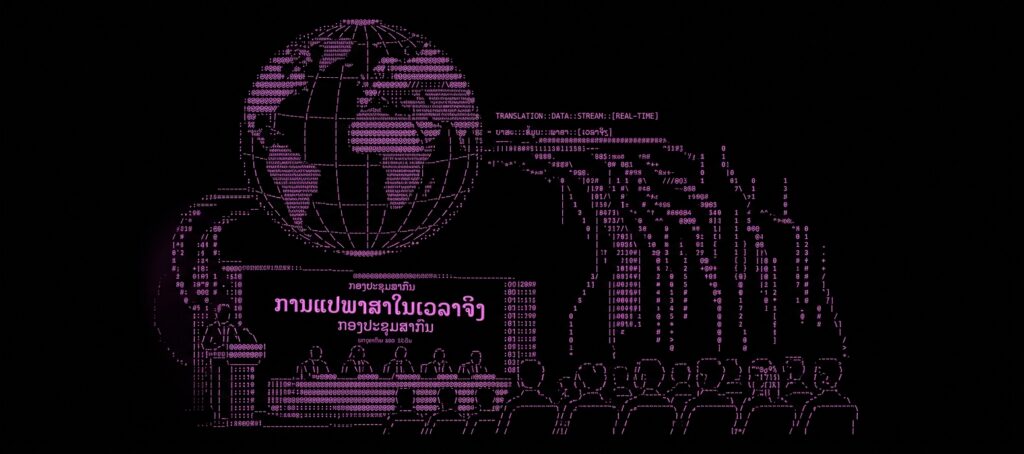
When Laos assumed the ASEAN Chairmanship in 2024, Vientiane hosted the 44th and 45th ASEAN Summits alongside dozens of ministerial meetings, business forums, and security dialogues, all requiring Lao-English interpretation infrastructure that the country had never deployed at that scale before. Lao event translation may not headline the global conference circuit, but for the growing network of development summits, energy conferences, and Belt and Road forums flowing through this landlocked-turned-land-linked nation, getting it right is no longer optional.
Lao is spoken natively by roughly 5 to 7 million people in Laos itself (WorldData), but the broader linguistic picture is far larger. Across Thailand’s Isan region, over 20 million people speak a closely related Lao-Isan dialect that shares deep grammatical and lexical roots with standard Lao (Talkpal). Factor in diaspora communities across the United States, France, Canada, and Australia, and somewhere between 25 and 30 million people communicate in Lao or closely related varieties.
Laos as a Conference Destination: Small Country, Outsized Diplomatic Footprint
The 2024 ASEAN Chairmanship: A Watershed Year
Laos’s year as ASEAN Chair in 2024 transformed Vientiane into a diplomatic conference hub. Under the theme “Enhancing Connectivity and Resilience,” the country hosted (ASEAN Secretariat):
- 44th and 45th ASEAN Summits (October 8-11, 2024) with heads of state from all 10 ASEAN members plus dialogue partners
- 57th ASEAN Foreign Ministers’ Meeting and related events (July 24-27, 2024)
- ASEAN Business and Investment Summit (ABIS) with hundreds of private-sector delegates
- ASEAN Defence Ministers Meeting (ADMM) and ADMM-Plus
- ASEAN Regional Forum (ARF) on security cooperation
- ASEAN Tourism Forum (January 22-27, 2024)
Development and Governance Conferences
- Mekong River Commission (MRC) Summit, the highest-level political event in Mekong water governance. The 4th MRC Summit convened in Vientiane in 2024 (MRC Secretariat)
- Greater Mekong Subregion (GMS) Economic Cooperation forums, ADB-backed conferences on cross-border trade, transport, and energy
- Vientiane International Trade Fair, the country’s largest commercial exhibition, held at Lao-ITECC
The Belt and Road Conference Circuit
China’s Belt and Road Initiative has made Laos a focal point. The Laos-China Railway, which began operations in December 2021, has carried over 20 million passenger trips and helped increase bilateral trade volume to $7.1 billion in 2023, a 26.6% year-on-year increase (Xinhua/Belt and Road Portal). The World Bank has estimated the railway could increase Laos’s aggregate income by up to 21% over the long term (World Bank). This has spawned a growing circuit of China-Laos economic cooperation summits, infrastructure investment forums, and BRI progress reviews, all requiring Lao-Chinese-English interpretation.
Key Industries Driving Lao Event Demand
Hydropower: The “Battery of Southeast Asia”
Laos has staked its economic strategy on becoming the “Battery of Southeast Asia,” with 75% of electricity exported to neighbors including Thailand, Vietnam, Cambodia, and Malaysia (REGlobal). Large hydropower capacity is projected to reach 16 GW by 2035 (GlobalData/Energy Global). Energy summits, environmental impact forums, and cross-border power purchase agreement negotiations are regular occurrences in Vientiane.
Mining, Tourism, and Railway
Laos’s mining sector (copper, gold, potash) attracts international investment conferences. Tourism contributes roughly 10% of GDP, with post-pandemic recovery bringing 1.6 million foreign visitors in the first half of 2023 alone. The Laos-China Railway has catalyzed a wave of logistics and infrastructure conferences focused on turning Laos from a “landlocked” to a “land-linked” economy.
Linguistic Challenges: Why Lao Is Harder Than It Looks
A Tonal Language with Six Tones
Lao is a tonal language with six lexical tones in the Vientiane dialect. Misinterpreting tone in real-time transcription does not produce a slight mispronunciation: it produces a completely different word. For AI-powered transcription, tonal accuracy is fundamental, not optional.
Lao Script: Distinct from Thai Despite Visual Similarity
Lao is written in Tua Lao, a script derived from Khmer writing traditions around the 14th century. While visually similar to Thai script, Lao script is a distinct system with its own character inventory and orthographic conventions (United Language Group). Crucially, Lao does not use spaces between words: spaces appear between sentences or clauses, but within phrases, words run together without delimitation. This creates a fundamental challenge for automated text processing (W3C Southeast Asian Language Requirements).
The Thai-Lao Mutual Intelligibility Question: While informal spoken Lao and Thai (particularly Isan Thai) achieve moderate mutual intelligibility, formal registers diverge substantially. Government proceedings in Vientiane use vocabulary and constructions that a Thai interpreter unfamiliar with Lao officialese will miss. At a diplomatic summit or regulatory conference, “close enough” is not close enough.
Lao is classified as a low-resource language in natural language processing. Training data for Lao speech recognition and machine translation is orders of magnitude smaller than for Thai, Vietnamese, or Chinese. Lao uses distinct registers for different social contexts: Buddhist religious events, government proceedings, and informal business networking each employ different vocabulary layers.
Vientiane’s Conference Infrastructure
| Venue | Capacity | Notable Events |
|---|---|---|
| National Convention Centre (NCC) | 3,000+ participants; 500-seat main hall | ASEAN Summits 2024, MRC Summit |
| Lao-ITECC | 30,000 sqm exhibition space; 300+ booths | Vientiane International Trade Fair |
| Don Chan Palace | 215 rooms; convention hall for 500+ | 2nd ASEAN Business Summit, ASEAN Finance Ministers’ Meeting |
| Crowne Plaza Vientiane | Conference facilities for up to 400 | Corporate events, bilateral summits |
The NCC was purpose-built with Chinese government support and consists of three main buildings including a multifunctional area, VIP zone, and reception hall. For the 2024 ASEAN Chairmanship, it served as the primary venue for heads-of-state meetings.
A Concrete Scenario: The Hydropower Investment Forum
Imagine you are organizing a 2-day energy investment forum at the National Convention Centre in Vientiane. Your attendee profile: 40% Lao government officials and energy ministry staff (working in Lao), 25% Chinese investors and state-owned enterprise representatives (working in Mandarin), 20% Thai utility executives and regulators (working in Thai), and 15% international development bank representatives and environmental consultants (working in English).
Traditional interpretation would require staffing four language booths covering Lao-English, Lao-Chinese, Lao-Thai, Chinese-English, and Thai-English pairs. Finding qualified Lao-Chinese simultaneous interpreters with hydropower terminology fluency will take months. Cost for two days: easily $30,000-$50,000.
This is exactly the kind of multi-language, technical-vocabulary, parallel-session scenario that Snapsight was built to handle. Snapsight’s real-time transcription captures each session in its source language and delivers live translation to every attendee’s device in their preferred language. The Lao energy minister’s opening address, dense with hydropower technical terminology, is transcribed in Lao and simultaneously available in Chinese, Thai, and English. After the event, AI-generated summaries synthesize insights across all sessions regardless of source language.
With 627+ events and 10,415+ sessions transcribed across 75+ languages, Snapsight brings proven infrastructure to events where traditional interpretation simply cannot scale. The platform’s 91% autonomous operation rate means your team manages the event, not the technology.
Cultural Considerations for Events in Laos
Buddhist Calendar and Scheduling. Laos is a deeply Buddhist society. The Buddhist Lent period (Khao Phansa, typically July-October) restricts many types of public celebrations. Boun That Luang (November) and Boun Pi Mai (Lao New Year, April 14-16) will affect attendee availability and venue access.
The Baci Ceremony Tradition. Many Lao conferences begin or conclude with a Baci (or Sou Khuan) ceremony, a spiritual ritual involving cotton string tying around wrists. International organizers should build time for this and brief non-Lao attendees on appropriate etiquette.
French Colonial Legacy. Laos’s French colonial history means some formal and legal vocabulary retains French influences. For certain diplomatic and legal conferences, French-Lao interpretation may be as relevant as English-Lao.
Growing Chinese Influence. China is Laos’s largest foreign investor and aid donor. Lao-Chinese is becoming an increasingly important language pair at business events, sometimes surpassing Lao-English in practical demand.
Beyond Translation: Event Intelligence in Lao
AI-Generated Session Summaries
Every session, whether delivered in Lao, Chinese, Thai, or English, is summarized with key discussion points, decisions reached, and action items identified. Lao-speaking attendees receive summaries in Lao; international delegates receive them in their preferred language.
Cross-Session Synthesis
For multi-day forums with parallel tracks, Snapsight synthesizes themes across all sessions. A delegate who attended the hydropower financing track can review AI-generated insights from the environmental assessment track, across languages.
Post-event, every session transcript is searchable across all supported languages. A researcher querying “environmental impact assessment” will surface relevant passages from Lao-language sessions that discussed the same topic.
Related Language Guides
For organizers building multilingual event strategies across mainland Southeast Asia, see our guides to Thai event translation and Vietnamese event translation, two languages that frequently appear alongside Lao at Mekong region conferences. The parent event translation hub covers Snapsight’s full 75+ language capabilities.
Frequently Asked Questions
In informal settings with limited technical vocabulary, Thai and Lao speakers can achieve basic mutual intelligibility. However, for formal conference proceedings, government addresses, regulatory discussions, and technical presentations, the vocabulary and register divergence is significant enough that dedicated Lao interpretation is necessary. Relying on Thai-Lao proximity at a diplomatic summit risks both miscommunication and cultural insensitivity.
Lao script does not place spaces between words, making tokenization a fundamental challenge. Snapsight uses dictionary-based word segmentation models specifically trained on Lao text, similar to approaches used for Thai and Khmer. This is more computationally intensive than processing space-delimited languages, but it is essential for accurate transcription and translation.
The most common language pairs for Vientiane-based events are Lao-English (international conferences), Lao-Chinese (Belt and Road and investment forums), and Lao-Thai (cross-border trade and Mekong governance). Development conferences often add Vietnamese and French. Snapsight supports all these pairs simultaneously.
Lao is part of Snapsight’s 75+ language suite. Given Lao’s status as a low-resource language in NLP, Snapsight’s event-trained models offer meaningfully better performance than general-purpose translation tools, particularly for formal and technical vocabulary common at conferences.
For events requiring traditional human interpretation, Lao-Chinese and Lao-English simultaneous interpreters with technical specialization may require 3-6 months of lead time due to the small pool of qualified professionals. With Snapsight’s AI-powered approach, setup is significantly faster, but we recommend engaging at least 4-6 weeks before the event to configure custom vocabulary for your specific subject matter.