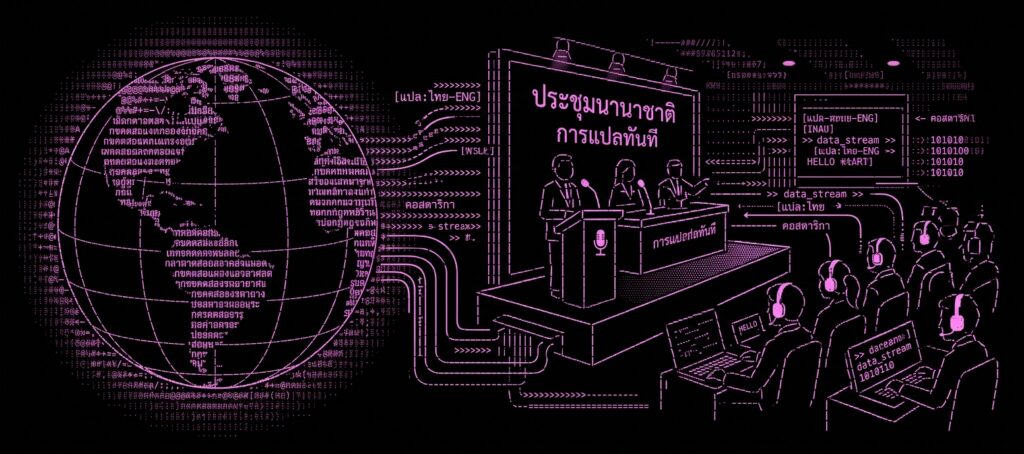
Thailand hosted 158 international association conventions in 2024, ranking first in ASEAN and fifth in Asia-Pacific (ICCA, 2024 Country Rankings). Bangkok alone accounted for 115 of those meetings, placing it seventh globally among over 1,500 cities, up from fifteenth the year before. That is not a gradual climb. It is a country systematically executing a government-backed strategy to become the meetings capital of Southeast Asia, and every one of those 158 conventions needed Thai event translation infrastructure that most organizers only start thinking about six weeks before doors open.
The Thailand Convention and Exhibition Bureau (TCEB) is targeting 200 billion baht in MICE revenue for fiscal 2026, up from 148 billion baht generated by 25.3 million MICE travelers in 2024 (TCEB, 2025 Annual Report). Thailand is not just hosting events. It is engineering an entire economic sector around them. For event organizers, this means a fast-growing pipeline of multilingual conferences where Thai-English interpretation is the operational backbone, and where the Thai language itself presents challenges that generic translation tools consistently fail to handle.
Thailand’s MICE Ecosystem: Government Strategy Meets Global Ambition
The TCEB Machine
Few countries invest in their MICE industries as deliberately as Thailand. The Thailand Convention and Exhibition Bureau, established in 2004, operates as a standalone government agency with a singular mandate: position Thailand as Asia’s leading business events destination. TCEB’s 2026 roadmap centers on three schemes, “Stay Longer,” “Spend More,” and “See You Again,” designed to increase per-traveler MICE spending while pushing events beyond Bangkok into secondary cities (TCEB, 2025).
The results are measurable. In 2024, the MICE sector contributed over 309 billion baht to Thai GDP, representing roughly 1.67% of total economic output (TCEB, 2024 Performance Data). TCEB has committed to sustaining 5% annual growth for the MICE segment over the next four years, a rate that deliberately exceeds Thailand’s overall GDP growth target (Bangkok Post, 2025).
Marquee event: Thailand has been selected to host the IMF-World Bank Annual Meetings in 2026, an event expected to bring over 50,000 participants to Bangkok and generate more than 20 billion baht in economic impact (Nation Thailand, 2025). Winning that bid required years of infrastructure investment and a demonstrated track record of hosting large-scale multilingual events.
13 Cities, Not Just Bangkok
For the first time, 13 Thai cities appeared in the 2024 ICCA rankings: Bangkok, Chiang Mai, Pattaya, Phuket, Chon Buri, Chiang Rai, Pathum Thani, Hua Hin, Khon Kaen, Samui, Nakhon Ratchasima, Nonthaburi, and Pattani (ICCA, 2024 Report). This geographic spread matters for translation planning.
Bangkok’s three flagship venues anchor the circuit. The Queen Sirikit National Convention Center (QSNCC), recently renovated and expanded, hosts events from the Sustainability Expo to international engineering conferences. BITEC (Bangkok International Trade and Exhibition Centre) serves as the primary venue for trade shows like Food Pack Asia and the ASEAN Solar PV & Energy Storage Expo. IMPACT Muang Thong Thani, with its Challenger Halls and Arena, handles everything from the Bangkok International Motor Show to government summits.
Major Events Driving Thai Translation Demand
Thailand’s event calendar spans automotive, food and hospitality, energy, sustainability, and government, and the multilingual demands vary significantly by sector.
Bangkok International Motor Show, held annually at IMPACT Challenger, the 47th edition (March 25 to April 5, 2026) brings together automakers, EV manufacturers, and parts suppliers from across Asia. With Chinese EV brands increasingly prominent alongside Japanese, Korean, and European manufacturers, the event requires Thai-English translation at minimum, with Thai-Chinese and Thai-Japanese pairs increasingly in demand for B2B matchmaking sessions.
Sustainability Expo (SX), hosted at QSNCC each September-October, is Southeast Asia’s largest sustainability event. The 2025 edition ran ten themed zones with more than 280 exhibitors and featured seminars on circular economy, clean energy, and ESG reporting, topics where Thai technical vocabulary intersects with international standards that attendees expect to hear in English.
Food & Hotel Thailand / Food Pack Asia draws procurement teams from the Middle East, Europe, and across ASEAN to BITEC. Translating Thai food science terminology (fermentation processes, food safety standards, cold chain logistics) requires interpreters who understand both the technical content and the regulatory frameworks being discussed.
IMF-World Bank Annual Meetings 2026 is the marquee event on Thailand’s near-term calendar. With 50,000+ expected participants from 190 member countries, the translation infrastructure required will span dozens of language pairs, but Thai-English will be the backbone for all local logistics, government interactions, press coverage, and cultural programming.
The Thai Language: Five Tones, No Spaces, and a Royal Register
Thai is not simply “difficult.” It is difficult in ways that specifically undermine the tools and processes most event organizers rely on for translation.
Tonal Complexity That Breaks Machine Translation
Thai has five distinct tones: mid, low, falling, high, and rising. The word “mai” alone can mean “new,” “not,” “silk,” “wood,” or serve as a question particle, depending entirely on its tone (Ethnologue, 2025). In a conference hall with 800 people, ambient noise, and a speaker who shifts pace and volume throughout a keynote, tonal disambiguation degrades rapidly.
This is not a theoretical problem. Standard automatic speech recognition (ASR) engines trained primarily on clean audio samples struggle with the acoustic variability of live event environments. Tonal errors cascade: a mistranscribed tone changes the word, which changes the sentence meaning, which produces a translation that bears no relation to what the speaker said.
No Spaces Between Words
Thai script does not use spaces to separate words, only to mark the end of sentences or clauses. The 44 consonant symbols, 16 vowel symbols (combining into at least 32 vowel forms), and four tone diacritics flow continuously, with vowels appearing above, below, before, or after the consonant they modify (1StopAsia, 2025). There is no capitalization to mark proper nouns or sentence beginnings.
For machine translation systems, word segmentation is the foundational step. In English or French, spaces provide natural boundaries. In Thai, the system must first determine where one word ends and the next begins, and getting that wrong means every subsequent step (parsing, translation, display) produces nonsense.
Formality Registers and Royal Vocabulary
Thai maintains distinct registers of formality that go well beyond the polite/casual distinction familiar in European languages. There are five broadly recognized speech registers: street Thai, common Thai, formal Thai, rhetorical Thai, and royal Thai (rachasap). Each uses different vocabulary, not just different conjugations or endings, but entirely different words for common concepts.
Why this matters at events: A government minister speaking at an opening ceremony will use formal or rhetorical Thai. A startup founder pitching at a side event will use common Thai. A session honoring a member of the royal family will require royal vocabulary where even everyday words like “eat,” “sleep,” and “speak” are replaced with completely different terms. An interpreter, or an AI system, must recognize which register is being used and translate accordingly.
71 Million Speakers, One Dominant Dialect
Thai has approximately 71 million speakers: 27 million native speakers of Central Thai and 44 million who learned it as a second language, often speaking regional dialects like Isan, Northern Thai (Kam Muang), or Southern Thai at home (Ethnologue, 2025). Central Thai is the standard for interpretation, but regional accents persist, and speakers from Isan or the deep south may pronounce tones differently or use loanwords from Lao or Malay.
A Concrete Scenario: Multilingual Conference at QSNCC
Imagine you are organizing a four-day sustainability conference at the Queen Sirikit National Convention Center. You have 2,400 registered attendees: 55% Thai-speaking, 25% English-speaking, 10% Chinese-speaking (primarily from companies investing in Thai renewable energy), and 10% Japanese-speaking (from manufacturing firms with Thai operations). Your program includes a government opening ceremony with a deputy prime minister, 45 breakout sessions across six parallel tracks, a trade exhibition floor with 180 booths, and evening networking receptions.
Traditional simultaneous interpretation would require at minimum 12 interpreters covering Thai-English, Thai-Chinese, and Thai-Japanese pairs across the plenary and at least two breakout tracks. For a four-day event, the interpretation budget alone exceeds $60,000, and you still cannot cover all 45 breakout sessions simultaneously.
How Snapsight changes this: Rather than staffing interpretation teams across every room, Snapsight’s real-time transcription captures every session in its source language and delivers live translation to each attendee’s device. The deputy prime minister’s formal Thai is transcribed with tonal accuracy and rendered in English, Chinese, and Japanese simultaneously. All 45 breakout sessions are captured, not just the three rooms with interpreters. After each day, AI-generated summaries synthesize insights across all six parallel tracks, so that a Japanese manufacturing executive who attended the energy storage sessions can read what happened in the circular economy track, in Japanese, over breakfast the next morning.
Snapsight has processed over 10,415 sessions across 627 events in 75+ languages. The Operator Agent manages session capture autonomously, joining sessions based on the published agenda, monitoring audio quality, and flagging issues without requiring a human technician in every room.
Industries Driving Thai Event Translation Demand
Automotive & EV Manufacturing
Thailand is Southeast Asia’s largest automotive manufacturing hub, producing over 1.8 million vehicles annually. The shift to electric vehicles has attracted Chinese, Japanese, Korean, and European manufacturers. Thai-Chinese translation demand has surged as BYD, Great Wall Motor, and MG (SAIC) expand their Thai operations.
Food, Agriculture & Hospitality
As the world’s second-largest rice exporter and a major producer of seafood, sugar, and tropical fruits, Thailand’s food industry drives a robust trade show circuit. Events like Food Pack Asia draw buyers who need Thai-English and Thai-Arabic interpretation for contract negotiations and food safety certifications.
Energy & Sustainability
Thailand’s commitment to carbon neutrality by 2050 has generated a wave of energy transition events. The ASEAN Solar PV & Energy Storage Expo and bilateral energy forums require translation of highly technical content across Thai, English, Chinese, and Japanese.
Medical Tourism & Healthcare
Thailand hosts over 3.5 million medical tourists annually. Medical terminology in Thai borrows heavily from Pali, Sanskrit, and English, creating a hybrid vocabulary that challenges interpreters unfamiliar with the domain.
Planning a Multilingual Event in Thailand: Practical Considerations
- Venue infrastructure varies. QSNCC and BITEC have built-in interpretation booth infrastructure and professional AV support. Smaller venues in Chiang Mai, Phuket, or Khon Kaen may require you to bring your own equipment.
- Thai business culture values relationships. Networking is not transactional. Meals, temple visits, and social programming are integral. Language barriers during these informal moments are often more consequential than those in formal sessions.
- Calendar awareness matters. Major Buddhist holidays (Songkran in April, Makha Bucha, Visakha Bucha) can affect venue availability, staffing, and attendee travel. The Thai royal calendar also creates periods requiring additional protocol sensitivity.
- Visa logistics are straightforward. Thailand offers visa-on-arrival for nationals of 93 countries and has expanded its visa exemption list through 2026 to support MICE growth (TCEB, 2025).
Frequently Asked Questions
Professional Thai-English simultaneous interpretation typically runs $1,500 to $2,500 per day per interpreter, and best practice requires two interpreters per language pair to rotate every 20-30 minutes. For a three-day conference with a single plenary track, budget $9,000 to $15,000 for Thai-English alone. Adding Thai-Chinese or Thai-Japanese pairs doubles or triples the cost, and availability of qualified interpreters in these pairs is limited. Book at least three months in advance for events in Bangkok, longer for secondary cities.
Tonal accuracy in Thai ASR has improved significantly, but performance depends heavily on audio quality and speaker clarity. In controlled environments with quality microphones, modern AI systems achieve high accuracy on Central Thai. In live event settings with ambient noise, accuracy drops for tonal distinctions. Snapsight’s approach combines optimized audio capture with AI models trained on event-specific audio conditions, not clean studio recordings, which narrows the gap between lab performance and real-world performance.
In most conference settings, speakers use formal or common Thai, and a single translation system handles both. The exception is government ceremonies or royal-adjacent events where rachasap (royal vocabulary) is used. If your event includes a royal patron or senior government official in a protocol-heavy opening ceremony, confirm that your translation provider can handle the register shift. For the remaining 95% of conference content, standard formal Thai is the operating register.
Thai-English is the baseline for virtually every international event in Thailand. Thai-Chinese (Mandarin) has become the fastest-growing pair, driven by Chinese investment in Thai manufacturing, real estate, and tourism. Thai-Japanese remains strong due to Japan’s long-standing manufacturing presence in Thailand. Thai-Korean demand is emerging as Korean companies expand operations in the Eastern Economic Corridor.
Yes. Snapsight operates anywhere with internet connectivity, which covers all major Thai event venues including IMPACT and QSNCC in Bangkok, Chiang Mai International Exhibition and Convention Centre, Royal Phuket Marina, and emerging venues in Khon Kaen and Pattaya. Because Snapsight runs on attendees’ own devices rather than requiring interpretation booth infrastructure, it is particularly well-suited to venues in secondary cities where built-in interpretation facilities may be limited.