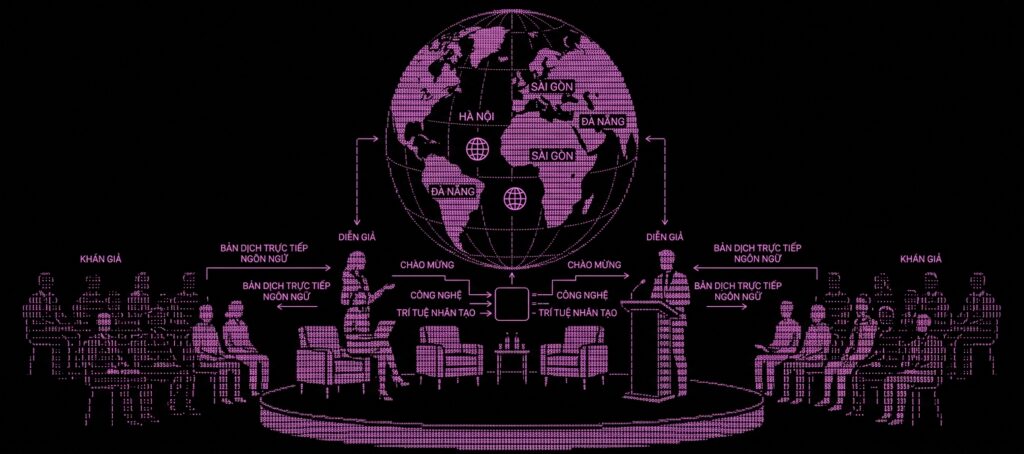
Vietnam’s MICE industry reached $7.3 billion in 2025 and is projected to grow at 6.67% annually through 2033 (IMARC Group, 2025). That number alone would make it noteworthy. But the story beneath the number is more revealing: the Saigon Exhibition and Convention Center hosted back-to-back international semiconductor, manufacturing, and energy exhibitions throughout 2025, while Hanoi broke ground on the Vietnam National Exposition Center, a 130,000-square-meter complex that will rank as the largest exhibition facility in Asia and the second-largest globally when completed. Vietnam is not just participating in Southeast Asia’s conference boom. It is building the infrastructure to lead it.
For event organizers, this creates a specific and growing challenge: Vietnamese event translation. With 86 million native speakers (Ethnologue, 2024), a six-tone phonological system that makes real-time interpretation uniquely difficult, and an event calendar increasingly populated by international technology, manufacturing, and energy conferences, getting Vietnamese language support right is no longer optional. It is the difference between an event that connects with its audience and one that loses them in the first five minutes.
Vietnam’s MICE Ecosystem: Scale, Speed, and Government Backing
The Numbers Behind the Growth
Vietnam’s trajectory in the MICE sector is not a gradual climb. It is an acceleration. The country’s MICE market is estimated at $7.71 billion for 2026, up from $7.28 billion in 2025 (Mordor Intelligence, 2025). Ho Chi Minh City alone has positioned itself as the anchor of this strategy, with the People’s Council passing Resolution No. 62/2025 to subsidize MICE tourism, directly incentivizing international conferences, seminars, and exhibitions that combine business programming with tourism.
The national target is aggressive: 25 million international tourists and 150 million domestic tourists by 2026, with MICE events serving as a core pillar of the government’s tourism strategy (Ministry of Culture, Sports and Tourism, 2025). This is backed by infrastructure spending, visa liberalization, and dedicated convention bureau staffing in every major city.
Event Infrastructure That Matches the Ambition
| Venue | Location | Capacity / Features |
|---|---|---|
| Saigon Exhibition and Convention Center (SECC) | Ho Chi Minh City | 40,000 sqm indoor, 20,000 sqm outdoor, 2,000-seat convention center, two on-site hotels |
| Vietnam National Exposition Center (VNEC) | Hanoi (Dong Anh) | 130,000 sqm indoor, 20.6 hectares outdoor, nine functional zones. Largest in Asia when complete. |
| National Exhibition Construction Centre | Hanoi | Operational. Hosts VIET INDUSTRY (10,000 sqm, 500 booths) and Vietnam Expo (35th edition) |
| Da Nang Convention Facilities | Da Nang | Mid-sized international conferences. Coastal location, international airport, UNESCO proximity |
Conferences Driving Vietnamese Translation Demand
SemiExpo Vietnam was held in Hanoi in November 2025 under the theme “Powering Vietnam’s Semiconductor Ambition,” drawing approximately 5,000 delegates and 200 exhibition booths from major global semiconductor companies including Lam Research, Micron, GlobalFoundries, Tokyo Electron, KLA, STMicroelectronics, and Siemens. With keynotes and technical workshops delivered in both Vietnamese and English, real-time translation was essential for cross-border collaboration.
Vietnam Expo, the 35th Vietnam International Trade Fair (April 2026), brings together 500+ exhibitors from 20 countries across 600 booths and 10,000 square meters. The trade fair covers manufacturing, electronics, agriculture, and consumer goods, each sector with its own technical vocabulary that general interpreters struggle to handle in real-time Vietnamese-English pairs.
ITE HCMC (International Travel Expo), scheduled for August 2026 at SECC, is one of Southeast Asia’s leading tourism industry exhibitions, drawing tourism boards, hotel groups, and travel operators from across Asia-Pacific for B2B matchmaking sessions that run in Vietnamese, English, Mandarin, Japanese, and Korean.
Global Energy Congress and Exhibition, announced for December 2026 in Hanoi, is expected to attract 800+ companies and 1,500 delegates from 50+ countries. This signals Vietnam’s intent to position itself as a hub for energy sector conferences, where technical translation of power systems, renewable energy, and grid infrastructure terminology will be critical.
The Vietnamese Language: Six Tones and the Problem They Create
Vietnamese is an Austroasiatic language, the most widely spoken in its family by a factor of several times, with 86 million native speakers and another 11 million second-language speakers worldwide (Ethnologue, 2024). It uses Latin script (quoc ngu), which gives it an apparent accessibility that masks significant complexity underneath.
The Tonal System That Defeats Generic Solutions
Vietnamese uses six lexical tones: level (ngang), falling (huyen), rising (sac), dipping-rising (hoi), rising glottalized (nga), and heavy falling (nang). The word “ma,” for instance, can mean ghost, cheek, but, horse, grave, or rice seedling depending on which tone is applied. This is not a minor phonological detail. It is the structural foundation of meaning in Vietnamese.
For real-time event interpretation and AI-powered transcription, the tonal system creates three specific challenges:
- Tone recognition in noisy environments. Conference halls, trade show floors, and networking sessions produce ambient noise that interferes with tone perception. Human interpreters compensate through context; machine transcription systems that are not specifically trained on Vietnamese tonal patterns produce errors that cascade through entire sentences.
- Regional tonal variation. Northern Vietnamese speakers (Hanoi dialect) rely heavily on voice quality and phonation type to distinguish tones. Southern Vietnamese speakers (Ho Chi Minh City dialect) primarily use pitch height and pitch contour (1stopAsia, 2025). Central Vietnamese (Hue dialect) represents yet another system. A transcription model trained predominantly on northern speech patterns will systematically misinterpret southern speakers, and vice versa.
- Speed and density. Vietnamese is a monosyllabic language: approximately 92% of its lexicon consists of single-syllable words. This means spoken Vietnamese packs more discrete meaning-bearing units per second than polysyllabic languages like English or French. Simultaneous interpreters working from Vietnamese into English must process more individual word-decisions per minute while simultaneously tracking tonal distinctions.
Diacritics: The Written Challenge
Vietnamese uses Latin script, but it is one of the most heavily diacriticized writing systems in the world. Five tone marks, plus additional diacritics modifying vowel quality, produce distinct characters for each phoneme. Live captioning and transcription systems that strip or misrender diacritics do not just look unprofessional; they produce text that is genuinely unreadable. The word “ban” without diacritics could mean table, friend, to sell, or a government decree, and a Vietnamese reader cannot disambiguate without the marks.
Key point: For event captioning displayed on screens, projectors, or attendee devices, full diacritical accuracy is not a nice-to-have. It is a basic readability requirement.
Technical Vocabulary Gaps
Vietnam’s rapid industrialization has outpaced the development of standardized Vietnamese technical terminology in many fields. Semiconductor manufacturing, advanced materials science, renewable energy engineering, and AI/ML all rely heavily on English loanwords that are inconsistently adapted into Vietnamese. At SemiExpo Vietnam, for example, presenters code-switch between Vietnamese and English mid-sentence when discussing wafer fabrication processes or chip architecture, a pattern that breaks traditional interpretation models that assume a single source language per utterance.
A Scenario: The Manufacturing Conference in Ho Chi Minh City
Imagine you are organizing a 2-day manufacturing technology summit at SECC in Ho Chi Minh City. You have 800 attendees: 55% Vietnamese-speaking (from manufacturers across all three dialect regions), 25% English-speaking (from multinational OEMs and component suppliers), 10% Japanese-speaking (from Japanese manufacturers with Vietnamese operations), and 10% Korean-speaking (from Korean FDI firms including Samsung, LG, and Hyundai).
Traditional RSI staffing for this event requires: Vietnamese-English interpreters (covering both northern and southern dialects), Japanese-Vietnamese interpreters, Korean-Vietnamese interpreters, and Japanese/Korean-English interpreters for cross-coverage. Minimum staffing: 8-12 interpreters for the main stage alone, with additional teams for parallel breakout sessions. Cost estimate: $35,000-50,000 for the two days, assuming you can even find qualified Korean-Vietnamese technical interpreters in Ho Chi Minh City, a language pair with extremely limited interpreter availability.
How Snapsight solves this: Rather than staffing a dozen interpreters across four language pairs and three Vietnamese dialect regions, Snapsight’s real-time transcription captures each session in its source language, including the code-switched segments where speakers shift between Vietnamese and English mid-sentence. Live translation delivers the content to each attendee’s device in their preferred language. The government minister’s formal northern Vietnamese keynote reaches English, Japanese, and Korean-speaking attendees simultaneously. After the summit, AI-generated summaries synthesize insights across all sessions regardless of source language.
Vietnam’s Diaspora: Why Vietnamese Translation Extends Beyond Vietnam
Vietnamese is not confined to Vietnam. The global diaspora creates significant event translation demand in unexpected locations:
- United States: Over 1.5 million Vietnamese speakers, the sixth most spoken language in the country (US Census Bureau). Vietnamese-American business associations, healthcare conferences, and technology events in Silicon Valley’s substantial Vietnamese engineering community all require Vietnamese-English interpretation.
- Australia: 321,000 Vietnamese speakers with major concentrations in Sydney and Melbourne (Australian Bureau of Statistics, 2021 Census). Australia-Vietnam trade conferences, education fairs, and bilateral government forums operate in Vietnamese-English.
- France: Approximately 400,000 people of Vietnamese descent, the largest Vietnamese community in Europe. Franco-Vietnamese business events require Vietnamese-French interpretation, a language pair with even fewer qualified interpreters than Vietnamese-English.
- Canada: 240,000 Vietnamese speakers concentrated in Toronto, Montreal, and Vancouver.
For event organizers working across the Thai and Indonesian conference circuits in Southeast Asia, Vietnamese represents the third major language requirement for regional events, and the one most frequently underserved due to interpreter scarcity.
Industries Driving Vietnamese Event Translation
Technology & Semiconductors
With major investments from Samsung, Intel, Amkor, Foxconn, NVIDIA, Qualcomm, and Marvell, Vietnam is transitioning from assembly operations to R&D and chip design. The Vietnam Semiconductor Research Institute (VSRI) is expected to launch by 2026. Every milestone generates conferences where Vietnamese-English technical translation is essential.
Manufacturing & Supply Chain
Vietnam is now the world’s second-largest smartphone manufacturer and a top-five exporter of electronics. The manufacturing conference circuit covers automotive components, textiles, food processing, and industrial automation, running year-round across SECC, VNEC, and the National Exhibition Construction Centre.
Energy & Infrastructure
The Global Energy Congress and Exhibition (December 2026) marks Vietnam’s entry as a major energy conference host. With ambitious renewable energy targets and massive infrastructure projects (the North-South Expressway, Long Thanh International Airport), energy events require translation of highly specialized engineering and regulatory vocabulary.
Tourism & Hospitality
Vietnam’s target of 25 million international tourists by 2026 drives a robust tourism conference circuit. ITE HCMC, VITM Hanoi (April 2026), and the annual MICE Expo convene tourism operators, hotel groups, and destination marketing organizations from across Asia-Pacific.
How Snapsight Handles Vietnamese Event Translation
Snapsight supports Vietnamese across its full platform: real-time transcription with diacritical accuracy, live translation across 75+ language pairs, and AI-powered post-event summaries. Having processed over 10,415 sessions across 627 events, the platform is built for the specific challenges Vietnamese presents at scale.
- Tonal accuracy in transcription: Purpose-built for tonal languages, handling the six-tone system with dialect-aware processing that distinguishes northern, southern, and central Vietnamese pronunciation patterns.
- Diacritical precision: Full rendering of Vietnamese diacritics in live captions and transcripts. No stripped characters, no ambiguous output.
- Code-switching handling: Vietnamese-English code-switching, common in technology and manufacturing contexts, is captured as-is rather than forcing a single-language assumption.
- Multi-language event support: Vietnamese-English-Japanese-Korean-Mandarin configurations for the multi-language events that define Vietnam’s international conference circuit.
- 91% autonomous operation: The Operator Agent joins sessions, monitors quality, and manages the technical workflow without requiring on-site language specialists.
Planning a Vietnamese-Language Event: What Organizers Need to Know
Cultural Considerations
Vietnamese business culture values relationship-building before transactional discussion. Expect networking sessions and meals to run longer than in Western conference formats. Formal events involving government officials use northern Vietnamese conventions and formality registers that differ from the more casual tone of startup and tech events in Ho Chi Minh City. Understanding which register is appropriate, and ensuring your translation solution preserves it, matters.
The Vietnamese calendar includes Tet (Lunar New Year, typically late January to mid-February) and several national holidays that effectively shut down the conference circuit for extended periods. Planning events within two weeks of Tet is inadvisable.
Visa and Logistics
Vietnam has progressively liberalized visa requirements for international travelers, with e-visa availability for citizens of 80+ countries and visa exemptions for many ASEAN and select Western nations. Ho Chi Minh City’s Tan Son Nhat and Hanoi’s Noi Bai airports are well-connected international hubs. The under-construction Long Thanh International Airport (expected completion 2026-2027) will add significant capacity for Ho Chi Minh City’s MICE ambitions.
Frequently Asked Questions
Vietnamese has six lexical tones that change word meaning entirely. In a conference setting, this means that transcription and interpretation systems must accurately capture tonal distinctions or risk producing incoherent output. The challenge is compounded by regional variation: northern, southern, and central Vietnamese realize tones differently, so a single acoustic model may not serve speakers from all regions at a national event.
AI-powered translation has made significant progress with Vietnamese, particularly for written text. Real-time spoken translation adds complexity due to the tonal system, code-switching between Vietnamese and English in technical contexts, and the need for full diacritical accuracy in displayed text. Snapsight’s platform addresses these challenges through dialect-aware processing and specialized handling of tonal languages, delivering live translation across Vietnamese and 75+ other languages.
Qualified Vietnamese-English simultaneous interpreters typically cost $800-1,500 per day per interpreter, with a minimum of two interpreters per language pair for sessions exceeding 30 minutes. For a multi-day, multi-track event requiring Vietnamese-English plus additional pairs like Vietnamese-Japanese or Vietnamese-Korean, traditional interpretation costs can exceed $40,000. AI-powered solutions like Snapsight offer predictable per-event pricing that scales across unlimited concurrent sessions and language pairs.
While both cities use Vietnamese, the dominant dialect differs: northern Vietnamese in Hanoi, southern Vietnamese in Ho Chi Minh City. For events drawing attendees from across Vietnam, your translation solution should handle both dialect groups. Snapsight’s transcription engine is trained across Vietnamese dialect variation, so a single setup serves audiences regardless of the speaker’s regional origin.
Vietnamese-English is the baseline for virtually all international events. Vietnamese-Japanese and Vietnamese-Korean are increasingly common given Japan and Korea’s massive FDI presence. Vietnamese-Mandarin matters for cross-border trade events, particularly in northern Vietnam. Vietnamese-French retains relevance for development, cultural, and diplomatic events given the historical relationship. Snapsight supports all of these pairs simultaneously within a single event configuration.