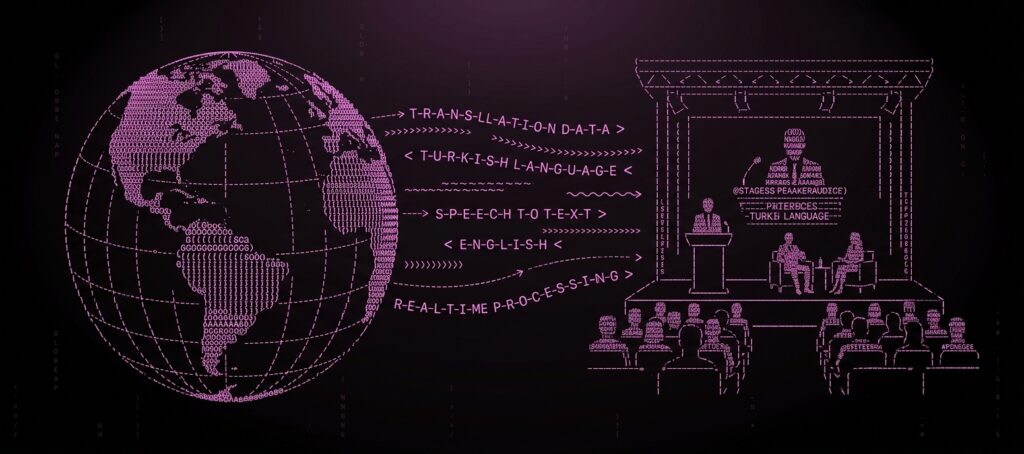
Istanbul hosted 86 international congresses in 2024, climbing back into the ICCA’s global top 20 for the first time since 2015, and the city is targeting the top 10 by 2027 (ICCA GlobeWatch 2024 Country & City Rankings). With Turkey ranking as the world’s 16th-largest economy by nominal GDP at $1.57 trillion (IMF, 2025) and sitting at the literal crossroads of Europe and Asia, Turkish event translation is not a niche requirement. It is a strategic capability for any organization running conferences in one of the world’s most active and ambitious MICE markets.
Turkish is spoken by approximately 84 million native speakers, with roughly 90 million speakers worldwide (Ethnologue, 2025). Beyond Turkey itself, Turkish is an official language in Cyprus and is widely spoken by diaspora communities across Germany (over 3 million speakers), the Netherlands, Austria, Belgium, and France. For event organizers, this means Turkish language support is relevant not only for conferences in Istanbul and Antalya, but for European events drawing significant Turkish-speaking business delegations.
Turkey’s Conference Landscape: Where Defense Expos Meet Solar Fairs
Turkey’s event industry reflects the country’s unusual economic profile: a G20 member with deep industrial capacity, a defense sector that has become a major global exporter, and an energy market undergoing rapid transformation. The result is an event calendar that spans sectors most Western European conference cities never touch.
The Flagship Events
IDEF (International Defence Industry Fair) is by far the largest defense exhibition in the Eurasian region and consistently ranks among the top five globally. The 17th edition in July 2025 drew professional exhibitors from 44 countries, with companies from 96 countries presenting over a thousand new products, and more than 140,000 visitors passed through four simultaneous venues across Istanbul (Defence Turkey Magazine, 2025). At an event of this scale, Turkish-English translation is the baseline, but IDEF also requires Turkish-Arabic, Turkish-Korean, and Turkish-Malay language pairs to serve its Middle Eastern and Asia-Pacific defense delegations.
WIN Eurasia, held annually at Istanbul Expo Center, is Eurasia’s leading industrial fair. The 2024 edition drew 750 companies from 19 countries and 41,554 visitors from 90 countries (WIN Eurasia, 2024). Covering industrial automation, energy, robotics, and factory technologies across 65,000 square meters in seven halls, WIN Eurasia 2026 is scheduled for June 10-13 at Istanbul Expo Center in Yesilkoy. The technical depth of these sessions, discussing PLC programming, SCADA systems, and robotic welding specifications, demands interpreters who understand both Turkish engineering terminology and the specific standards frameworks used across European and Middle Eastern manufacturing.
SolarEX Istanbul has grown into the world’s third-largest solar energy technologies exhibition. Its 18th edition in April 2026 will occupy 65,000 square meters across seven halls, hosting investors from 125+ countries (SolarEX Istanbul, 2026). The fair received “Prestigious Fair” status from Turkey’s Ministry of Trade, reflecting the government’s strategic investment in positioning Istanbul as a renewable energy knowledge hub. Real-time translation at SolarEX must handle the intersection of Turkish energy policy terminology, international photovoltaic standards, and commercial negotiation language, a combination that challenges even experienced human interpreters.
MUSIAD EXPO, organized by the Independent Industrialists and Businessmen’s Association, is Turkey’s most comprehensive mixed-trade fair. The 20th edition in November 2024 hosted 2,150 participants from 115 countries and over 300 companies from 24 sectors, targeting $1 billion in business volume (TRT World, 2024). The event spans textiles, machinery, construction, energy, food, defense, and advanced technology, making it one of the most linguistically demanding fairs in the region, where a single buyer-seller meeting might shift between Turkish, Arabic, English, and Farsi within minutes.
Beyond Istanbul: Antalya and Ankara
Istanbul dominates Turkey’s conference calendar, but it is not the only hub. Antalya, with its 300+ days of sunshine, more than 300 five-star hotels, and over 175,000 convention seats, hosted the G20 Summit in 2015 and continues to attract major international gatherings (Business Review, 2025). ANFAS Antalya Expo Center serves as the city’s primary exhibition venue, particularly strong in tourism, agriculture, and food industry events.
Ankara’s ATO Congresium and the capital’s government conference facilities host events tied to Turkey’s diplomatic and regulatory apparatus, including EU accession discussions, NATO-related forums, and bilateral trade negotiations where Turkish-English and Turkish-French interpretation are essential.
Key Industries Driving Turkish Event Translation Demand
Defense and Aerospace
Turkey’s defense industry has become a major global force. Events like IDEF, the Eurasia Airshow, and numerous bilateral defense cooperation summits require sophisticated translation across Turkish, English, Arabic, Korean, and increasingly Malay and Urdu as Turkey deepens defense export relationships with Southeast Asia and South Asia. The technical vocabulary, from UAV specifications to radar system parameters, is highly specialized and poorly served by generalist interpreters.
Energy and Renewables
Turkey is undergoing a massive energy transition while remaining a critical transit country for oil and gas pipelines connecting Central Asia and the Middle East to Europe. The SPE Europe Energy Conference & Exhibition is scheduled for June 2026 at Swissotel The Bosphorus, Istanbul. Turkey’s solar capacity is expanding rapidly, and events like SolarEX and the International Energy Congress & Expo (EIF Turkey) attract global participants who need real-time Turkish-English translation for policy sessions, technical workshops, and investment roundtables.
Construction and Real Estate
Turkey is one of the world’s largest construction markets, with Turkish contractors active across Central Asia, the Middle East, and Africa. Trade fairs like the Istanbul Real Estate Fair and construction technology exhibitions draw developers, investors, and government officials from dozens of countries. The translation challenge here extends beyond technical vocabulary to legal and regulatory language: property law, zoning regulations, and construction standards differ significantly across Turkish, Arabic, and English legal frameworks.
Textiles and Manufacturing
Turkey is the world’s fourth-largest textile and apparel exporter, and events like Texhibition Istanbul, Istanbul Fashion Connection, and HOMETEX draw international buyers who negotiate in Turkish, English, Arabic, and Russian. Speed matters at these trade events: buyers making purchasing decisions in real time need accurate translation of product specifications, pricing terms, and delivery conditions.
The Turkish Language: Why Translation Is Harder Than It Looks
Turkish presents a distinctive set of challenges for event translation that many organizers underestimate.
Agglutinative Structure
Turkish is a heavily agglutinative language, meaning grammatical meaning is conveyed by stacking suffixes onto root words rather than using separate words (Ethnologue, 2025). A single Turkish word can convey what requires an entire English clause. The classic example: “Avrupalilastiramadiklarimizdanmissiniz,” a single word meaning roughly “You are said to be one of those whom we could not make European.” While extreme examples like this are rare in conference settings, the agglutinative structure means that real-time transcription systems must parse long compound words correctly, and simultaneous interpreters must process grammatically complete information that arrives at the end of a Turkish sentence, not the beginning.
SOV Word Order
Turkish uses Subject-Object-Verb (SOV) order, while English follows Subject-Verb-Object (SVO). This means a Turkish speaker delivers the verb, the most critical piece of information, at the end of the sentence (Language Unlimited, 2025). For simultaneous interpreters, this creates a significant lag: they must wait for the Turkish speaker to finish their sentence before they know whether the statement is affirmative, negative, conditional, or interrogative. In fast-paced panel discussions, this structural delay can cause interpreters to fall behind, lose nuance, or guess incorrectly.
Key linguistic challenge: Turkish’s agglutinative structure and SOV word order create a double bind for interpreters. The meaning is compressed into long compound words, and the verb arrives last. AI-powered transcription handles this consistently across parallel sessions, while human interpreters face fatigue-driven accuracy drops after 30 minutes.
Vowel Harmony and Morphological Complexity
Turkish follows strict vowel harmony rules, where suffixes must match the vowel pattern of the root word. This creates morphological regularity that helps native speakers but can trip automated systems that treat each suffix independently (PeerJ Computer Science, 2025). For AI-powered transcription, correctly segmenting Turkish compound words and applying vowel harmony rules is essential for producing readable, accurate text.
Register and Formality
Turkish distinguishes between formal address (siz) and informal address (sen), and the choice carries significant social weight in business and government contexts. A defense industry keynote demands formal register throughout. A startup pitch at a tech meetup might oscillate between formal and informal. Interpreters must read the room and adjust, something that requires cultural fluency, not just linguistic competence.
Technical Vocabulary Gaps
While Turkey’s 1928 script reform (replacing Arabic script with Latin alphabet) modernized written Turkish, technical and scientific vocabulary still presents challenges. Many technical fields borrow heavily from English, French, or Arabic, creating a hybrid vocabulary that varies by industry and speaker generation. Defense industry presenters may use English acronyms within Turkish sentences. Energy sector professionals might mix Turkish and English technical terms freely. An interpreter or AI system that handles only “standard” Turkish will miss these domain-specific patterns.
Cultural Considerations for Event Organizers
Turkish Hospitality and Relationship Building
Turkish business culture places enormous emphasis on personal relationships. Events in Turkey typically include extended networking meals, tea (cay) breaks that serve as informal relationship-building sessions, and social programming that international organizers sometimes underestimate in importance. Translation support should extend beyond formal sessions to these informal settings, where some of the most consequential business conversations happen.
Scheduling Around Religious and Cultural Calendar
Ramadan and the subsequent Bayram (Eid) holidays significantly affect event scheduling and attendance in Turkey. During Ramadan, daytime event sessions may need adjustment to accommodate fasting attendees, and major holidays can reduce domestic attendance by 30-40%. Event organizers should consult the Islamic calendar when scheduling and ensure translation services account for the modified daily schedules during these periods.
The Europe-Asia Narrative
Turkey’s position as a bridge between Europe and Asia is not just geography: it is a core part of the country’s business identity and event marketing. Conferences in Istanbul frequently frame their value proposition around this bridging role, and translation services should be prepared to handle content that references both European regulatory frameworks (EU standards, GDPR) and Middle Eastern or Central Asian business practices in the same session.
A Real Scenario: Multilingual Industrial Fair in Istanbul
Imagine you are organizing a three-day industrial automation conference at Istanbul Expo Center, co-located with WIN Eurasia. You have 2,000 attendees: 55% Turkish-speaking, 25% English-speaking, 10% Arabic-speaking, and 10% split across German, Russian, and Farsi. Your program includes 40 technical sessions across six parallel tracks, a main-stage keynote program with speakers from Siemens Turkey, a Saudi Arabian industrial automation firm, and an American robotics company, plus a dedicated B2B matchmaking program where buyers and sellers need real-time language support.
Traditional RSI would require 8-12 interpreters covering Turkish-English, Turkish-Arabic, and English-German pairs at minimum, costing upward of $50,000 for three days, with the added challenge of finding interpreters who understand industrial automation terminology in all relevant language pairs. Staffing a Turkish-Arabic interpreter with robotics expertise in Istanbul requires months of lead time.
The Snapsight advantage: Real-time transcription captures every session in its source language, whether Turkish, English, or Arabic. Each attendee receives live translation on their own device, in their preferred language. The agglutinative structure of Turkish, the SOV word order, the domain-specific vocabulary: these are computational challenges that AI handles consistently across 40 parallel sessions, not bottlenecks that require a dozen specialized human interpreters.
After the event, AI-generated summaries synthesize insights across all tracks and languages, so attendees who could only attend six of 40 sessions still capture the full scope of what was discussed. Snapsight has powered 627+ events and processed 10,415+ sessions across 75+ languages, operating at 91% autonomy, meaning your team focuses on running the event, not managing translation logistics.
Practical Guidance for Turkish Event Translation
- Start with the language pairs that matter. Turkish-English is the baseline for any international event in Turkey. But depending on your sector, Turkish-Arabic (defense, energy, construction), Turkish-German (automotive, manufacturing), and Turkish-Russian (energy, tourism) may be equally critical.
- Account for technical vocabulary early. Provide speakers’ presentations, glossaries, and key terminology lists in advance. Turkish technical vocabulary varies significantly by industry and even by company. A glossary review before the event prevents costly misinterpretations during live sessions.
- Plan for informal settings. Turkish business culture relies on relationship building outside formal sessions. Consider providing translation support for networking dinners, tea breaks, and site visits, not just keynote stages.
- Verify venue infrastructure. Istanbul’s major venues, including Istanbul Expo Center (Yesilkoy), Istanbul Congress Center (over 16,000 sq m of exhibition space and a 3,705-seat auditorium), and Lutfi Kirdar ICEC (2,000-seat auditorium and 7,000+ sq m of space), all support modern event technology (ICVB, 2025). But older or satellite venues may require additional technical setup for real-time translation systems.
- Consider the diaspora. If your event has a European component, remember that over 3 million Turkish speakers live in Germany alone. A European technology conference or trade show may have significant Turkish-speaking attendance that benefits from Turkish language support even when the event is held in Berlin or Frankfurt.
For organizers working across the broader Eastern Mediterranean, Turkish event translation connects naturally with Greek event translation, as many industries (shipping, tourism, energy) operate across both markets. And for events spanning Turkey’s Middle Eastern trade relationships, understanding Arabic event translation helps organizers plan multilingual support that covers the full geographic reach of their audience. For a complete view of Snapsight’s multilingual capabilities across all supported languages, visit our event translation hub.
Planning a Multilingual Event With Turkish-Speaking Attendees?
Turkey’s conference market is accelerating. Istanbul’s climb back into the ICCA’s global top 20, combined with the country’s ambitious infrastructure investments and its unique position spanning two continents, means more international events and more demand for Turkish event translation that goes beyond basic interpretation. Whether you are organizing a defense exhibition with 140,000 visitors or a focused energy roundtable with 200 executives, the linguistic and cultural complexity of Turkish demands solutions built for scale.
See how Snapsight handles real-time Turkish transcription and translation, or talk to our team about your specific event requirements.
Frequently Asked Questions
Traditional Turkish-English simultaneous interpretation typically runs $1,500-2,500 per interpreter per day, and most events require at least two interpreters per language pair to manage fatigue during long sessions. For a three-day conference with three language pairs (Turkish-English, Turkish-Arabic, Turkish-German), you are looking at $27,000-$45,000 in interpretation costs alone, before equipment rental. AI-powered translation solutions like Snapsight can reduce these costs significantly while covering more sessions simultaneously.
Modern AI transcription systems have made significant advances in processing agglutinative languages like Turkish. The key challenge is correctly segmenting compound words and applying vowel harmony rules to produce accurate, readable transcription. Snapsight’s AI handles Turkish morphological complexity across 75+ languages, processing the long compound words and SOV sentence structure that make Turkish particularly demanding for real-time systems.
Yes. Turkish register differences between formal (siz-based) and informal (sen-based) contexts are significant, and experienced interpreters adjust their language accordingly. Government and diplomatic events demand strict formal register, while startup and technology events may use a more casual tone. AI translation systems must similarly adapt to context. Snapsight’s language models are trained across registers to handle this variation.
Turkish-English is essential for virtually every international event. Beyond that, Turkish-Arabic is critical for defense, energy, and construction events (given Turkey’s deep trade relationships with the Gulf states and MENA region). Turkish-German matters for manufacturing and automotive (Germany is Turkey’s largest export market). Turkish-Russian is relevant for energy and tourism. And for events at the Turkey-Central Asia nexus, Turkish-Kazakh and Turkish-Uzbek pairs are increasingly important.
Ramadan shifts event schedules significantly. Daytime sessions may start later and end earlier, networking meals move to post-iftar timing, and overall attendance from domestic participants can decrease during the holy month and especially during the subsequent Bayram holidays. Event organizers should plan translation coverage around modified schedules and may need to adjust session formats, with shorter sessions and more breaks, to accommodate fasting attendees and speakers.