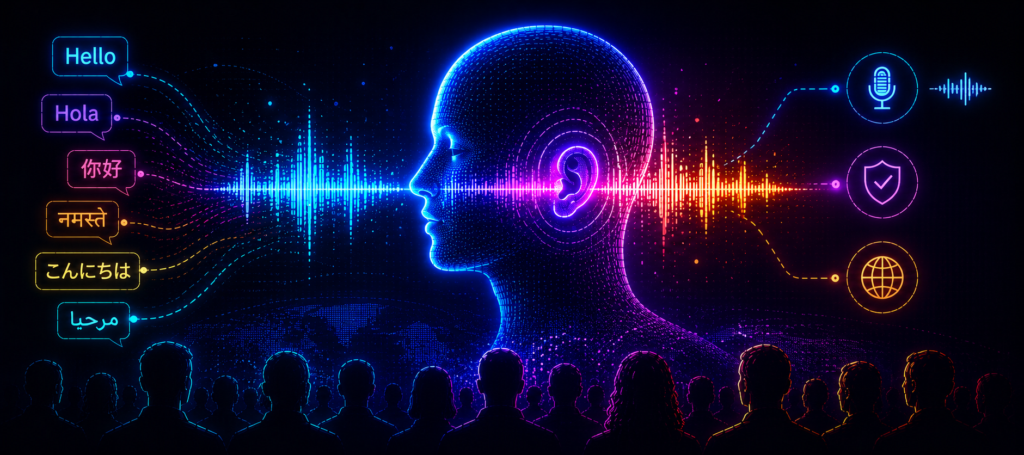

A keynote speaker walks off stage in Singapore. Within minutes, attendees in Berlin, São Paulo, and Tokyo are watching the same talk in their own languages. Not subtitled. Not dubbed by a stranger. The speaker’s actual voice, with their actual tone, accent, and pacing, is delivering the words in fluent German, Portuguese, and Japanese.
This is not a glimpse of the future. AI voice cloning at events is happening right now in 2026, and the conversation around it is finally catching up. The technology is real, the use cases are growing, and the ethical questions are bigger than most event organizers have started asking.
Here is what AI voice cloning means for events, where it works, and the questions every host needs to answer before deploying it.
What AI Voice Cloning Actually Does
AI voice cloning is the ability to recreate a person’s voice from a short audio sample, then use that voice to generate new speech in any language. A 30-second sample of a speaker reading prepared text is now enough for modern systems to produce convincing speech in dozens of languages.
This is different from text-to-speech, which produces a generic computer voice. Voice cloning preserves the actual identity of the speaker. The result sounds like them, talks like them, and carries their personality across language barriers that used to feel impossible to cross.
Three Legitimate Use Cases at Events Today
Voice cloning is being used in real events right now in three specific ways.
1. Multilingual delivery of recorded keynotes
A speaker records their keynote once in English. Voice cloning then produces the same keynote in 15 to 30 other languages, all in the speaker’s own voice. International attendees get the full speaker presence instead of a third-party interpreter. This is the most established and least controversial use case today.
2. On-demand content in the attendee’s preferred language
After the event, recordings become available in any language an attendee chooses. The speaker’s voice carries through, which keeps the post-event content emotionally consistent with the live experience. Repurposing reach goes up because content is no longer locked to one language.
3. Speaker accessibility for those who cannot attend live
When a speaker cancels at the last minute or cannot travel, voice cloning combined with a prepared transcript can deliver something close to the intended experience. This is not a replacement for the speaker being there, but it is a meaningful backup when the alternative is silence.
The Ethical Questions Worth Asking
Voice cloning raises real issues that event teams need to answer clearly before deployment.
Consent. Has the speaker given explicit, written permission for their voice to be cloned? Generic speaker release forms from 2022 do not cover this. A specific clause is now required.
Disclosure. Should the audience be told they are hearing a cloned voice rather than a live performance? Most event ethics experts say yes. Hidden voice cloning erodes trust the moment anyone notices.
Boundaries. What can the cloned voice say, and who decides? A speaker may agree to clone their voice for a keynote but not for promotional content. Boundaries must be defined upfront.
Data retention. What happens to the voice model after the event? Is it deleted, retained, or licensed for future use? Speakers increasingly ask this question before signing.
Protection from misuse. A leaked voice model could be used to impersonate the speaker elsewhere. Security around the voice file matters as much as the recording itself.
The Risks Most Event Teams Underestimate
Beyond ethics, voice cloning at events comes with practical risks worth planning for.
- A poorly cloned voice can sound uncanny and damage the speaker’s reputation
- Cultural nuances do not always translate, even with perfect voice matching
- Audience members may feel deceived if disclosure comes too late
- Sponsors and partners may have policies against AI-generated speaker content
- Future events may struggle to feature the same speaker if the cloned version is what audiences expect
None of these are reasons to avoid voice cloning. They are reasons to deploy it carefully.
How to Deploy Voice Cloning Responsibly
Step 1: Get explicit written consent
Update your speaker release form to include a specific voice cloning clause. Cover what languages, what content, what duration, and what storage. Have an attorney review the final language for your jurisdiction.
Step 2: Disclose to your audience
Use a clear, simple statement at the start of any cloned-voice content. Something like “This translation uses an AI-generated voice based on the original speaker, with their permission.” Transparency builds trust. Hidden use destroys it.
Step 3: Let the speaker review before publishing
Before any cloned-voice content goes live, the speaker should listen to a sample in each language and confirm it represents them well. Build this review step into your workflow. Speakers will appreciate the respect.
Step 4: Define the voice model lifecycle
Decide upfront how long the voice model will exist, who can access it, and when it gets deleted. Document this in the speaker agreement. A clean lifecycle policy protects both the speaker and the event organizer from future complications.
The Future of Voice at Events
Voice cloning is one part of a bigger shift. Within the next two years, expect to see real-time voice cloning during live sessions, meaning a speaker on stage in English will be heard in real time by global attendees in their own languages, in the speaker’s actual voice. The technology is almost ready. The ethical frameworks need to catch up faster.
Events that move thoughtfully now will be ready for what comes next. Events that rush in without consent, disclosure, or guardrails will spend the next decade dealing with the consequences.
How Snapsight Approaches the Voice Question
Snapsight delivers real-time translation across 75+ languages, with content intelligence built for the realities of multilingual events. The platform is designed for transparency, with clear data handling, customizable retention, and consent-aware workflows that respect the speaker as much as the audience.
Across 627+ events and 10,415+ sessions processed at 91 percent autonomous operation, Snapsight has built the foundation that makes new technologies like voice cloning practical without losing the trust that makes events work in the first place.
Key Takeaways
- AI voice cloning at events is real in 2026 and growing fast
- The three solid use cases are multilingual delivery, on-demand content, and last-minute backup
- Consent, disclosure, boundaries, and data retention must be answered before deployment
- Update speaker release forms with specific voice cloning language
- Transparency with the audience builds trust. Hidden use destroys it