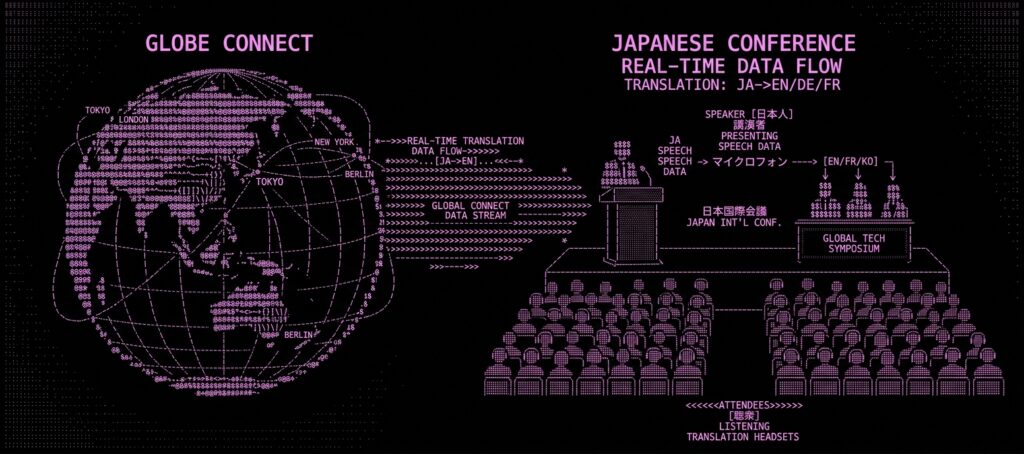
Real-time Japanese translation for conferences, trade shows, and business events. With 123-126 million native speakers and Japan’s $37 billion MICE market, Japanese event translation requires specialized capabilities. Snapsight delivers AI-powered Japanese translation alongside summaries, takeaways, and cross-session intelligence.
Why Japanese Event Translation Matters in 2026
A Concentrated Language Market
Japanese presents a unique language market:
- 123-126 million native Japanese speakers worldwide (WorldData)
- 98.4% are native speakers, one of the highest native speaker ratios globally
- 99%+ of speakers live in Japan, the most geographically concentrated major language
- 9th most used language online, 2.7% of global web content (Babbel)
Unlike widely dispersed languages, Japanese is concentrated, meaning events targeting Japan require dedicated Japanese support rather than hoping bilingual attendees can adapt.
Japan’s Significant MICE Market
Japan’s meetings, incentives, conferences, and exhibitions market is substantial:
- 2024 market value: USD 37.25 billion (Market Research Future)
- 2035 projection: USD 90.3 billion (8.38% CAGR)
- Global share: 2.01% of worldwide MICE market
- Regional position: Top 5 Asia-Pacific MICE market
- Business travel growth: 15% increase in bookings from 2019 to 2023
Where Japanese Translation Matters
| Venue/Region | Event Significance |
|---|---|
| Tokyo Big Sight | 127 trade shows, 594 upcoming expos |
| Osaka | Japan MICE Expo, Osaka-Kansai World Expo hub |
| Technology Events | 129 IT/telecom events annually |
| Manufacturing | 150 machinery/industrial events |
| Healthcare | 72 medical care events |
Major Japanese events include NIKKEI MESSE, JAPAN SHOP, FOODEX JAPAN, SEMICON Japan, and the International Robot Exhibition.
The Challenge with AI Japanese Translation
Japanese presents unique and significant challenges for AI translation systems:
Keigo: The Honorific Language System
Japanese has three distinct politeness levels embedded in grammar:
- Teinei-go (polite/formal language)
- Sonkei-go (respectful/honorific language, elevating the listener)
- Kenjo-go (humble language, lowering the speaker)
The AI Challenge: English has no equivalent embedded formality grammar. AI systems must infer the correct politeness level from context: speaker status, relationship, setting. Getting it wrong in business contexts signals cultural ignorance. A simple “I will do it” has completely different Japanese forms depending on who is speaking to whom and in what context.
Kanji Complexity
Japanese uses three character sets simultaneously:
- Kanji: ideograms (Chinese characters) with multiple readings
- Hiragana: phonetic characters for Japanese words
- Katakana: phonetic characters for foreign words
A single kanji can have multiple pronunciations depending on context. Translation systems must understand not just characters but their contextual readings.
Structural Differences
- Word order: Subject-Object-Verb (vs. English Subject-Verb-Object)
- Subject omission: Japanese frequently omits subjects, requiring context inference
- High context dependency: meaning often implied rather than stated
Proposed Solutions
Leading translation approaches for Japanese:
- Default to polite form (teinei-go) for general content
- Allow users to select politeness level for specific contexts
- Language-specific selectors like “Japanese (Respectful)” for business events
How Snapsight Handles Japanese Events
Snapsight’s AI is trained specifically on event content with attention to Japanese linguistic requirements.
During Your Event
- Attendees access via QR code or link: no app downloads required
- Select Japanese as preferred language: interface immediately switches
- Receive real-time translated content:
- Live transcription in Japanese
- Session summaries in Japanese
- Key takeaways in Japanese
- Q&A translated bidirectionally
Custom Vocabulary for Japanese Business
- Industry-specific terms: manufacturing, technology, healthcare vocabularies
- Company names: correct rendering in katakana or original form
- Product terminology: technical specifications with Japanese conventions
- Honorific handling: appropriate formality for business contexts
Beyond Translation: Japanese Event Intelligence
Translation is the beginning. Snapsight delivers complete event intelligence in Japanese:
AI-Generated Summaries
Every session summarized in Japanese with appropriate formality, highlighting key discussion points for Japanese-speaking attendees.
Key Takeaways Extraction
The most important points from each session, automatically identified and delivered in Japanese with cultural context preserved.
Cross-Session Intelligence
Themes and patterns across your entire event, synthesized and presented in Japanese. Japanese-speaking attendees receive the same strategic intelligence as other language groups.
Personalized Content Delivery
- Executives receive strategic summaries with appropriate honorific tone
- Technical attendees receive implementation details
- Sales teams receive market and competitive insights
- Everyone gets relevant intelligence, in Japanese
Japanese Translation for Different Event Types
Trade Shows
Japan hosts world-class trade exhibitions:
- Tokyo Big Sight: primary venue for international trade
- Makuhari Messe: technology and automotive shows
- Intex Osaka: Western Japan exhibitions
Snapsight enables international exhibitors and Japanese attendees to engage across language barriers.
Technology Conferences
Japan’s technology sector is globally significant: semiconductor and electronics, robotics and automation, automotive and mobility, gaming and entertainment. 129 IT/telecom events annually require precise technical terminology in Japanese.
Manufacturing Events
Japan leads in manufacturing excellence: 150 machinery/industrial events annually, quality management conferences, supply chain summits, and Industry 4.0 and smart manufacturing. Technical precision in Japanese translation is non-negotiable.
Healthcare Conferences
72 medical care events annually covering pharmaceutical industry, medical devices, healthcare technology, and aging society solutions. Medical terminology requires specialized vocabulary handling.
Japan MICE Market Trends
Technology Integration
Japanese venues increasingly emphasize hybrid event capabilities, advanced AV and streaming infrastructure, real-time translation technology, and mobile-first attendee experiences.
International Events Resurgence
Post-pandemic recovery plus Osaka-Kansai World Expo is driving increased international conference hosting, growing demand for multilingual support, and investment in MICE infrastructure.
AI Adoption in Japan: 78% of organizations use AI in at least one business function, with technology companies at 94% AI adoption rate. Growing comfort with AI-powered event solutions is accelerating demand for platforms like Snapsight.
Events We’ve Powered with Japanese Translation
Snapsight has processed 10,000+ sessions across 627+ events in 75+ languages. Japanese is a key language for Asia-Pacific events, supporting:
- International trade shows with Japanese exhibitors and attendees
- Technology conferences bridging Japanese and global tech communities
- Corporate events for multinational companies with Japanese operations
- Association meetings with Japanese chapter participation
The world’s most important events trust Snapsight: Reuters, IBM, Siemens, Singapore Government.
Why Choose Snapsight for Japanese Event Translation
75+ Languages, One Platform
Japanese is one of 75+ languages Snapsight supports. If your event includes English, Mandarin, or Korean attendees alongside Japanese speakers, one platform handles everything.
Cultural Context Preservation
Snapsight’s AI is trained to preserve appropriate formality and cultural context in Japanese translations, not just word-for-word conversion.
91% Autonomous Operations
Snapsight’s Operator Agent manages sessions automatically. Your team focuses on attendees, not technology.
Enterprise Security
ISO 27001 and SOC 2 certified. Your event content is protected with enterprise-grade security.
Frequently Asked Questions
Snapsight’s AI is trained on Japanese business content with awareness of formality requirements. For specialized needs, custom vocabulary and context settings can be configured.
Custom vocabulary support allows you to add specialized terms, product names, and industry-specific Japanese terminology.
Snapsight integrates with major event platforms used in Japan and internationally.
Contact us to discuss accessibility requirements including sign language support.