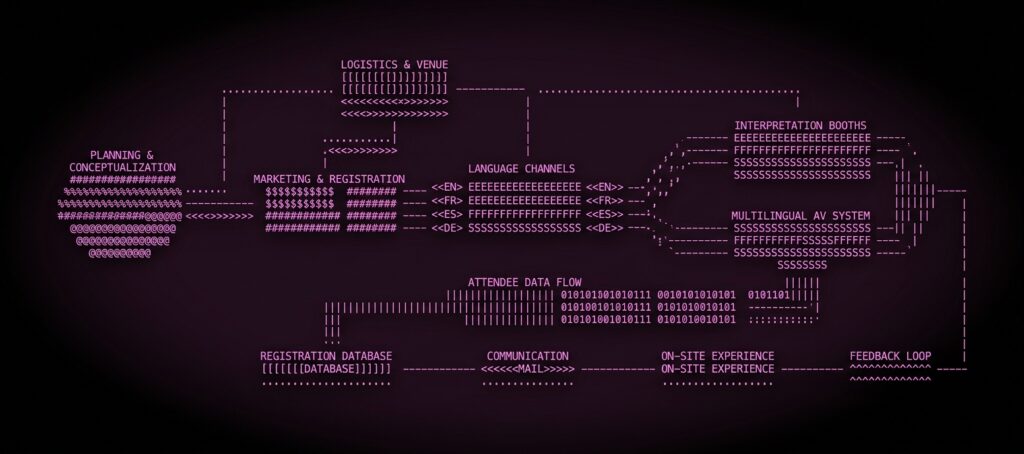
Hybrid event technology is the combination of hardware, software, and connectivity infrastructure that enables events to deliver a cohesive experience to both in-person and remote attendees simultaneously. It bridges a physical venue with a digital platform so that virtual participants can watch sessions, interact with speakers, network with other attendees, and access event content with an experience comparable to being on-site, while in-person attendees benefit from digital tools like live captioning, real-time translation, and event apps.
More than 123 million hybrid events took place globally in 2025, making hybrid the fastest-growing event format in the industry (Bizzabo, 2026). The global events industry is projected to reach $1.55 trillion by 2028, and hybrid technology is a primary driver. According to EventsAir’s 2026 trends report, 59.4% of organizations want software that supports both in-person and virtual events from a single platform, confirming that hybrid is no longer experimental. It is standard operating procedure.
This guide covers the technology components that make hybrid events work, what they cost, how to evaluate vendors, and where the category is heading.
Hybrid Event Technology Defined
Hybrid event technology is not a single product. It is a technology stack that connects two distinct experiences, in-person and virtual, into one event. The defining characteristic is bidirectional interaction: virtual attendees can participate in Q&A, chat with in-person attendees, visit sponsor booths, and join networking sessions, not just watch a livestream passively.
The concept emerged gradually. Before 2020, “hybrid” usually meant a livestream bolted onto an in-person event with minimal interaction. The pandemic forced rapid development of truly integrated hybrid solutions. By 2022, dedicated hybrid event platforms and AV packages had matured to the point where the two audiences could share a genuinely comparable experience.
The key technical challenge remains synchronization. In-person attendees experience sessions with zero latency, natural audio, and physical networking. Virtual attendees experience sessions through a screen with inherent latency (typically 3-15 seconds for live streaming), digital audio, and facilitated networking. Hybrid technology’s job is to minimize these gaps.
How Hybrid Event Technology Works
On-Site Hardware Layer
The physical venue requires specific equipment to capture and transmit the in-person experience.
- Professional cameras: PTZ (pan-tilt-zoom) cameras or operated cameras capture speakers, presentation slides, and audience reactions. Most hybrid events use 2-4 cameras per session room.
- Audio capture: Professional microphones (lavalier, podium, and audience mics) feed clean audio to the streaming encoder. Audio quality is the single most important factor in virtual attendee satisfaction.
- Streaming encoders: Hardware or software encoders compress video and audio for real-time delivery to the virtual platform. Encoders like Epiphan Pearl, vMix, or OBS handle switching between camera angles and slide presentations.
- Display screens: In-room screens showing virtual attendee questions, chat, and remote speaker video. These are essential for making virtual attendees visible to the in-person audience.
- Network infrastructure: Dedicated, high-bandwidth internet separate from venue Wi-Fi. Most production teams require 20-50 Mbps upload per session room for reliable HD streaming.
Virtual Platform Layer
- Streaming delivery: CDN-based distribution ensures consistent video quality regardless of attendee location. Platforms like Hopin, vFairs, Bizzabo, and Zoom Events handle this natively.
- Interactive features: Q&A, polls, chat, and reactions that work across both audiences. The best platforms display virtual audience questions on in-room screens so speakers address them alongside in-person questions.
- Networking tools: AI-powered matchmaking, virtual lounges, and 1:1 video meeting scheduling for virtual attendees.
- Expo and sponsor spaces: Virtual booths that complement physical exhibit halls, giving sponsors visibility across both audiences.
Content and Intelligence Layer
This is the fastest-evolving component of hybrid technology. Beyond streaming video, modern hybrid events capture, process, and distribute content intelligence.
- Real-time transcription: AI-powered speech-to-text converts every session into searchable text as it happens
- Live translation: Content delivered in multiple languages simultaneously for global audiences
- Session summaries: AI-generated highlights and key takeaways distributed during or immediately after sessions
- Content archiving: Searchable library of all event content, available on-demand within hours, not weeks
Integration Layer
- Registration platform to virtual platform: Attendee data syncs so login credentials, session selections, and profile information transfer automatically
- Event platform to CRM: Engagement data (sessions attended, booths visited, content downloaded) flows to Salesforce, HubSpot, or similar systems for lead scoring and follow-up
- Content platform to marketing automation: Session recordings, transcripts, and summaries feed post-event content campaigns
Hybrid Event Technology for Events: Why It Matters
Audience Expansion
Hybrid technology multiplies event reach. An in-person conference limited to 1,000 venue seats can serve 5,000-10,000 additional virtual attendees. For associations and membership organizations, this means more members can access the annual conference.
Revenue Diversification
Hybrid events create multiple revenue streams. In-person tickets command premium pricing ($500-$2,000+). Virtual tickets offer a lower-cost option ($50-$300). 86% of B2B organizations report positive ROI within 7 months of hosting a hybrid event.
Risk Mitigation
Events are vulnerable to disruption from weather, health emergencies, travel restrictions, and venue issues. Hybrid technology provides a fallback. If in-person attendance drops, the virtual component ensures the event still reaches its audience.
Content Value
Hybrid technology captures event content by default. AI-powered platforms like Snapsight process event content across 75+ languages and generate cross-session insights, turning a three-day conference into months of searchable content.
Types of Hybrid Event Technology Approaches
Simulcast Model
The simplest approach. In-person sessions are livestreamed to virtual attendees with basic interaction (chat, Q&A). Virtual attendees watch but have limited ability to participate beyond text-based interaction.
- Best for: Budget-conscious events, large keynotes, one-way content delivery
- Cost range: $5,000-$15,000 for a two-day event
- Limitations: Virtual attendees feel like second-class participants
Parallel Experience Model
The virtual event runs as a distinct experience alongside the in-person event. Virtual attendees have their own moderators, networking spaces, and engagement tools. Some sessions are shared (keynotes, major panels), while others are exclusive to each format.
- Best for: Mid-size conferences, events where virtual and in-person audiences have different needs
- Cost range: $20,000-$75,000 for a two-day event
- Limitations: Requires more staff and content planning
Integrated Model
Both audiences share a fully unified experience. Virtual attendees appear on screens in session rooms. Q&A is blended across formats. Networking matches in-person and virtual attendees. Sponsors engage both audiences through a single booth strategy.
- Best for: Premium conferences, events where audience equity is a priority
- Cost range: $50,000-$200,000+ for a multi-day event
- Limitations: Highest complexity, requires experienced production team
Hub-and-Spoke Model
A primary in-person event (hub) connects with satellite viewing locations (spokes) and individual virtual attendees. Spokes may be coworking spaces, regional offices, or partner venues. Each spoke has its own local facilitator.
- Best for: Global organizations, events with strong regional communities
- Cost range: $30,000-$100,000 depending on spoke count
- Limitations: Coordination complexity across locations and time zones
Hybrid Event Technology Costs and Pricing
Technology Cost Components
- AV production and streaming: $3,000-$15,000 per day depending on the number of rooms and camera setups. This is the largest variable cost.
- Virtual event platform: $5,000-$50,000 per event depending on platform, attendee count, and features.
- Network infrastructure: $1,000-$5,000 for dedicated internet lines. Never rely on venue Wi-Fi for production streaming.
- On-site technical staff: $1,500-$5,000 per day for AV operators, streaming engineers, and technical directors.
- Content capture and processing: $500-$3,000 per day for transcription, captioning, and translation services. AI-powered platforms like Snapsight reduce this cost while adding multilingual access.
- Post-production: $2,000-$10,000 for editing recordings, adding captions, and publishing on-demand content.
Budget Planning by Event Size
| Event Size | Budget Range |
|---|---|
| Small hybrid (100-300 attendees, 1 day) | $8,000-$25,000 |
| Mid-size conference (500-1,500 attendees, 2 days) | $25,000-$75,000 |
| Large conference (2,000-5,000 attendees, 3 days) | $75,000-$200,000 |
| Enterprise hybrid (5,000+ attendees, multi-day) | $200,000+ |
The most common annual technology spend for events is $10,000-$30,000 (Zoom/Bizzabo survey, 2025). Organizations running 3-5 hybrid events per year benefit from annual platform licenses and standing AV vendor relationships that reduce per-event costs by 20-40%.
How to Choose a Hybrid Event Technology Solution
Evaluation Checklist
- Platform unification: Does the platform manage both in-person and virtual experiences from a single dashboard, or do you need separate tools?
- Streaming quality and reliability: What is the platform’s uptime SLA? What latency can virtual attendees expect?
- Audience interaction parity: Can virtual attendees participate in Q&A, networking, and engagement activities at the same level as in-person attendees?
- Content capture: Does the platform record, transcribe, and archive sessions automatically? In how many languages?
- Analytics across formats: Can you measure engagement for both audiences in a single report?
- Scalability: Can the platform handle your smallest and largest events on the same infrastructure?
- Vendor ecosystem: Does the platform integrate with your registration, CRM, and marketing systems?
Questions to Ask Vendors
- What is the maximum concurrent viewer count you have successfully supported?
- How do you handle in-room display of virtual attendee questions?
- What is your failover plan if the live stream drops during a keynote?
- Can attendees switch between in-person and virtual tickets after registration?
- What accessibility features are built in (captioning, screen reader support, keyboard navigation)?
Hybrid Event Technology vs. Virtual Event Platforms
Hybrid event technology and virtual event platforms overlap but serve different needs.
Virtual event platforms are designed for fully online events. They excel at digital-native experiences but may not integrate well with on-site AV equipment, in-room displays, or physical venue logistics.
Hybrid event technology encompasses the virtual platform plus the on-site hardware, streaming infrastructure, and integration layer that connects both experiences. A hybrid technology solution includes a virtual event platform as one component.
The practical implication: you can run a virtual event on a virtual event platform alone. You cannot run a hybrid event without additional on-site technology, production staff, and integration work.
The Future of Hybrid Event Technology
Three trends are reshaping hybrid events in 2026 and beyond.
AI-powered content intelligence. The next generation of hybrid technology goes beyond streaming to deliver real-time intelligence. Platforms analyze session content as it happens, generating summaries, detecting themes, and surfacing insights for both audiences. Snapsight exemplifies this shift, processing 10,415+ sessions across 627+ events in 75+ languages, turning event content into searchable institutional knowledge.
Reduced production complexity. New hardware (AI-powered cameras that auto-track speakers, cloud-based encoders) and platform features (built-in production studios) are lowering the technical barrier. Events that previously required a five-person AV crew can be produced with two people and intelligent automation.
Personalized attendee experiences. AI matchmaking, personalized agendas, and content recommendations are making hybrid events more relevant for each attendee. Rather than a one-size-fits-all broadcast, each attendee receives a curated experience based on their role, interests, and engagement history.
Related Terms
- Virtual Event Platform: Software for hosting fully online events
- Event Analytics: Data tools for measuring event performance across formats
- Live Event Transcription: Real-time speech-to-text for capturing session content
- Live Captioning: Real-time text display of spoken content for accessibility and comprehension
- Event ROI: Methods for measuring return on investment from hybrid events
- ADA Compliance for Events: Accessibility requirements that apply to both in-person and virtual components
Plan for 20-50 Mbps dedicated upload per session room for HD streaming, plus 10-20 Mbps for general event operations (registration kiosks, event apps, attendee Wi-Fi). Always use a dedicated hardwired connection for streaming, separate from the venue’s general Wi-Fi. For multi-room events, bonded cellular connections provide a reliable backup. Test your actual bandwidth at the venue at least two weeks before the event, during the same time of day.
The most effective strategies are dedicated virtual moderators who facilitate chat and Q&A, interactive polls and reactions visible to both audiences, breakout sessions designed specifically for virtual participants, and gamification that awards points for engagement across sessions. Data shows that virtual attendee engagement drops sharply after 45 minutes, so design sessions in 30-45 minute blocks with interaction built in every 10-15 minutes.
Usually no. Running a single hybrid event costs 20-40% more than an in-person-only event, but less than running two separate events. The savings come from shared content (one speaker preparation, one set of presentations), combined registration and marketing, and unified sponsor packages. The break-even point is typically around 200 virtual attendees, after which additional virtual attendance is nearly pure margin.
Beyond your standard event team, plan for: a streaming/AV production lead, one AV technician per session room being streamed, a virtual platform moderator per active session, and a technical director coordinating between in-person and virtual operations. For events with more than three concurrent sessions, add a dedicated virtual attendee support person to handle platform access issues.
Track separate metrics for each audience, then compare. Key hybrid-specific metrics include virtual-to-in-person engagement ratio (are virtual attendees participating at comparable rates?), cross-format networking (how many connections were made between in-person and virtual attendees?), content consumption patterns (which sessions did virtual attendees prefer?), and audience conversion (did virtual attendees convert to in-person for the next event?). The 2026 benchmark for hybrid events is a 52% overall attendance rate against registrations, with virtual attendance rates typically 10-15 percentage points lower than in-person.