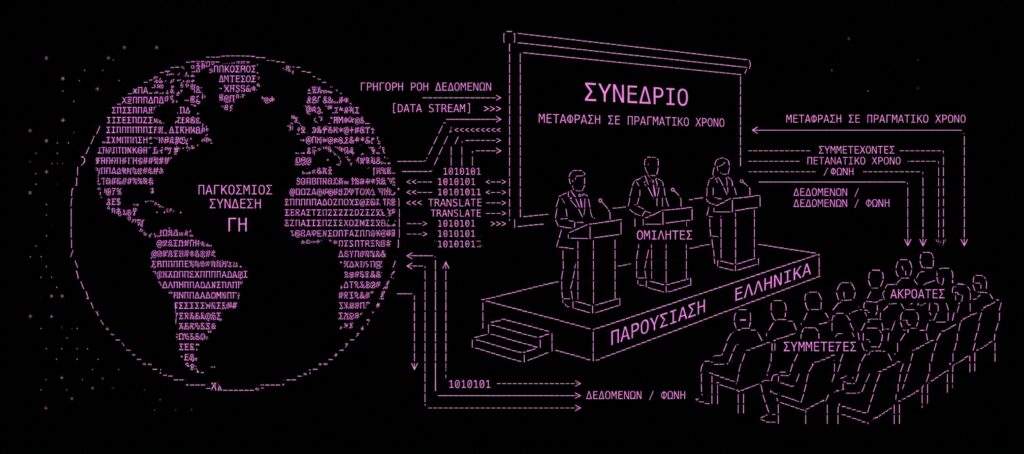
Athens climbed to 10th globally and 7th in Europe in the ICCA 2024 city rankings for international association meetings, jumping five places from the previous year and displacing Madrid from the top ten (ICCA, 2024 GlobeWatch Rankings). That ascent is not a statistical fluke. Greece hosted events that drew an estimated 40,300 international participants and generated more than 94 million euros in direct conference revenue for Athens alone in 2024 (GTP Headlines, May 2025). For event organizers working in this market, Greek event translation is no longer a niche concern. It is a logistical requirement for any serious gathering in the Eastern Mediterranean.
Greece sits at a crossroads that is geographic, linguistic, and strategic. An EU member state with deep ties to Southeastern Europe, the Middle East, and North Africa, the country hosts events spanning shipping, energy, democracy and governance, tourism, and technology. Its two major event cities, Athens and Thessaloniki, serve distinct roles in this ecosystem. And its language, with roughly 13 million speakers (Ethnologue, 2025), a unique non-Latin script, and a complex morphological system, presents interpretation and translation challenges that generic solutions handle poorly.
Greece’s Conference Landscape: Two Cities, One Ascendant Market
Athens: Top-Ten Global Conference City
Key venues include Metropolitan Expo Athens (hosts Posidonia); Megaron Athens International Conference Centre (2,000-seat purpose-built facility); and the Stavros Niarchos Foundation Cultural Center (SNFCC), the 861-million-dollar Renzo Piano-designed complex with the 1,400-seat Stavros Niarchos Hall. The Taekwondo Olympic Stadium conversion at Palaio Faliro will further expand capacity.
Thessaloniki: The Northern Gateway
Ranked 46th globally and 28th in Europe (ICCA 2024). The Thessaloniki International Exhibition Centre is undergoing a 120-million-euro redevelopment (completion targeted 2029). Thessaloniki will host the ICCA Mediterranean and France-Benelux Joint Chapter Meeting in June 2026.
Together, Athens and Thessaloniki form a dual-hub strategy that the Greek Meetings Alliance is actively promoting to position Greece as a leading European MICE destination (ICCA World, 2025).
Flagship Conferences: Where Greek Event Translation Matters Most
Posidonia International Shipping Exhibition is the world’s most important shipping event. The 2024 edition broke records with over 40,000 participants from 138 countries (Posidonia Events, 2024). The 2026 edition (June 1-5) is extending its footprint to three weeks of activities. Greece controls approximately 21% of the global merchant fleet, making Piraeus the undisputed center of global shipowning.
Delphi Economic Forum has become one of Southern Europe’s most influential policy conferences. The 11th annual meeting runs April 22-25, 2026, in the historic town of Delphi. The forum convenes heads of state, finance ministers, academic leaders, and business executives, with satellite events in Washington D.C., Paris, and Sydney.
Athens Democracy Forum, founded in 2012, convenes at the Athens Conservatoire each fall. The 2025 edition drew more than 460 participants. The 2026 edition is scheduled for September 29 to October 2.
Thessaloniki International Fair, the 90th edition running September 5-13, 2026, with Japan as the honored country. The 89th edition attracted 228,974 visitors and approximately 1,500 exhibitors.
Energy and East Mediterranean Events, including the Athens Energy Summit (15th edition in 2026), the GIE Annual Conference, and the Greek Offshore Renewable Energy Conference, draw international energy professionals and combine highly technical terminology with policy language.
Greek Language: Why It Challenges Event Translation
The Greek Alphabet and Script
Modern Greek uses the Greek alphabet: 24 letters with distinct uppercase and lowercase forms, plus a special final form for sigma. This is a non-Latin script, which means any captioning, subtitle, or real-time display system must render Greek characters correctly. Systems optimized for Latin alphabets sometimes mishandle diacritical marks (the tonos accent mark that indicates stress) or fail to render polytonic characters found in formal, academic, and liturgical contexts.
Morphological Complexity
Greek is a highly inflected language. Nouns decline across four cases (nominative, genitive, accusative, vocative) and three genders. Verbs conjugate across person, number, tense, aspect, voice, and mood. This has two implications for real-time translation:
- Latency in simultaneous interpretation. An interpreter or AI system may need to wait for a verb ending to determine the tense and aspect before rendering the equivalent in English.
- Higher error rates in automated speech recognition. Misrecognizing a word ending in Greek can change the entire meaning of a sentence.
The Diglossia Legacy
From the 19th century until 1976, Greece experienced linguistic diglossia: Katharevousa (formal) coexisting with Dimotiki (everyday vernacular). Although Dimotiki became the official language in 1976, the legacy persists. Legal texts, some academic writing, and older institutional language still incorporate Katharevousa forms. At events, a government minister may use archaic constructions while a tech startup founder uses Standard Modern Greek peppered with English loanwords.
A Scenario: The Multilingual Energy Conference in Athens
Consider a 500-person energy conference at the Megaron Athens International Conference Centre. The audience is 50% Greek-speaking (domestic energy companies, government regulators, and shipowners exploring LNG), 30% English-speaking (international energy majors, EU officials, and technology vendors), and 20% split across Turkish, Arabic, and French.
Traditional interpretation requires 8-10 interpreters across four language pairs, with specialized energy sector vocabulary. The cost for three days of booth interpretation: 35,000 to 50,000 euros.
How Snapsight handles this: Real-time transcription captures each session in its source language, then delivers live translation to each attendee’s device. The Greek minister’s keynote is transcribed with the morphological precision Greek demands, then rendered in English and Arabic simultaneously. After the event, AI-generated summaries synthesize insights across all sessions regardless of source language.
Snapsight has processed over 10,415 sessions across 627 events in 75+ languages. The platform operates 91% autonomously.
Industries Driving Greek Event Translation Demand
- Shipping and maritime. Greece is the world’s largest shipowning nation. Greek-English is the baseline pair, but the international nature of shipping means Mandarin, Japanese, Korean, and Norwegian are frequently required.
- Energy and infrastructure. Greece’s position as an East Mediterranean energy corridor creates a steady stream of energy conferences with audiences spanning Greece, Turkey, Israel, Egypt, and the broader EU.
- Tourism and hospitality. Greece welcomed over 30 million tourists in 2024. Events require Greek paired with German, French, Italian, and increasingly Mandarin.
- Governance and policy. The Athens Democracy Forum, Delphi Economic Forum, and EU events require the highest register of Greek interpretation: formal, precise, and politically sensitive.
Cultural Context for Event Organizers
- Scheduling. Greek events often start later than Northern European equivalents. Build buffer time into the program, especially for morning sessions.
- Hospitality. Coffee breaks and meals are where relationships are built. Allocate generous networking time.
- Religious and cultural calendar. Greek Orthodox Easter (different calendar than Western Easter) is the most important holiday. Avoid scheduling during Holy Week. August is a near-total business shutdown.
- Name days. Greeks celebrate name days as much as birthdays. A thoughtful gesture to acknowledge during events.
Frequently Asked Questions
Expect to pay between 800 and 1,200 euros per day per interpreter for Greek-English simultaneous interpretation in Athens. A standard two-interpreter booth for a full-day conference typically costs 2,000 to 3,000 euros per day including equipment. Specialized domains like shipping or energy command premium rates. A three-day event with four language pairs can exceed 40,000 euros for interpretation alone.
Modern AI speech recognition has made significant advances with Greek, but the language’s morphological complexity means accuracy depends heavily on the system. Snapsight’s real-time transcription is trained to handle Greek inflectional patterns, including case endings and verb conjugations that carry meaning. The key challenge is domain-specific vocabulary, as shipping terminology at Posidonia differs substantially from policy language at the Delphi Forum, and Snapsight’s models adapt to the domain context of each session.
Greek-English is the dominant pair at virtually every international event. Beyond that, shipping events frequently need Greek-Mandarin, Greek-Japanese, and Greek-Korean; energy events require Greek-Turkish and Greek-Arabic; tourism conferences add Greek-German, Greek-French, and Greek-Italian; and EU-oriented policy events may need Greek paired with any of the 24 official EU languages.
English proficiency is high among Greek professionals, particularly in shipping, technology, and international business. However, senior executives and government officials often prefer to present in Greek, especially for formal addresses and policy statements. Audience members may follow English presentations but engage more deeply with Greek-language content. For events with domestic Greek attendees, Greek-language support is expected, not optional.