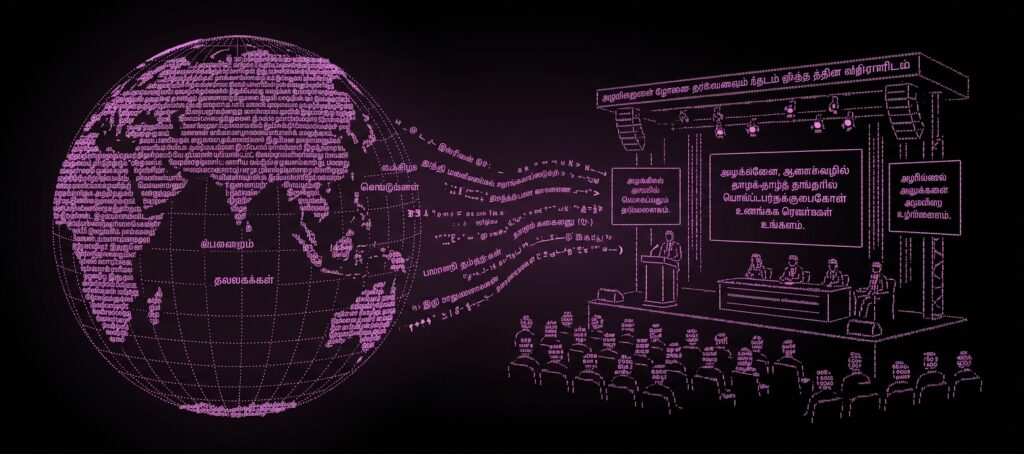
Tamil is one of the oldest continuously spoken languages on Earth. Its literary tradition stretches back more than 2,000 years, with the earliest Sangam literature dating to roughly the 3rd century BCE, and it was the first language to be officially designated a classical language of India by the central government in 2004 (Government of India, Ministry of Culture). Yet Tamil is not a museum artifact. It is the working language of Chennai, a city that manufactures over 30% of India’s automobiles, hosts the country’s second-largest IT services cluster after Bangalore, and is rapidly emerging as one of South Asia’s premier MICE destinations. With approximately 78 million native speakers and over 85 million total speakers worldwide according to Ethnologue (2025 edition), Tamil is spoken as an official language in three countries: India, Sri Lanka, and Singapore.
For event organizers bringing international conferences to Tamil Nadu, or for Tamil Nadu-based organizations hosting global audiences, the question of Tamil event translation is not an afterthought. It is the difference between an event that resonates with its full audience and one that excludes the majority of the room. Government officials, academic researchers, healthcare professionals, automotive engineers, and textile industry executives across Tamil Nadu operate in Tamil as their primary professional language.
Tamil Nadu’s Event Landscape: Scale, Sectors, and Global Ambition
Tamil Nadu’s MICE industry has grown at a compound annual growth rate of 9.3% over the past five years, driven by massive state government investment in infrastructure and industrial promotion (BW Hotelier, 2025). Chennai ranks among India’s top metro MICE hotspots, alongside Delhi, Mumbai, and Bangalore (ICE India, 2025).
Tamil Nadu Global Investors Meet (TNGIM)
The flagship investment event organized by the Government of Tamil Nadu, TNGIM has become one of India’s most significant business summits. The 2024 edition, held at Chennai Trade Centre on January 7-8, attracted 631 memoranda of understanding (MoUs) representing an investment commitment of Rs 6,64,180 crore, approximately USD 79 billion (TNGIM 2024 Official Report). A subsequent Investors Meet in Hosur in September 2025 secured 92 MoUs worth Rs 24,307 crore (approximately USD 2.74 billion), expected to generate over 49,000 jobs (WION News, 2025). International delegates presenting investment proposals to state officials and district-level administrators need Tamil translation to ensure their pitches land with the decision-makers who matter most.
Chennai International Film Festival (CIFF)
The 22nd edition of CIFF, organized by the Indo Cine Appreciation Foundation (ICAF), ran from December 12-19, 2024. Tamil Nadu’s film industry, Kollywood, produces roughly 300 films annually, making it India’s second-largest film production center after Bollywood. Film industry events, award ceremonies, and market sessions at CIFF require Tamil-English translation for the international guests, distributors, and journalists who attend alongside a predominantly Tamil-speaking local industry.
Auto Expo Component Show and Automotive Events
Chennai’s identity as the “Detroit of India” is backed by hard numbers: the city accounts for over 30% of India’s automobile production and roughly 40% of auto component manufacturing, with 60% of India’s automotive exports originating from Tamil Nadu (India-Briefing, 2025). The state produced over 400,000 of the one million EVs sold in India in 2023, accounting for 40% of national EV production and 68% of all EV two-wheelers (Acara Solutions, 2025). Providing Tamil translation for technical presentations directly affects whether a supplier demonstration converts into a purchase order.
Premier Event Venues: Infrastructure for Global Conferences
| Venue | Location | Capacity / Size | Best For |
|---|---|---|---|
| Chennai Trade Centre | Nandambakkam, Chennai | 10,560 sq m, 75+ event days/year | Investment summits, exhibitions |
| ITC Grand Chola | Chennai | 100,000 sq ft convention centre, 2,500 conference / 4,000 reception | Medical conferences, banking summits |
| CODISSIA Trade Fair Complex | Coimbatore | 160,000+ sq ft across 40 acres | Textiles, engineering, SME summits |
Events at CODISSIA draw a more heavily Tamil-speaking audience than Chennai, making Tamil translation even more essential for international participants.
The Tamil Language: Why Translation Demands Specialized Expertise
Tamil is not simply “another Indian language.” Its linguistic architecture presents specific challenges that generic translation platforms routinely mishandle.
A Unique Script with 247 Characters
The Tamil script consists of 12 vowels (uyir), 18 consonants (mei), 216 compound characters formed by combining consonants with vowels (uyirmei), and one special character (aaytha ezhuthu), totaling 247 characters. Unlike Devanagari (used for Hindi), Tamil script does not use conjunct characters or a connecting horizontal line (shirorekha). Each character is visually distinct, but the sheer number of compound forms means that rendering Tamil in real-time captioning systems requires font libraries and text-rendering engines specifically optimized for the script.
Agglutinative Grammar
Tamil is an agglutinative language, meaning grammatical relationships are expressed by adding suffixes to root words. There is no absolute limit on the length of agglutination, producing single words that would require an entire phrase or sentence in English. The word “pokamudiyadavarkalukkaaka” (for the sake of those who cannot go) is a single grammatical unit built from multiple morphemes. This agglutinative structure means that word-by-word translation produces nonsense. A translation system must parse the morphological structure to extract meaning.
Diglossia: Two Tamils in One
Critical challenge: Tamil exhibits one of the most pronounced cases of diglossia of any world language. Literary Tamil (centamil), used in formal writing, government communications, and public speeches, is structurally different from Colloquial Tamil (koduntamil), used in everyday conversation. The verb conjugations, pronouns, and even basic syntactic patterns differ substantially. At events, a government official delivering a keynote will use centamil; the same official networking over coffee will switch to koduntamil. Effective Tamil event translation requires models that handle both registers.
Three Countries, Three Dialects
Tamil is not monolithic across its geographies. Indian Tamil (particularly the Chennai and Madurai dialects), Sri Lankan Tamil (especially the Jaffna dialect), and Singapore Tamil have diverged significantly over centuries of separate development.
- Sri Lankan Tamil is notably more conservative, preserving features of Old Tamil that have disappeared from Indian dialects. The Jaffna Tamil dialect retains a three-way deictic distinction that all Indian Tamil dialects have reduced to a two-way system.
- Singapore Tamil has absorbed loanwords from English, Mandarin, and Malay, creating a distinct register.
Code-Switching with English
In professional settings across Chennai’s IT corridors, automotive boardrooms, and startup incubators, Tamil speakers routinely code-switch between Tamil and English, often within the same sentence. This Tamil-English code-switching pattern is analogous to the Hinglish phenomenon described in our Hindi event translation guide. A translation system that expects “pure” Tamil input will break on the English insertions; one expecting English will miss the Tamil grammatical scaffolding entirely.
Cultural Considerations for Event Organizers
Language as Identity
Tamil speakers have a deep cultural attachment to their language. Tamil Nadu is the only Indian state that successfully resisted the imposition of Hindi as a national language. Using Tamil in event communications, signage, and translation is not merely a practical convenience: it is a sign of respect that Tamil-speaking attendees will notice and appreciate.
Festival and Calendar Awareness
Pongal (mid-January), the Tamil harvest festival, is a four-day celebration during which business activity slows significantly. Tamil New Year (Puthandu, April 14) and Deepavali are similarly important. Government offices and many businesses observe these holidays strictly. International event organizers should consult the Tamil Nadu government holiday calendar.
Vegetarian Catering and Formal Register Expectations
Tamil event culture strongly emphasizes vegetarian catering, particularly at government and academic events. At government summits, academic conferences, and events involving senior officials, the use of formal Tamil (centamil) in translated materials is expected. Using colloquial Tamil in a government minister’s translated remarks would be perceived as disrespectful.
Practical Guidance: Planning Tamil Event Translation
- Assess your audience geography. If your event draws Tamil speakers exclusively from Tamil Nadu, standard Indian Tamil translation will suffice. If Sri Lankan Tamil or Singaporean Tamil speakers are part of your audience, discuss dialect accommodation with your translation provider.
- Prepare for code-switching. Brief your translation team on the technical domain of your event. Automotive, IT, healthcare, and textile events each have domain-specific English terminology that Tamil speakers will use within Tamil-language speech.
- Plan for diglossia. Formal sessions (keynotes, ministerial addresses, academic presentations) will use literary Tamil. Breakout sessions, workshops, and networking events will shift to colloquial Tamil.
- Test Tamil script rendering. Before going live, verify that your captioning and translation display systems render Tamil script correctly, all 247 characters, including the compound forms.
Snapsight’s platform, built on experience across 627+ events and 10,415+ sessions in 75+ languages with 91% autonomous operation, handles Tamil’s agglutinative grammar, diglossic registers, and code-switching patterns through models specifically trained on South Asian language data.
Frequently Asked Questions
Tamil has approximately 78 million native speakers and over 85 million total speakers worldwide, according to Ethnologue (2025). It is an official language in India (specifically Tamil Nadu and Puducherry), Sri Lanka, and Singapore, and is spoken by significant diaspora communities in Malaysia, Mauritius, South Africa, the UK, Canada, and the Gulf states.
Tamil’s combination of a unique 247-character script, agglutinative grammar that produces very long compound words, extreme diglossia between literary and colloquial registers, and significant dialect variation across India, Sri Lanka, and Singapore creates a uniquely challenging translation environment. Unlike Hindi or Bengali, Tamil belongs to the Dravidian language family rather than the Indo-Aryan family, meaning its grammatical structure is fundamentally different from North Indian languages.
Yes. While English is widely used in Chennai’s corporate and IT sectors, many attendees at trade fairs, government summits, and industry conferences, particularly those from Tier-II cities like Coimbatore, Madurai, Salem, and Tiruchirappalli, are more comfortable engaging in Tamil. Government officials at events like the Tamil Nadu Global Investors Meet frequently operate in Tamil. Providing translation expands your effective audience reach and improves engagement quality.
Sri Lankan Tamil, particularly the Jaffna dialect, preserves archaic features of Old Tamil that have been lost in Indian dialects. The differences extend to pronunciation, vocabulary, and some grammatical structures. While there is a degree of mutual intelligibility, the Jaffna dialect can be challenging for Indian Tamil speakers unfamiliar with it. For events drawing attendees from both India and Sri Lanka, dialect-aware translation planning is recommended.
Most large conferences in Tamil Nadu require at minimum English-Tamil bilingual support. Events with international delegates may need additional languages. A platform supporting 75+ languages allows organizers to offer Tamil alongside English, Hindi, and any other languages relevant to their attendee base, all from a single integrated system rather than managing multiple interpretation vendors.