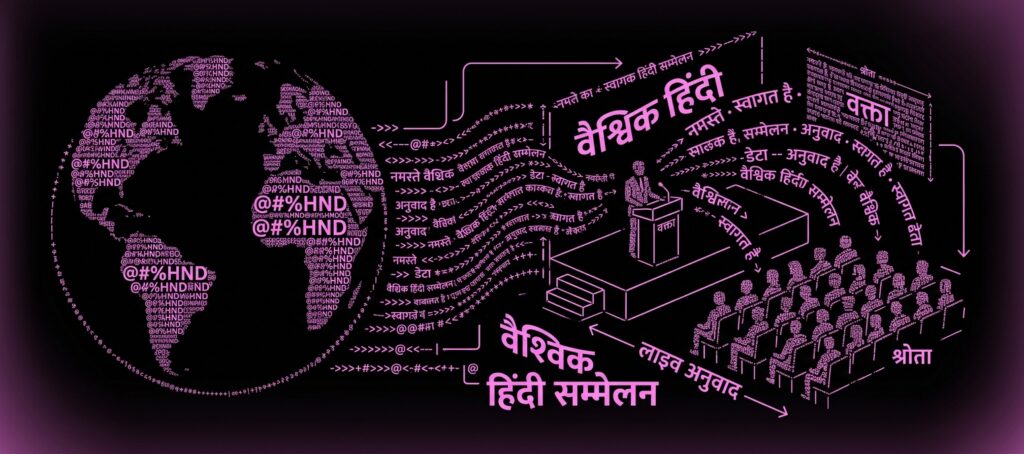
India’s MICE market was valued at USD 49.4 billion in 2024 and is projected to reach USD 103.7 billion by 2030 (Union Ministry of Tourism, 2025), and nearly every major event in the country faces the same unspoken tension: the conference runs in English, but more than half the audience would engage more deeply in Hindi. With 345 million native speakers and 609 million total speakers worldwide (Ethnologue, 2025), Hindi event translation is not a niche requirement. It is the bridge between India’s English-medium professional class and the vast majority of its population, and getting it right determines whether your event connects with its audience or merely performs for it.
India hosted enough international association meetings in 2024 to place in the ICCA’s top ten for the Asia-Pacific region, with New Delhi alone ranking 61st globally with 39 qualifying meetings (ICCA, 2024 Country and City Rankings). But those ICCA numbers only scratch the surface. Events like Vibrant Gujarat Global Summit draw 130,000 registered participants from 140 countries. India Mobile Congress attracted over 150,000 visitors and 7,000 delegates in 2025. These are massive, multilingual, and growing fast.
Government backing: The Union Ministry of Tourism announced the establishment of city-level convention promotion bureaus beginning in 2026, operating as public-private partnerships to serve as single-window facilitators for event organizers (PIB, 2025). The stated goal: to double India’s share of the global MICE market within five years.
The Hindi Paradox: English Events, Hindi Audiences
India is one of the world’s most linguistically diverse countries, with 22 officially recognized languages under the Eighth Schedule of the Constitution. Hindi is the most widely spoken among them, used by 52.83% of the population. English serves as a subsidiary official language and dominates professional, corporate, and academic contexts.
This creates what seasoned event organizers in India call the Hindi paradox. Most conferences, summits, and trade events in India conduct their formal proceedings in English. But a significant portion of attendees, including government officials from Hindi-belt states, mid-career professionals, regional business leaders, exhibitors from smaller cities, and media representatives, would absorb and engage with the content far more effectively in Hindi.
For international event organizers bringing global content to Indian audiences, the implication is clear: providing Hindi translation does not just check an accessibility box. It fundamentally changes how your event lands. Audience participation increases. Questions during Q&A sessions become more substantive. Post-event content consumption reaches a wider segment of your attendee base when available in Hindi.
India’s Major Events: Where Hindi Translation Matters Most
Government and Investment Summits
Vibrant Gujarat Global Summit is India’s flagship investment event, held biennially in Gandhinagar. The 2024 edition drew 130,000 participants from 140 countries, and the Gujarat state government allocated Rs 175 crore (approximately USD 21 million) for the 2026 edition. While plenary sessions feature heads of state and global CEOs presenting in English, the regional conferences and exhibitions that run in parallel operate heavily in Hindi and Gujarati.
India Energy Week, organized under the aegis of the Ministry of Petroleum and Natural Gas, is Asia’s premier energy event. The 2025 edition featured 700+ exhibitors, 550+ speakers, and ministers from over 20 countries. Energy sector events in India draw a mix of global executives and Indian PSU leaders who present in English but network in Hindi.
Technology and Innovation Conferences
India Mobile Congress is Asia’s largest technology event, held at New Delhi’s Yashobhoomi Convention Centre. The 2025 edition hosted over 150,000 visitors and 7,000 global delegates from 150+ countries. Prime Minister Modi inaugurated the event, addressing the audience in Hindi, a reminder that even at India’s most internationally oriented tech summit, Hindi is the language of political leadership.
NASSCOM Technology & Leadership Forum is India’s premier IT industry summit, bringing together over 1,600 CXOs and thought leaders. While the IT industry operates primarily in English, NASSCOM’s broader membership includes firms from Tier-II cities where Hindi is the first language of many technology professionals.
Life Sciences, Automotive, and Aerospace
BioAsia, held annually in Hyderabad, hit a record 4,000 delegates and 500+ companies in its 2026 edition. Auto Expo, held at Greater Noida’s India Expo Mart, draws a massive domestic audience from North India for whom Hindi is the primary business language. Aero India, held at Bangalore’s Yelahanka Air Force Station, draws military and government delegations that operate in Hindi.
The Hinglish Challenge: Why Hindi Event Translation Is Uniquely Complex
Code-Switching and Hinglish
The most distinctive feature of Hindi in professional contexts is pervasive code-switching between Hindi and English, commonly called “Hinglish.” A speaker at an Indian tech conference might deliver a sentence that is grammatically Hindi but contains English technical terms, brand names, and industry jargon, sometimes switching mid-clause.
This creates a significant challenge for both human interpreters and AI translation systems. A system trained to translate “pure” Hindi will stumble on the English insertions. A system expecting English will miss the Hindi grammatical framework. Handling Hinglish accurately requires models specifically trained on code-mixed data (ACL Anthology, 2022). Snapsight’s transcription engine is built to handle this kind of code-switching, recognizing the mixed-language input and producing coherent output in whichever target language the attendee selects.
Devanagari Script and Real-Time Captioning
Hindi is written in the Devanagari script, which presents specific challenges for real-time captioning at events. The script is an abugida (each character represents a consonant with an inherent vowel), characters combine in complex conjunct forms, and the horizontal line (shirorekha) connecting characters means that rendering must be handled differently from Latin-script languages.
Regional Variation and the 22-Language Context
While Hindi is the most widely spoken language in India, event organizers must understand that India has 22 officially recognized languages, and attendees from South India (Tamil, Telugu, Kannada, Malayalam speakers), Northeast India (Assamese, Bengali speakers), and other regions may not speak Hindi. For a truly inclusive event, Hindi translation is necessary but not always sufficient. Snapsight’s support for 75+ languages means you can serve attendees from Tamil-speaking Chennai and Bengali-speaking Kolkata alongside the Hindi-speaking majority.
India’s Premier Event Venues
| Venue | City | Capacity / Key Features |
|---|---|---|
| Bharat Mandapam (IECC, Pragati Maidan) | New Delhi | 7,000-seat main hall, 3,000-seat amphitheater, 150,000 sqm exhibition space |
| Yashobhoomi (IICC, Dwarka) | New Delhi | 107,000 sqm Phase 1, 15 halls seating 11,000 total. Asia’s largest convention center. |
| Jio World Convention Centre | Mumbai (BKC) | Corporate and financial event circuit |
| BIEC (Bangalore International Exhibition Centre) | Bangalore | Technology, aerospace, and manufacturing events |
| HICC (Hyderabad International Convention Centre) | Hyderabad | BioAsia, pharmaceutical industry events |
A Scenario: The Multilingual Reality of an Indian Global Summit
Consider this scenario: you are organizing a 3-day investment summit at Yashobhoomi in New Delhi. Your event brings together 2,500 attendees: international investors from the US, UK, Japan, and the Gulf; Indian business leaders from Mumbai, Delhi, and Bangalore; state government officials from Uttar Pradesh, Rajasthan, and Madhya Pradesh; and exhibitors from manufacturing hubs in Ludhiana, Kanpur, and Ahmedabad.
Your keynote speakers include an American private equity partner presenting in English, a Union Minister who will deliver remarks in Hindi, a Japanese automotive executive presenting through an interpreter, and an Indian industrialist who will deliver a classic Hinglish presentation.
Traditional interpretation would require separate Hindi-English, Japanese-English, and potentially Japanese-Hindi interpreter teams for each room. The cost for 12-16 interpreters across three days, including booth rental and equipment, easily exceeds USD 30,000.
How Snapsight handles this: Real-time transcription captures each session in its source language, including Hinglish presentations where the system’s code-switching models maintain accuracy across the Hindi-English boundary. The Union Minister’s Hindi remarks are available in English and Japanese within seconds. The Hinglish presentations are rendered into clean Hindi or clean English based on the attendee’s selection. After the summit, AI-generated summaries synthesize insights across all sessions and language tracks.
Snapsight has processed over 10,415 sessions across 627+ events in 75+ languages. The platform operates at 91% autonomy, meaning your team is in the room building relationships, not managing interpretation logistics.
Cultural Context: What Event Organizers Need to Know
- Audience scale and VIP protocols. Indian events tend to be large. Inaugural ceremonies feature elaborate protocols: the lighting of a ceremonial lamp (deep prajwalan), garland exchanges, and formal welcomes. Hindi is the language of government ceremony.
- Networking culture. Indian business culture is relationship-driven. The real business happens during networking breaks, over chai in exhibition halls, during lunch, at evening receptions. These interactions happen primarily in Hindi.
- Scheduling considerations. India’s event calendar must account for Republic Day (January 26), Independence Day (August 15), Diwali, Holi, Eid, Navratri, and extreme weather. The peak MICE season in North India runs from October to March.
Industries Driving Hindi Event Translation Demand
IT & Digital Transformation
India’s push to digitize government services and rural economies means an expanding audience of mid-level officials and regional tech entrepreneurs who operate in Hindi.
Energy & Infrastructure
India is the world’s third-largest energy consumer. PSU executives and state-level officials frequently present and negotiate in Hindi, making Hindi-English translation essential for international participants.
Pharmaceuticals & Life Sciences
India manufactures over 60% of the world’s vaccines and is the largest provider of generic medicines globally. Hindi translation bridges the gap between India’s vast pharma workforce and international partners.
Automotive & Manufacturing
India is the world’s third-largest automobile market. Events like Auto Expo draw exhibitors and buyers from India’s industrial heartland, the Hindi-speaking states that are the backbone of Indian manufacturing.
Frequently Asked Questions
Traditional human simultaneous interpretation for Hindi-English at a multi-day conference in India typically costs between USD 15,000 and USD 35,000, depending on the number of rooms requiring coverage, session hours per day, and the technical complexity of the content. Specialized domains like pharmaceuticals, energy, or legal proceedings command premium rates. AI-powered solutions like Snapsight can significantly reduce these costs while extending coverage to every session simultaneously.
Code-switching between Hindi and English (Hinglish) is one of the most challenging aspects of Hindi event translation. Standard machine translation models trained on monolingual data frequently fail when encountering mixed-language input (ACL Anthology, 2022). Snapsight’s transcription engine is specifically trained on code-mixed data patterns common in Indian professional settings, enabling it to process Hinglish presentations and produce coherent output in either Hindi or English based on the attendee’s language preference.
It depends on your audience composition. While Bangalore and Hyderabad have local languages (Kannada and Telugu, respectively), events that draw national audiences, such as BioAsia in Hyderabad or Aero India near Bangalore, include significant contingents from Hindi-speaking states. For national or international events in these cities, offering Hindi alongside English and the local language provides the most inclusive coverage.
Government events in India frequently feature formal Hindi (Shuddh Hindi or Sanskritized Hindi) that differs significantly from conversational Hindi. This register uses complex vocabulary drawn from Sanskrit and avoids English loanwords, the opposite of Hinglish. Your translation solution must handle both registers: the formal Hindi of ministerial addresses and the Hinglish of industry panel discussions. Ensure your provider or platform has been tested on formal government Hindi, not just conversational data.
For a national-level event in India, plan for a minimum of Hindi and English. For events drawing international delegates, add the relevant foreign languages (Japanese, Korean, Arabic, French, German, depending on your delegate profile). For events in non-Hindi-speaking regions, add the local state language. A large Indian summit may realistically need 4-6 language tracks. Snapsight supports 75+ languages simultaneously, allowing you to cover every language requirement from a single platform.