Slovakia manufactured 993,000 vehicles in 2024, reaching 182 cars per 1,000 inhabitants, the highest per-capita car production on the planet (SARIO, 2025). Four global automakers operate assembly plants within a country of 5.4 million people, and the supply chain conferences, engineering summits, and trade exhibitions that orbit this industry generate a constant stream of multilingual events where Slovak event translation is not a nice-to-have but a production requirement. Add GLOBSEC, one of Central and Eastern Europe’s most influential security forums, the ITAPA digital governance congress, and Bratislava’s growing reputation as a compact, accessible conference city on the Danube, and Slovakia punches well above its weight in the MICE world.
Yet Slovak remains one of the most overlooked languages in the event translation space. With approximately 5 million native speakers worldwide (Ethnologue, 2024) and a diaspora concentrated in the Czech Republic, the United States, Hungary, and Western Europe, the language occupies a curious position: small enough that most global event platforms ignore it, important enough that getting it wrong at a Bratislava automotive summit or a High Tatras leadership retreat can derail the entire experience.
Slovakia’s Conference Landscape: Small Country, Outsized Impact
Slovakia’s event scene is shaped by three forces: the automotive juggernaut, the IT and shared-services sector that has turned Bratislava into a Central European tech hub, and a government that actively promotes Slovakia as a destination for international forums.
The Automotive Circuit
The automotive industry contributes roughly 13% of Slovakia’s GDP and directly employs about 275,000 workers across four major assembly plants: Volkswagen in Bratislava, Stellantis in Trnava, Kia in Zilina, and Jaguar Land Rover in Nitra, supported by over 365 domestic suppliers (SARIO, 2025). This concentration generates a robust calendar of industry events. The Automotive Industry Conference, organized annually by the Slovak Automotive Industry Association (ZAP), draws OEM executives, Tier 1 suppliers, and government officials to discuss electrification timelines, supply chain resilience, and workforce development. Volvo Cars has announced plans for a new plant in Kosice with production expected by 2027, adding yet another manufacturer to the ecosystem and another set of supplier conferences to the Slovak calendar.
The multilingual reality: A typical automotive supplier summit in Bratislava might feature German-speaking VW executives, Korean-speaking Kia engineers, British Jaguar Land Rover representatives, and Slovak government officials, all in the same plenary session. Traditional interpretation setups struggle with this four-language complexity, and staffing Korean-Slovak interpreters in Central Europe is a months-long procurement exercise.
GLOBSEC and the Security Forum Circuit
GLOBSEC, the Bratislava-based think tank, has established itself as one of the leading strategic security platforms in the CEE region since its founding in 2005 (GLOBSEC, 2025). The annual GLOBSEC Forum in Bratislava draws heads of state, defense ministers, and foreign policy leaders from across NATO and EU member states. The GLOBSEC Tatra Summit, held each October at Strbske Pleso (the highest village in Slovakia, on the banks of a glacial lake in the High Tatras) convenes approximately 150 C-suite business leaders, OECD officials, and political decision-makers in an exclusive, invitation-only format (GLOBSEC, 2025). The 2025 edition was co-chaired by Mathias Cormann, Secretary-General of the OECD; Thierry Deau, CEO of Meridiam; and Gordon Bajnai, former Prime Minister of Hungary.
Events of this caliber require flawless multilingual support. Delegates speak Slovak, English, German, French, and Hungarian, often switching mid-panel. The intimate format of the Tatra Summit (think alpine conference rooms, not convention center halls) makes traditional booth-based simultaneous interpretation impractical.
ITAPA and the Digital Governance Track
Since 2002, the ITAPA (Information Technologies and Public Administration) congress has been Slovakia’s flagship technology event, running under the auspices of top government representatives (ITAPA, 2026). The congress features nearly 100 speakers across more than 10 panel sessions, dozens of keynotes, and open discussions focused on eGovernment trends and solutions. The 2025 program included ITAPA AI, a dedicated event on artificial intelligence held at Bratislava Castle. For 2026, ITAPA has scheduled events in June and November in Bratislava. These events attract EU digital policy officials, international technology vendors, and Slovak civil servants, a mix that demands Slovak-English interpretation at minimum, with German and French frequently needed for EU institutional speakers.
Key Venues: Where Slovak Events Happen
Incheba Expo Bratislava is Slovakia’s largest exhibition center, offering 60,000 square meters of indoor space and 40,000 square meters of outdoor area, with the flexibility to host events from 50 to 50,000 participants. The venue welcomes approximately 1 million visitors annually across 120 events, and the Incheba Expo Arena seats up to 5,500 (Incheba, 2025). Automotive trade shows, technology expos, and government forums regularly use this venue.
The National Tennis Centre in Bratislava and the X-bionic Sphere in Samorin (just south of Bratislava) have emerged as mid-size conference venues that combine meeting facilities with sport and wellness infrastructure, appealing to the incentive and corporate retreat segment.
For more intimate gatherings, Bratislava Castle itself serves as an event venue, as demonstrated by the ITAPA AI 2025 program. The castle’s location above the Danube, with views stretching to Austria, makes it a distinctive backdrop for high-level forums.
The Slovak Language: What Event Organizers Need to Know
Slovak belongs to the West Slavic branch of the Indo-European language family, closely related to Czech and Polish. But “closely related” masks real complexity that matters for event translation.
The Rhythm Rule
Slovak is the only Slavic language that enforces a “rhythmic law,” a phonological constraint that prohibits two adjacent long syllables (Slovak Academy of Sciences). This means that suffixes and word forms change depending on the length of the preceding syllable, creating patterns that AI speech recognition models trained primarily on Czech or Polish will mishandle. For live transcription, this matters: an algorithm that does not account for the rhythm rule will produce garbled suffixes, turning technical terminology into nonsense.
Diacritics and the Alphabet
Slovak uses two distinct diacritical systems: the haciky (carons, e.g., c, s, z) that modify consonant pronunciation, and the dlzne (acute accents, e.g., a, e, i, o, u, l, r) that indicate vowel and consonant length. Slovak is notable for having two L-characters with diacritics: the syllabic l (long L) and l with a caron (soft L). Dropping or misplacing these marks is not a cosmetic error; it changes meaning. “Sud” means barrel; “sud” with an acute accent means court. For event captioning displayed on screens, correct diacritical rendering is essential.
Czech-Slovak Mutual Intelligibility, and Its Limits
Most varieties of Czech and Slovak are mutually intelligible, forming a dialect continuum that spans intermediate Moravian dialects (Language Sciences, 2023). Standardized forms are easily distinguishable through vocabulary, orthography, pronunciation, and morphology. However, eastern Slovak dialects are structurally different from both standard Slovak and Czech, and intelligibility drops significantly. An event organizer who assumes a Czech interpreter can cover Slovak attendees may find that it works for attendees from Bratislava but fails for those from Kosice or Presov. This is a common and costly mistake in Central European event planning.
Six Cases, Three Genders
Slovak has six grammatical cases, three genders (with masculine further divided into animate and inanimate), and a formal/informal register distinction that governs how speakers address each other at events. A Slovak government minister expects the formal “vy” register; switching to informal “ty” signals either intimacy or disrespect.
Palatal Consonants
Slovak uses palatal consonants more frequently than Czech, giving the language a phonetically “softer” quality (Polilingua, 2025). It also features diphthongs (ia, ie, iu, uo) that Czech lacks. For speech recognition, this softer articulation means models trained on Czech audio will systematically misrecognize Slovak phonemes.
The Scenario: A Four-Language Automotive Supplier Summit
Imagine you are organizing a two-day automotive supplier conference at Incheba Expo Bratislava. You have 800 attendees: 45% Slovak-speaking (local OEM staff, government officials, domestic suppliers), 25% German-speaking (VW and Stellantis executives from headquarters), 20% English-speaking (Jaguar Land Rover representatives, international consultants), and 10% Korean-speaking (Kia engineers and management from Hyundai Motor Group). Your program includes a plenary with the Slovak Economy Minister, six parallel breakout sessions on EV battery supply chains, and a networking dinner with toasts in Slovak.
Traditional RSI for this setup requires 8-12 interpreters across four language pairs (Slovak-German, Slovak-English, German-English, Korean-English, and ideally Korean-Slovak), at a cost that can exceed EUR 35,000 for the event. Finding Korean-Slovak interpreters in Central Europe means flying in specialists from Seoul or Vienna, adding travel and accommodation costs. And parallel breakout sessions multiply the staffing requirement.
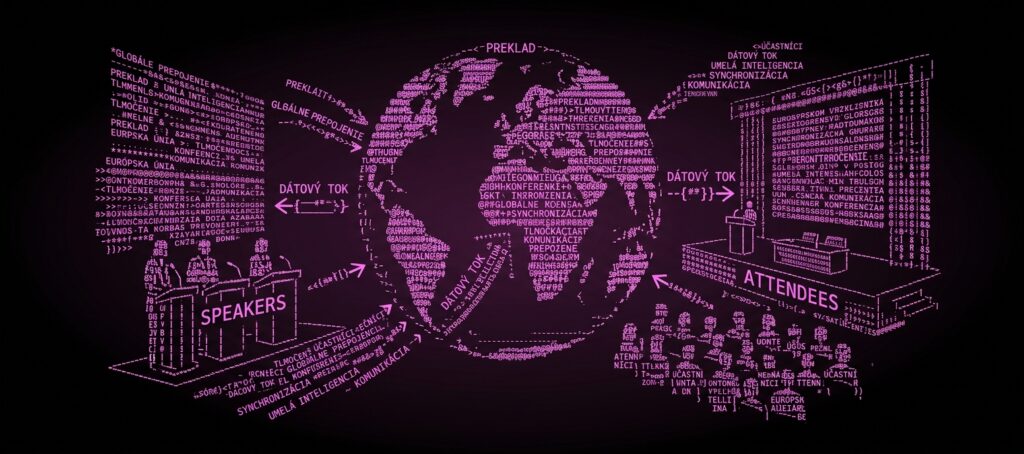
How Snapsight handles this: Rather than staffing a dozen interpreters, Snapsight’s real-time transcription captures each session in its source language and delivers live translation to every attendee’s device: Slovak, German, English, and Korean simultaneously. The Slovak Economy Minister’s keynote, delivered in rapid Slovak with six-case morphological density, is transcribed with proper diacritical rendering and translated into all three target languages in real time. After the event, AI-generated summaries synthesize insights across all six breakout sessions, regardless of source language, delivering a unified intelligence report to every attendee in their preferred language.
With 627 events powered, 10,415 sessions transcribed across 75+ languages, and 91% autonomous operation, Snapsight handles the linguistic complexity of Central European events without requiring your team to manage interpreter logistics, equipment setup, or post-event content processing.
Industries Driving Slovak Event Translation Demand
Automotive Manufacturing and EV Transition
As the world’s largest per-capita car producer, Slovakia’s automotive events are inherently international. The transition to electric vehicles has added urgency: Volvo’s planned Kosice plant, Stellantis’s EV production in Trnava, and VW’s electric model lines in Bratislava all generate conferences on battery technology, charging infrastructure, and workforce reskilling that draw speakers from across Europe and Asia.
IT and Shared Services
Bratislava has become a Central European hub for IT shared services, with companies including IBM, Dell, AT&T, Accenture, and Swiss Re operating centers in the city. The ITAPA congress and events like SlovakiaTech bring together local IT professionals with international partners, creating demand for Slovak-English interpretation in technical contexts where vocabulary precision matters.
Energy and Green Transition
Slovakia’s energy sector, including the Mochovce nuclear power plant expansion and growing renewable energy investment, generates conferences where Slovak, English, and French (due to French nuclear industry involvement) are the primary languages. The Central European Energy Conference, held periodically in Bratislava, addresses cross-border energy infrastructure connecting Slovakia with Austria, Hungary, the Czech Republic, and Poland.
Tourism and Cultural Heritage
Slovakia’s Tokaj wine region (shared with Hungary), High Tatras mountain tourism, and UNESCO-listed sites like Vlkolinec and Spissky Castle drive a tourism conference circuit that intersects with the broader Central European hospitality industry. Events like the Bratislava Economic Forum and regional tourism summits require Slovak-English and Slovak-German language support.
Cultural Norms for Event Organizers
Slovak business culture blends Central European formality with genuine hospitality. A few considerations for event planners:
- Punctuality matters but flexibility is expected. Slovak professionals arrive on time for formal sessions but expect networking breaks to run long. Build buffer time into your agenda.
- Wine culture is serious. Slovakia’s Tokaj region produces wines that rival Hungarian Tokaji, and offering Slovak wine at event dinners signals cultural awareness. A toast (“Na zdravie!”) is expected at formal dinners.
- The handshake and greeting hierarchy. In formal settings, wait for the more senior person to initiate a handshake. Use academic and professional titles (Ing., Dr., Prof.) until invited to use first names.
- Smaller but personal. Slovak events tend to be smaller than those in Prague or Vienna, but the networking is deeper. Attendees expect to have substantive conversations, not just exchange business cards.
Frequently Asked Questions
Professional Slovak-English simultaneous interpretation typically costs EUR 800-1,200 per interpreter per day in Bratislava, with a minimum of two interpreters required per language pair for sessions longer than one hour. For multi-language events (adding German and Korean), costs escalate rapidly. A two-day, four-language event can exceed EUR 35,000 including equipment rental. AI-powered solutions like Snapsight can reduce these costs by 60-80% while supporting all four languages simultaneously.
For standard Slovak speakers from western Slovakia, Czech interpretation is often partially intelligible. However, attendees from eastern Slovakia (Kosice, Presov regions) speak dialects that diverge significantly from Czech. More importantly, using Czech for Slovak government officials or corporate executives can be perceived as dismissive of Slovak national identity, a sensitivity that intensified after the 1993 separation of Czechoslovakia. For professional events, dedicated Slovak language support is strongly recommended.
Slovak-English is the dominant pair, followed by Slovak-German (driven by the automotive and financial sectors). Slovak-Hungarian is important for events in southern Slovakia, where a significant Hungarian-speaking minority resides. Korean-Slovak and French-Slovak are emerging pairs driven by automotive investment and EU institutional events, respectively.
Snapsight’s Slovak language model is trained on native Slovak speech data, handling the full diacritical system (haciky, dlzne) and the rhythmic law that governs syllable-length alternation. Transcriptions render all accented vowels and modified consonants correctly, which is critical for on-screen captioning at conferences where attendees read along in real time.
Bratislava is exceptionally accessible: 60 kilometers from Vienna International Airport (a 45-minute drive), with direct rail connections to Vienna, Budapest, and Prague. Incheba Expo offers 60,000 square meters of indoor space for up to 50,000 participants. The city’s compact size means most conference hotels, restaurants, and venues are within a 15-minute radius. Costs are significantly lower than Vienna or Prague, typically 30-40% less for comparable venue and hotel quality.