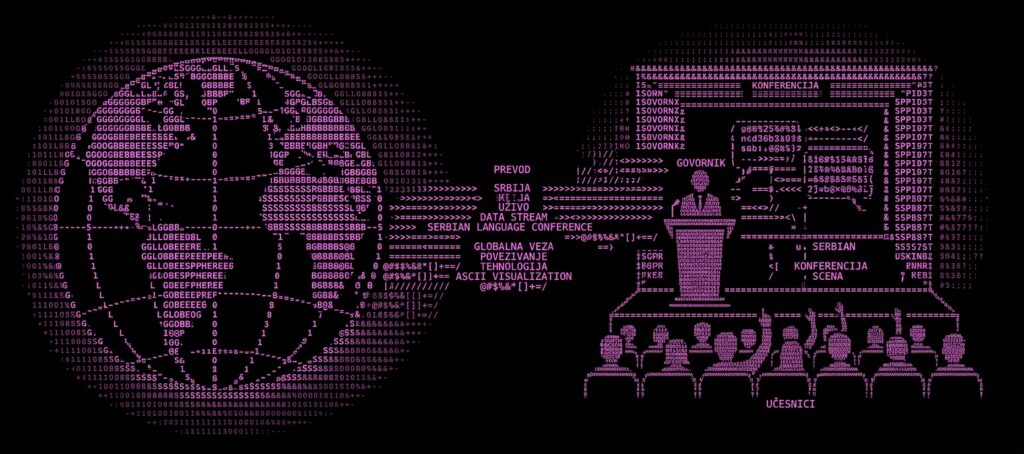
Serbian is the only European language written in two fully parallel scripts, Cyrillic and Latin, with both constitutionally official and in daily simultaneous use. That single fact makes Serbian event translation fundamentally different from every other language on this list. When the Belgrade Security Forum draws diplomats and defense analysts from 60+ countries each October, or when the Stellantis plant in Kragujevac hosts automotive supply chain summits for European OEMs, translation systems face a challenge that goes far beyond vocabulary: they must handle a language where even the choice of alphabet carries political and cultural weight.
Serbia’s IT exports surpassed $4.3 billion in 2024, a 20% year-over-year increase that now represents nearly 10% of national GDP. Belgrade and Novi Sad are climbing startup ecosystem rankings across Central and Eastern Europe. As the country accelerates its EU accession path and positions itself as a technology outsourcing hub, international conferences in Belgrade are multiplying, and with them, the demand for Serbian event translation that understands the linguistic, political, and cultural layers that make this market unique.
The Serbian-Speaking Conference Market: Where Events Happen
Belgrade: The Western Balkans’ Conference Capital
Belgrade’s convention infrastructure is anchored by three major venues:
| Venue | Capacity / Details | Typical Events |
|---|---|---|
| Sava Centar | 69,720 sqm usable space, 4,000-seat theater, 15 conference halls | Belgrade Security Conference, diplomatic forums, government summits |
| Belgrade Fair (Beogradski Sajam) | 16 halls, 300,000+ sqm total space | HORECA hospitality fair, Belgrade Book Fair, agricultural expos |
| Stark Arena | 18,386 capacity, multi-purpose | Large-scale cultural events, Eurovision 2008, sports championships |
Belgrade hosts a steady stream of international forums. The Belgrade Security Forum (BSF), organized annually since 2011, brings together government representatives, academics, and NGO leaders from across Europe to debate Balkan and European security policy. The Belgrade Security Conference held at Sava Centar in November 2025 featured the theme “Pathways to Freedom” with three days of multilingual programming. Both events routinely require Serbian-English interpretation as baseline, with French, German, and Russian also in demand.
The technology conference scene is growing rapidly. Copy Paste Conference serves Serbia’s design and digital community. The Cyber Security Summit in Belgrade has become an annual gathering for IT security professionals across Southeastern Europe. Serbia’s national delegation brought 25 startups to Web Summit 2025, and the country was named a Future Digital Economy Partner Country at GITEX Global 2025 in Dubai.
Novi Sad and Beyond
Novi Sad, Serbia’s second city and European Capital of Culture in 2022, hosts the Novi Sad Fair convention center and is home to EXIT Festival, which drew approximately 200,000 visitors annually. Other conference cities include Nis (electronics and university conferences), Kragujevac (automotive industry events near the Stellantis/Fiat plant), and Zlatibor/Kopaonik (mountain resort conferences, particularly popular for corporate retreats and IT industry gatherings).
Why Serbian Events Need Dedicated Translation
Speaker Population and Regional Reach
Serbian has approximately 12 million speakers worldwide (Ethnologue, 2024), distributed across Serbia (~6.7 million), Bosnia and Herzegovina (~1.5 million), Montenegro (~250,000), Kosovo (Serbian-speaking minority), and a diaspora of ~800,000, with major communities in Germany (~200,000), Austria, Switzerland, the United States, Canada, Australia, and Sweden.
Industries Driving Conference Demand
- Technology and IT outsourcing. Serbia’s IT sector employs over 125,000 professionals across more than 4,000 companies. IT exports grew from EUR 900 million in 2016 to an estimated $5 billion in 2025. The Science Technology Park Belgrade has supported over 240 early-stage tech companies.
- Automotive manufacturing. The Stellantis plant in Kragujevac produces the Fiat Grande Panda, Serbia’s first serial production of electric vehicles. The EUR 190 million modernization project employs approximately 6,000 workers.
- Agriculture and food. Vojvodina is one of Europe’s most fertile agricultural regions. The HORECA fair and agricultural expos at Belgrade Fair attract participants from across the Balkans.
- Energy and mining. Serbia is investing in lithium mining, renewable energy, and regional energy interconnection. Energy conferences draw multilingual audiences requiring Serbian alongside English, German, and Chinese.
- Security and diplomacy. Given Serbia’s position between EU accession talks, historical ties with Russia, and growing Chinese investment, Belgrade has become a hub for geopolitical conferences where multilingual capability is the substance of the event itself.
The Dual-Script Challenge: What Makes Serbian Translation Unique
Full Synchronic Digraphia
Serbian is the only European language with full synchronic digraphia, the simultaneous, interchangeable use of two complete writing systems. The Serbian Cyrillic alphabet (30 letters) and Gaj’s Latin alphabet have a perfect one-to-one character correspondence.
The script choice is never neutral: Official government documents constitutionally use Cyrillic. Business and technology contexts overwhelmingly use Latin. Media splits roughly evenly, with online content skewing Latin. Academic and literary traditions vary by institution and generation. For event translation, this creates a decision most vendors never consider: which script should live captions use? At a Belgrade Security Conference with government officials, Cyrillic is expected. At a tech startup summit, Latin is the default. Get it wrong, and your translation signals cultural ignorance before anyone reads a single word.
Serbian, Croatian, Bosnian, Montenegrin: The Pluricentric Minefield
Serbian, Croatian, Bosnian, and Montenegrin are linguistically four standard varieties of a single pluricentric language, with mutual intelligibility that “exceeds that between the standard variants of English, French, German, or Spanish.” Yet they are politically, legally, and emotionally separate languages. A regional conference in Belgrade that draws attendees from Zagreb, Sarajevo, and Podgorica is technically using one language, but every native speaker can instantly identify which country a translation came from.
| Feature | Serbian | Croatian | Bosnian |
|---|---|---|---|
| Script | Cyrillic + Latin | Latin only | Latin (primarily) |
| “Bread” | hleb | kruh | hljeb |
| “History” | istorija | povijest | historija |
| “Airport” | aerodrom | zracna luka | aerodrom |
| Pronunciation | Ekavian (Belgrade) | Ijekavian (Zagreb) | Ijekavian (Sarajevo) |
A translation system that lumps these together as “Serbo-Croatian” will offend audiences in every country.
Grammatical Complexity
Serbian has seven grammatical cases, three genders, two numbers, and a verb aspect system (perfective/imperfective) that changes meaning in ways English speakers find opaque. Technical vocabulary at automotive or IT conferences often uses calques from English that have not been standardized, and a translation system must handle these variants without breaking.
Scenario: A Three-Day Automotive Supply Chain Summit in Kragujevac
Imagine you are organizing a three-day automotive supply chain conference near the Stellantis plant in Kragujevac. You have 400 attendees: 55% Serbian-speaking (from Serbia and Bosnia), 25% German-speaking (Volkswagen, BMW, and Bosch representatives), 15% Italian-speaking (Stellantis corporate and Tier 1 suppliers from Turin), and 5% English-speaking (US and UK industry analysts).
Your keynote speaker is a Serbian government minister presenting in Serbian (Cyrillic slides, ekavian pronunciation). Your breakout sessions include technical panels where engineers code-switch between Serbian and English. Traditional interpretation would require 6-8 interpreters across three language pairs, costing EUR 20,000-30,000 for the event.
How Snapsight handles this: Real-time transcription captures every session in its source language (the minister’s Serbian keynote, the German engineering panels, the Italian supply chain presentations) and delivers live translation to each attendee’s device. The system handles the Cyrillic-Latin script distinction automatically, and post-event AI summaries synthesize insights across all sessions regardless of source language. Across 627 events and 10,415 sessions, Snapsight operates at 91% autonomy with minimal human intervention.
Cultural Context for Event Organizers
- Slava tradition. The slava (patron saint celebration) is a uniquely Serbian Orthodox tradition. During slava season (November-January is peak), key decision-makers may be unavailable. Schedule major conferences accordingly.
- Kafana networking. The kafana (traditional cafe/restaurant) is where real business relationships form. Event organizers who build in extended lunch breaks and evening social programs will see better attendee satisfaction.
- Rakija protocol. Sharing homemade rakija (fruit brandy) is a serious cultural ritual. At networking dinners, toasts (zdravice) are elaborate and personal.
- Orthodox calendar. Serbian Orthodox Christmas falls on January 7, and Orthodox Easter can differ from Western Easter by up to five weeks.
- Punctuality. Expect a more Mediterranean approach to time than a Germanic one. Build buffer time into session schedules.
How Snapsight Handles Serbian Event Translation
Dual-Script Output
Transcripts and translations can be delivered in both Cyrillic and Latin script, matching the context of the event. Serbian-specific language models distinguish Serbian from Croatian, Bosnian, and Montenegrin vocabulary.
Multi-Language & Post-Event Intelligence
Serbian-English, Serbian-German, Serbian-Italian, Serbian-French, and Serbian-Russian are all supported simultaneously. AI-generated summaries, key takeaways, and cross-session synthesis across all language tracks are available in any supported language.
For events that draw audiences from across the Western Balkans, Snapsight’s ability to handle Serbian alongside Croatian and Slovenian, respecting the distinct standards of each, eliminates the political risk that comes with treating them as interchangeable.
Frequently Asked Questions
Yes. While speakers of Serbian and Croatian understand each other fluently, using one standard for audiences from both countries signals carelessness at best and political insensitivity at worst. Every native speaker will immediately notice vocabulary and pronunciation differences. For regional events drawing attendees from Serbia, Croatia, Bosnia, and Montenegro, provide separate Serbian and Croatian language tracks. Snapsight handles these as distinct languages, not dialects.
It depends on the audience. Government and diplomatic events default to Cyrillic, which is the constitutionally official script. Technology, business, and international-facing events typically use Latin. If your audience is mixed, offering both options is ideal. Snapsight supports script selection so attendees can choose their preference.
Serbian’s seven grammatical cases create challenges for ASR because word endings change based on grammatical function, and spoken Serbian frequently drops articles and uses shortened forms. Snapsight’s Serbian language model is trained on natural spoken Serbian, including the informal registers common at networking sessions, rather than written-standard Serbian alone, which significantly improves real-time accuracy.
Serbian-English is the baseline pair at virtually every international event in Belgrade. Serbian-German is essential for automotive, manufacturing, and EU-related events. Serbian-Italian matters for Stellantis supply chain and cultural events. Serbian-Russian appears at energy, security, and diplomatic forums. Serbian-French is occasionally needed at Francophonie-adjacent diplomatic events. Snapsight supports all five pairs simultaneously.
Serbian occupies an intermediate position. It has less digital training data than languages like German or French, but significantly more than truly low-resource languages. The primary challenge is not data volume but data quality: much available text is undifferentiated Serbo-Croatian, which does not reflect the distinct Serbian standard. Snapsight’s models are trained specifically on Serbian-standard data to avoid this problem.