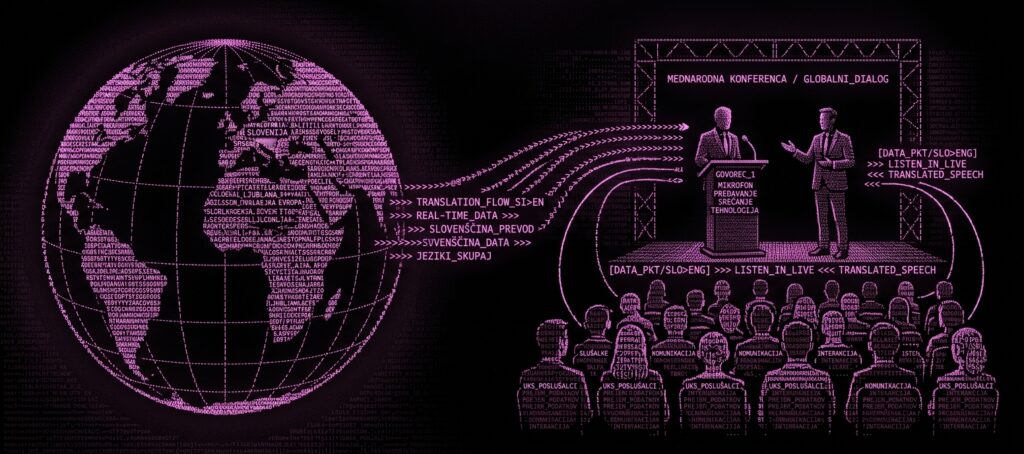
Ljubljana recorded 99 international association meetings in 2024, a 23.8% year-on-year jump that lifted the city to 39th globally and 23rd in Europe on the ICCA rankings (ICCA, 2024 Country/City Rankings). For a country of barely two million people, that is an extraordinary density of international events. And nearly every one of them faces the same question: how do you provide Slovenian event translation when the language is spoken by fewer people than live in metropolitan Houston, yet features a grammatical dual number, 48 distinct dialects, and six noun cases that make it one of the most structurally complex languages an interpreter can encounter?
Slovenia has built a conference reputation that far outstrips its size. The European Green Capital 2016 label, a mature pharmaceutical export sector, a strategic Adriatic logistics position, and a government that actively uses diplomacy-by-conference (from the Bled Strategic Forum to the Brdo-Brijuni Process) mean that event organizers working in Slovenia are not dealing with a niche market. They are dealing with a sophisticated, multilingual one that happens to operate in a language most translation vendors treat as an afterthought.
Slovenia’s Outsized Conference Ecosystem
A Small Country with Big Venues
Slovenia punches well above its weight in the MICE sector. Jan Orsic, Head of the Ljubljana Convention Bureau, became the first Slovenian ever elected to the ICCA Board of Directors, a recognition that the country’s meetings infrastructure has matured into something the global industry takes seriously (Visit Ljubljana, 2025).
- Cankarjev dom (Ljubljana): Slovenia’s largest cultural and congress centre, with 23 multi-purpose halls. Designed by architect Edvard Ravnikar and built between 1977 and 1982, it remains the default host for major international events in the capital.
- GR Ljubljana Exhibition and Convention Centre: 20 multi-functional halls across 12,000 square metres, configurable for 25 to 4,000 delegates.
- Brdo Congress Centre: Located halfway between Ljubljana and Bled, near the international airport. The largest hall seats 550 and is frequently used for EU-level governmental summits and diplomatic events.
The annual Conventa trade show, now in its 18th edition, further cements Slovenia’s MICE credentials. Conventa 2026 hosted 192 invited buyers from 38 countries and 129 exhibitors from 18 nations, generating thousands of pre-scheduled business meetings and reinforcing Ljubljana as the networking hub for the “New Europe” meetings industry (Conventa, 2026).
Flagship Events That Need Multilingual Support
Bled Strategic Forum. The country’s most prominent international event. The 20th edition (September 2025) drew over 2,300 participants from 94 countries, with 185+ speakers across 31 high-level debates and more than 50 hours of programming (Government of Slovenia, 2025). Discussions run primarily in English, but bilateral meetings, side events, and the Young BSF programme involve Slovenian extensively. The diplomatic nature of the event means that interpretation quality is not a convenience; it is a protocol requirement.
PODIM Conference. Central and Eastern Europe’s leading startup and technology conference, held annually in Maribor. PODIM 2025 (12-14 May) brought together early- and seed-stage startups with global investors across two venues: Maribox for the Main Stage and Demo Studios, and Narodni dom Maribor for the Deal Room, which schedules 1,300+ one-to-one meetings over two days (Podim, 2025).
Government and diplomatic events at Brdo. The Brdo-Brijuni Process, a Slovenian-Croatian diplomatic initiative, regularly brings Western Balkans leaders to Brdo Congress Centre. EU presidency events, bilateral summits, and ministerial meetings at Brdo require real-time interpretation across Slovenian, English, and often Croatian, Serbian, and German.
Industries Driving Slovenian Event Demand
Pharmaceuticals
Pharmaceuticals account for more than 41% of Slovenia’s total goods exports (Slovenia Business, 2025). Krka and Lek (Sandoz/Novartis) dominate, hosting conferences with dense pharmacological vocabulary and EU regulatory terminology that sits at the intersection of chemistry, medicine, and compliance law.
Automotive Components
The automotive sector contributes roughly 10% of GDP and 20% of total exports (Focus Economics, 2025). Revoz (Renault’s Novo Mesto factory) is the anchor, but Slovenia’s real strength is in precision components, electronics, and tooling. Industry events with German OEMs create steady demand for Slovenian-German translation.
Logistics and Trade
The Port of Koper handled 623,731 TEUs in H1 2025, a 14% increase year-on-year (Baird Maritime, 2025). A 153-million-euro expansion will push annual container capacity to 1.8 million TEUs by 2027. As the gateway on the Baltic-Adriatic and Mediterranean corridors, Koper generates logistics and supply-chain conferences where Slovenian intersects with Italian, German, and English.
Sustainable Tourism
Ljubljana was named European Green Capital in 2016 and has since been ranked among the 100 most sustainable destinations in the world for seven consecutive years (Visit Ljubljana). Twenty percent of the city consists of protected natural areas, and the car-free city centre has become a model for sustainable urban design. This green identity drives a conference niche: sustainability-focused events, green-tourism summits, and smart-city forums where Slovenia’s own track record is the subject as much as the venue.
The Slovenian Language: Why It Challenges Every Translation System
The Dual Number Problem
Slovenian is one of the very few living Indo-European languages to preserve a fully productive dual grammatical number. Where English distinguishes only between singular and plural (“one book, two books, three books”), Slovenian has three forms: singular (ena knjiga), dual (dve knjigi), and plural (tri knjige). This applies to nouns, adjectives, pronouns, and verbs.
Why this matters for events: A speaker referring to “both presentations” or “the two panelists” triggers dual verb conjugation and dual noun declension. An AI system or human interpreter unfamiliar with the dual will produce output that sounds immediately wrong to Slovenian ears, even if the meaning is technically preserved. PLOS ONE research has shown that the dual number is cognitively active in Slovenian speakers from early childhood (PLOS ONE, 2016).
Six Cases and Dense Morphology
Slovenian nouns decline across six grammatical cases (nominative, genitive, dative, accusative, locative, instrumental), each with distinct endings across three genders and three numbers (singular, dual, plural). This means a single Slovenian noun can appear in 18 different forms before you even consider diminutives or augmentatives. A missed case ending changes meaning: “dve konferenci” (two conferences, nominative dual) versus “dveh konferenc” (of two conferences, genitive dual).
48 Dialects for Two Million Speakers
Slovenian has at least 48 recognized dialects, the highest dialect density relative to population of any European language. Some southern dialects lack the dual number entirely; central dialects show masculinization of neuter nouns; and speakers from opposite ends of the country can struggle with mutual intelligibility. For event organisers, this means that a conference in Maribor (Styrian dialect region) and one in Koper (Littoral/Primorska dialect region) pose different transcription challenges.
Partial Intelligibility with Croatian and Serbian
Slovenian shares partial mutual intelligibility with Croatian and, to a lesser degree, Serbian. In the Western Balkans conference circuit, organisers often assume that speakers of Slovenian, Croatian, and Serbian can simply understand one another. They often can, for everyday conversation. But for technical content, pharmaceutical terminology, or legal and regulatory language, the false-cognate problem and divergent specialist vocabulary make professional interpretation essential.
Event planners working across the Croatian and Slovenian conference circuits should treat these as separate language requirements, not interchangeable ones.
A Scenario: The Pharmaceutical Supply-Chain Summit at Cankarjev Dom
Picture a two-day pharmaceutical supply-chain conference at Cankarjev dom in Ljubljana. There are 400 delegates: 55% Slovenian-speaking (pharma executives, regulatory affairs officers, hospital procurement managers), 30% English-speaking (EU regulatory officials, international pharma partners), and 15% split between German and Italian (Austrian and Italian supply-chain partners with ties to Krka and Lek).
Day one features a keynote by a Krka R&D director presenting in Slovenian with dense pharmacological vocabulary, GMP compliance terminology, and EU regulatory references. Breakout sessions run in parallel: two in Slovenian, two in English, one bilingual Slovenian-German. Day two includes a regulatory panel with speakers from EMA (English), JAZMP (Slovenian), and the Austrian BASG (German).
Traditional interpretation: you need at minimum six interpreters covering three language pairs, each for six hours across two days. Finding interpreters who can handle pharmaceutical regulatory vocabulary in Slovenian-German is a specialist staffing challenge that takes weeks.
How Snapsight handles this: Real-time transcription captures each session in its source language (the Krka keynote in Slovenian, the EMA panel in English, the bilateral in German) and delivers live AI-powered translation to every attendee’s device. The dual-number morphology, the case endings, the pharmaceutical terminology: these are handled by language models trained on exactly this kind of dense, domain-specific content. After the event, AI summaries synthesize the key outcomes across all sessions, regardless of source language. Across 627 events and 10,415 sessions in 75+ languages, Snapsight operates at 91% autonomy.
Cultural Considerations for Events in Slovenia
- The green identity is real. Slovenia’s sustainability positioning is not marketing; it shapes how events are organized. Conventa 2026 introduced measurable sustainability metrics for exhibitors.
- Alpine-Mediterranean crossover. Slovenia sits at the intersection of Alpine (Austrian/German influence), Mediterranean (Italian coastal culture), and Balkan traditions. Networking tends to be less formal than in Germany but more structured than in Southern Europe.
- Small-country networking advantage. In a country of two million, the professional world is tightly connected. A pharmaceutical executive in Novo Mesto likely knows the logistics director at Port Koper and the startup founder presenting at PODIM.
- Wine culture is significant. Slovenia has three recognized wine regions, and post-session networking over local vintages is common. Meals are important; do not schedule working lunches that eliminate the social component.
Planning Your Slovenian-Language Event
Language Pair Priorities
- Slovenian-English: the default for any international event
- Slovenian-German: essential for automotive, pharmaceutical, and financial events given Austria and Germany’s economic ties
- Slovenian-Italian: relevant for events in Koper/Primorska and cross-border trade
- Slovenian-Croatian: for Western Balkans regional events, despite partial intelligibility
Timing and Calendar
Avoid scheduling events during the Christmas-New Year period (Slovenians take extended holidays), the August vacation month, and the week surrounding Slovenian Statehood Day (June 25). The Bled Strategic Forum in early September and Conventa in February anchor the MICE calendar; plan around rather than against them.
Frequently Asked Questions
Approximately 2.5 million people speak Slovenian worldwide. The vast majority live in Slovenia, with significant minority communities in Friuli-Venezia Giulia, Italy (approximately 60,000 speakers), southern Carinthia and parts of Styria in Austria (approximately 25,000), and western Croatian Istria. Diaspora communities in Argentina, the United States, Canada, and Australia also maintain the language.
For everyday conversation, there is partial mutual intelligibility. For technical, legal, pharmaceutical, or regulatory content at professional events, no. False cognates, divergent specialist vocabulary, and structural differences (Croatian does not use the dual number) mean that professional interpretation is essential for any event where accuracy matters.
Three factors: the dual grammatical number (singular/dual/plural distinctions in nouns, adjectives, pronouns, and verbs), six-case noun declension creating 18+ forms per noun, and 48 distinct dialects that can diverge significantly from Standard Literary Slovenian. Any AI system must handle all three to produce output that sounds natural to Slovenian speakers. Snapsight’s language models are trained on domain-specific content that accounts for this morphological complexity.
Slovenia has relatively high English proficiency, especially among younger professionals and in Ljubljana. However, pharmaceutical regulatory content, legal proceedings, government summits, and events targeting domestic industry audiences require Slovenian. For the Bled Strategic Forum, where diplomats from dozens of countries participate, Slovenian remains the protocol language alongside English. Skipping Slovenian translation signals that you do not take the host country seriously.
Slovenian interpreters are in limited supply globally, drawing from a pool serving a 2.5-million-speaker market. For a two-day conference requiring Slovenian-English and Slovenian-German interpretation, expect to pay between 8,000 and 15,000 euros for interpreter fees alone, plus booth rental and audio equipment. Availability is the bigger constraint: finding pharmaceutical or legal-specialist Slovenian interpreters requires months of lead time. AI-powered solutions like Snapsight reduce both cost and staffing pressure while maintaining quality across technical domains.