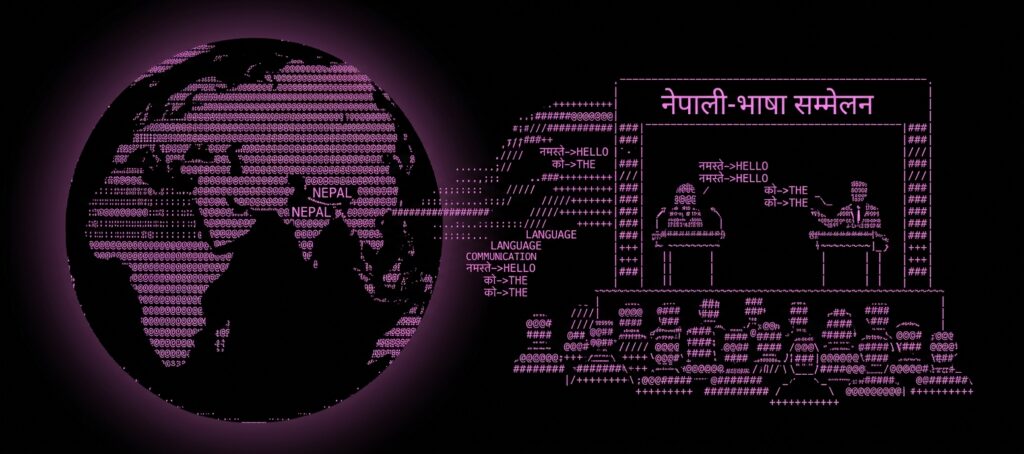
When Nepal’s Prime Minister inaugurated the Sagarmatha Sambaad in May 2025, bringing 350 delegates from 50 countries to Kathmandu to discuss climate change and mountain ecosystems, the translation challenge was not just English-to-Nepali. It was managing a multilingual dialogue where diplomats, scientists, and local community leaders each carried different linguistic expectations, from UN-standard English to Nepali with heavy Sanskrit-derived terminology to the indigenous languages that many mountain community representatives speak natively. The Sagarmatha Sambaad, Nepal’s flagship global dialogue forum, encapsulates the exact Nepali event translation challenge that conference organizers face: a small nation with outsized global relevance, where every major event runs at the intersection of international English and a complex South Asian linguistic landscape.
Nepali is spoken by approximately 16 million native speakers worldwide, with roughly 12.3 million in Nepal itself, about 44% of the country’s population as a mother tongue, rising to 77% when second-language speakers are included (Ethnologue, 2024). Another 2.9 million Nepali speakers live in India, concentrated in Sikkim, Darjeeling, and parts of Assam and West Bengal (Census of India, 2011). Significant diaspora populations in the Gulf states, Malaysia, Australia, the UK, and North America add to the language’s global footprint. But what makes Nepali event translation distinctive is not speaker volume: it is the nature of the events where Nepali matters, including development conferences, climate summits, tourism industry gatherings, and the growing circuit of investment forums that Nepal’s economy increasingly demands.
Nepal’s Conference Landscape: Where Development Meets Tourism
Nepal’s event scene is unlike any other in South Asia. It is shaped not by a massive domestic corporate sector, but by two overlapping forces: the international development and NGO ecosystem, and the tourism and adventure industry that draws over a million visitors per year.
The Development and NGO Conference Circuit
Nepal has historically been one of the most aid-dependent countries in the region. Until recently, approximately 39,759 NGOs and 189 international non-governmental organizations operated in the country, spanning health, agriculture, poverty alleviation, and governance sectors (Frontiers in Public Health, 2016). This density of development organizations has made Kathmandu a permanent node on the global conference circuit for climate, disaster resilience, and sustainable development.
The World Bank held its IDA21 Replenishment Meeting in Kathmandu, bringing senior officials from donor countries and international financial institutions to negotiate billions in development financing. USAID organized a dedicated Resilience Summit in Kathmandu to explore new models for addressing extreme poverty, food security, and climate-induced shocks. These are not small gatherings: they involve simultaneous interpretation across multiple languages, detailed technical vocabulary around development financing, and attendees ranging from Nepali government officials who conduct business in Nepali to international delegates who expect English or French.
The Sagarmatha Sambaad, Nepal’s answer to the Davos World Economic Forum, themed around climate and mountain ecosystems, has become the country’s most visible international dialogue. Its 2025 edition culminated in a 25-point “Sagarmatha Call for Action,” drawing heads of state, parliamentarians, and civil society leaders from 50 countries (Spotlight Nepal, 2025). The next edition is scheduled for 2027, and the event’s ambition is expanding.
Tourism, Mountaineering, and Hydropower Events
Nepal’s tourism industry crossed 1 million visitor arrivals in 2025, driven by improved connectivity and revived adventure tourism (World Bank, Nepal Development Update November 2025). Tourism contributes 6.6% of GDP, and the Nepal Tourism Board regularly convenes international forums on sustainable tourism, trekking regulations, and mountain safety.
Hydropower is Nepal’s other defining industry. The country holds an estimated hydropower potential of 83,000 megawatts, of which 45,000 megawatts are considered economically viable (World Bank, 2025). Energy conferences, investor forums, and infrastructure summits increasingly feature Nepali-language technical presentations alongside English sessions, particularly as domestic hydropower companies grow in scale and international investors seek to understand Nepal’s regulatory environment.
Remittances represent over 25% of Nepal’s GDP, climbing 19.2% to approximately $13.1 billion in FY2024/25 (World Bank, Nepal Development Update 2025). This economic reality drives conferences on migration, labor rights, and financial inclusion, often involving speakers who are more comfortable in Nepali than English.
Key Venues and Event Hubs
Kathmandu dominates Nepal’s conference infrastructure, though the picture is evolving.
The Soaltee Kathmandu (formerly Crowne Plaza Kathmandu-Soaltee) is Nepal’s premier convention venue, with its Megha Malhar convention complex offering seven meeting rooms accommodating 20 to 1,200 attendees. The independent convention complex can be configured from boardroom setups for 8 to reception-style events for 800 (Meetings & Conventions, 2025).
Hotel Yak & Yeti houses the Lal Durbar Convention Centre, a restored wing of the historic Lal Durbar Palace originally built in 1885. This venue hosts global conferences and diplomatic events, blending heritage architecture with modern event infrastructure.
Hyatt Regency Kathmandu serves as a frequent host for international summits and bilateral meetings, offering contemporary conference facilities in the Boudha area.
Birendra International Convention Centre (BICC) in New Baneshwor remains the government’s preferred venue for state-level events and large multilateral conferences, including SAARC summits and international development forums.
Beyond Kathmandu, Pokhara and Chitwan are emerging as secondary event destinations, particularly for tourism industry conferences and adventure tourism forums, while Lumbini draws Buddhist pilgrimage and interfaith dialogue events.
The Nepali Language Challenge: Why Standard Translation Falls Short
Nepali presents a set of interpretation and translation challenges that are distinct from its larger South Asian neighbors, and event organizers who assume it is “close enough to Hindi” quickly run into problems.
Devanagari Script and Hindi Overlap: A Double-Edged Sword
Nepali and Hindi share the Devanagari script, and both belong to the Indo-Aryan language family. This leads many organizers to assume Hindi interpreters can handle Nepali events. They cannot, at least not well. While the scripts are visually identical, Nepali uses 12 vowels and 36 consonants with distinct phonological rules (Omniglot, Nepali Language). Vocabulary divergence is significant, particularly in technical, legal, and development-sector terminology. A Hindi interpreter at a Nepali hydropower conference will miss critical nuances in regulatory and engineering vocabulary that have no Hindi equivalent.
For event organizers working across South Asia, the relationship between Nepali and Hindi is comparable to the Portuguese-Spanish dynamic: superficially similar, practically different. Our Hindi event translation guide explores the distinct challenges of India’s conference market, and the differences become stark when you compare the two languages’ technical registers.
The Honorific System: Five Levels of Formality
Nepali features one of the most granular honorific systems in any South Asian language. There are five recognized gradations: low, medium, high, very high, and royal (Nepali Language, MustGo). While the royal register has fallen into disuse since the abolition of the monarchy in 2008, the remaining four levels actively shape how speakers address each other, and how interpreters must calibrate their output.
At a development conference where a government minister, a UN representative, and a local community leader are all on the same panel, the Nepali interpreter must navigate three different honorific registers simultaneously. Using the wrong level is not just a grammatical error; it is a social signal that can undermine the speaker’s credibility or offend the audience. Automated translation systems that treat Nepali as a flat register miss this entirely.
SOV Word Order and Real-Time Interpretation
Nepali follows Subject-Object-Verb (SOV) word order, which creates a structural delay problem for simultaneous interpretation into English (SVO). The interpreter must wait for the Nepali speaker to reach the verb at the end of a clause before they can begin constructing the English equivalent. In technical presentations where sentences are long and information-dense, common in development and energy conferences, this delay compounds, creating gaps that frustrate English-speaking attendees.
Nepal’s 124 Languages: The Lingua Franca Problem
Nepal officially recognizes 124 languages (Census 2021). While Nepali serves as the lingua franca, many conference participants, particularly those representing indigenous communities, rural constituencies, or ethnic minority organizations, are not native Nepali speakers. They may speak Maithili (the second-most-spoken language, with 3.1 million speakers), Bhojpuri, Tamang, Newari, or one of dozens of Tibeto-Burman languages.
This means “Nepali event translation” is often a misnomer. The real challenge is multi-layer: indigenous language to Nepali to English, or vice versa. An organizer planning a climate resilience forum that includes both Kathmandu-based officials and mountain community representatives may need interpretation chains that go far beyond a simple Nepali-English pair.
A Scenario: The Nepal Infrastructure Investment Forum
Imagine you are organizing a 2-day infrastructure investment forum at the Soaltee Kathmandu. The event brings together 400 attendees: Nepali government officials from the Ministry of Energy and the Investment Board Nepal, international investors from Singapore, Japan, and the Gulf states, World Bank representatives, and Nepali hydropower company executives.
Your keynote is delivered in Nepali by the Minister of Energy, Water Resources and Irrigation. The technical sessions feature Nepali-language presentations on dam engineering and grid capacity, alongside English-language sessions from international engineering firms. A panel on community impact includes representatives from affected districts who speak Nepali as a second language and are most comfortable in Tamang or Tharu.
Traditional interpretation would require Nepali-English simultaneous interpreters with hydropower-specific technical vocabulary, a niche so narrow that staffing even two qualified interpreters in Kathmandu is a multi-month lead-time exercise. Adding a third language pair for community panel participants makes the logistics nearly unmanageable.
This is the scenario Snapsight was built to handle. Rather than staffing specialized interpreters for every language combination, Snapsight’s real-time transcription captures each session in its source language and delivers live translation to attendees’ devices. The Minister’s Nepali keynote, dense with hydropower regulatory terminology, is transcribed in Nepali and simultaneously available in English, Japanese, and Arabic. After the forum, AI-generated summaries synthesize insights across all sessions, giving international investors a structured English-language digest of every presentation, including the Nepali-language technical sessions they could not attend live.
With 10,415+ sessions processed across 627+ events in 75+ languages, Snapsight handles precisely this kind of multilingual complexity, operating at 91% autonomy so your team focuses on the event, not the technology.
Cultural Considerations for Event Organizers
Calendar and Scheduling
Nepal operates on the Bikram Sambat calendar, which is roughly 56.7 years ahead of the Gregorian calendar. The current Nepali year is 2082/83 BS. While international events typically use Gregorian dates, domestic communications, government documents, and local marketing should reference both calendars.
Dashain (September-October) is Nepal’s most important festival, a 15-day celebration during which government offices effectively shut down and domestic travel surges. Tihar (October-November) follows shortly after. Scheduling international events during these periods guarantees poor Nepali attendance and limited local support staff.
Business and Networking Norms
The Namaste greeting (palms together, slight bow) is standard in professional settings. Business cards are exchanged with the right hand or both hands; never with the left. Hierarchical respect is deeply embedded: younger or lower-ranking individuals wait for seniors to initiate conversation, and interrupting a senior speaker during Q&A is considered disrespectful.
Tea is the default hospitality gesture. Declining tea at a meeting or event is culturally awkward. Event organizers should ensure tea service is available throughout conference sessions, not just during formal breaks.
The NGO Conference Culture
Nepal’s development conference circuit has its own etiquette. Events often open with a formal “lighting of the lamp” ceremony. Government officials expect to be seated on a raised dais. Printed programs in both Nepali and English are standard. And there is an unspoken expectation that international organizations hosting events in Kathmandu will provide translation: the absence of Nepali interpretation at a development conference held in Nepal’s own capital signals institutional tone-deafness.
Related Language Guides
Nepal’s event translation needs overlap with several neighboring markets. For organizers working across the South Asian conference circuit, our guide to Bengali event translation covers the Bangladesh and Eastern India event landscape, where development conference culture shares many parallels with Nepal. The Hindi event translation page addresses India’s broader conference market, including the Devanagari-script dynamics that Nepali-Hindi interpretation requires. And for the broader multilingual event strategy, our event translation hub provides the complete framework for managing language complexity at any scale.
Frequently Asked Questions
Not reliably. While Hindi and Nepali share the Devanagari script and some vocabulary, the languages diverge significantly in technical, legal, and development-sector terminology. Nepali’s five-level honorific system also has no direct Hindi equivalent. A Hindi interpreter may achieve basic comprehension, but will miss critical nuances, particularly in formal government settings and technical conferences. Purpose-trained Nepali interpreters or AI-powered translation systems trained on Nepali-specific data are essential for professional events.
Qualified Nepali-English simultaneous interpreters in Kathmandu typically cost $300-$600 per day per interpreter, and professional standards require a minimum of two interpreters per language pair for events exceeding four hours. For a 2-day conference with parallel sessions, traditional interpretation can run $3,000-$8,000 depending on the number of rooms and language pairs. AI-powered alternatives like Snapsight reduce this cost significantly while adding capabilities like real-time transcription, post-event summaries, and multi-language output that traditional interpreters cannot provide.
Avoid the Dashain festival period (September-October) and Tihar (October-November) entirely. These are Nepal’s most important holidays, and domestic participation and local staffing will be severely limited. The pre-monsoon season (March-May) and post-monsoon season (October-November, after Tihar) are the preferred windows for international conferences in Kathmandu. Also note that Nepal uses the Bikram Sambat calendar; including BS dates alongside Gregorian dates in Nepali-language event materials is expected.
Yes. Snapsight supports Nepali as part of its 75+ language coverage, including real-time transcription in Devanagari script and live translation to and from English and other supported languages. The platform handles Nepali’s SOV word order and technical vocabulary across sectors including development, energy, and tourism, the industries that dominate Nepal’s conference landscape.