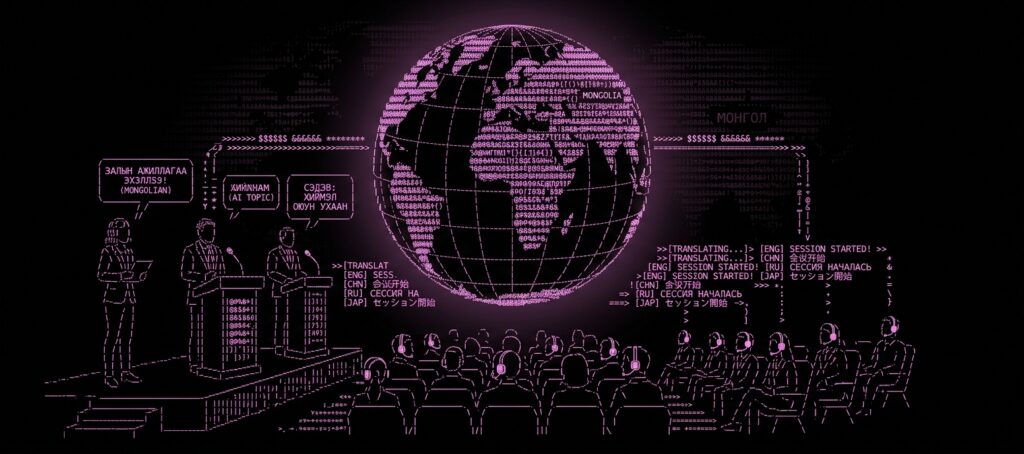
Mongolia welcomed over 846,000 international visitors by the end of 2025, a staggering 25-fold increase from the 33,100 arrivals recorded in 2021 (Mongolia eVisa Tourism Analysis, 2026), and a growing share of those visitors are flying into Ulaanbaatar for mining expos, investment forums, and development summits where Mongolian-English interpretation is not optional. With approximately 5.7 million speakers split between Mongolia and China’s Inner Mongolia Autonomous Region (Ethnologue, 2024), Mongolian is a language that most global event translation vendors ignore entirely. For the organizers navigating the country’s booming conference circuit, from the 15th Mongolia Mining expo to the Mongolia Economic Forum at the Government Palace, that gap between demand and available Mongolian event translation infrastructure is becoming a serious operational problem.
Mongolia’s Emerging Conference Landscape
A Resource Economy That Runs on International Capital
Mongolia’s economy is anchored by mining, and mining runs on foreign investment. Relatively strong global commodity prices, alongside stable output from the Oyu Tolgoi copper-gold mine operated by Rio Tinto, will underpin sectoral performance through 2026 (East Asia Forum, February 2026). Oyu Tolgoi alone is one of the world’s largest known copper-gold deposits, and in January 2026, Oyu Tolgoi LLC acknowledged the importance of “constructive engagement” with the Mongolian government as high-stakes renegotiations began (The Diplomat, February 2026).
| Event | Focus | Scale |
|---|---|---|
| Mongolia Mining (15th edition, April 2026) | International mining and oil expo | Largest mining event in Mongolia |
| MiningWeek & MinePro 2025 | Mining progress and responsibility | September 11-13; China designated Focus Country |
| Mongolia Economic Forum (MEF 2025) | Economic policy, FDI, critical minerals | Government Palace; Prime Minister attends |
| EU-Mongolia Business Forum | Strategic EU-Mongolia collaborations | Shangri-La Hotel, Ulaanbaatar; October 2025 |
| Mongolia Investment Forum | Global investors, potential LSE listings | International roadshow: London & New York |
Beyond Mining: The Industries Driving Mongolian Event Demand
- Renewable Energy: Over 300 MW of installed solar and wind capacity, with plans to scale to 3,000 MW by 2030. The Gobi Desert is one of Asia’s most promising renewable energy frontiers (Stockholm Environment Institute, 2024).
- Cashmere and Agriculture: Mongolia is the world’s second-largest cashmere producer. With roughly 70 million head of livestock (more than 20 times its human population), the pastoral economy generates trade shows where Mongolian-speaking herders, international buyers, and government regulators must communicate across language barriers.
- Financial Services: The Mongolia Investment Forum series (London, New York, Ulaanbaatar) brings together global investors exploring Mongolian bank listings on the London Stock Exchange. These events require precise Mongolian-English financial translation.
- Development and Governance: Mongolia’s strategic position between Russia and China, combined with its democratic governance model, makes it a natural venue for diplomatic and development events.
Why Mongolian Is Uniquely Challenging for Event Translation
The Dual Script Problem
Cyrillic Mongolian is the dominant script in Mongolia, adopted during the Soviet era in the 1940s. Virtually all modern business, government, and academic content uses Cyrillic. Traditional Mongolian script, written vertically and read left to right across columns, is experiencing a government-mandated revival. Inner Mongolia’s 2.8 million Mongolian speakers have historically used the traditional script alongside Chinese.
Researchers have found that the “diverse morphological rules make it challenging for models to learn the correspondence between two Mongolian characters,” and computer operating systems have historically provided incomplete support for traditional Mongolian script rendering (Mongolian Journal of Information and Digital Technology, 2024). A Transformer-based approach for Cyrillic-to-traditional Mongolian conversion achieved a 5.72% reduction in word error rate over previous methods, meaningful progress but an indicator of how far the field still has to go.
Agglutinative Grammar and Vocabulary Gaps
Vocabulary Explosion
Mongolian words consist of stems and suffixes, producing a vast vocabulary that includes many out-of-vocabulary (OOV) words that cannot be handled by rules and dictionaries alone. For mining conferences using technical terminology like “copper concentrate beneficiation process,” the agglutinative structure compounds the difficulty.
Segmentation Ambiguity
Unlike English, where spaces reliably separate words, Mongolian’s suffix-chaining means the AI must determine where one concept ends and another begins. In spoken Mongolian at conference speed, this segmentation challenge intensifies significantly.
Vowel Harmony and Phonological Complexity
Mongolian enforces vowel harmony, where vowels within a word must belong to the same harmonic class (front or back). When a speaker at a mining conference in Ulaanbaatar drops into rapid Mongolian with technical loan words from Russian or English, the AI must handle code-switching between harmonic Mongolian, non-harmonic loan words, and occasional full-language switches, all in real time.
Formality Registers
Mongolian lacks grammatical gender, which simplifies some translation challenges. However, formality registers are important in business and government contexts. Speaking to a minister at the Mongolia Economic Forum requires different verb endings and vocabulary than addressing a colleague at a mining exhibition. Event translation systems must navigate these registers correctly to avoid social missteps.
A Scenario: The Mining Investment Conference at Misheel Expo
You are organizing a three-day mining investment conference at Misheel Expo in Ulaanbaatar. Your event draws 600 attendees: 45% Mongolian-speaking (mining executives, government officials, geology faculty), 35% English-speaking (international investors, Rio Tinto representatives, World Bank analysts), and 20% Chinese-speaking (Inner Mongolian mining partners, Chinese EPC contractors, equipment suppliers).
| Requirement | Traditional RSI | AI-Powered (Snapsight) |
|---|---|---|
| Language pairs | Mongolian-English, Mongolian-Chinese, English-Chinese | All pairs handled simultaneously |
| Interpreter sourcing | Mongolian-Chinese mining interpreters: extremely scarce | No interpreter sourcing needed |
| Parallel sessions (6 rooms) | Logistical ordeal to staff all rooms | Automatic coverage across all rooms |
| Estimated cost (3-day) | $35,000+ | Significant reduction |
| Post-event intelligence | Not included | Cross-session synthesis in all three languages |
Mining and technical vocabulary support: Snapsight’s custom vocabulary allows organizers to pre-load industry-specific terminology (flotation, heap leaching, ore grade, stripping ratio, net asset value, offtake agreement, production-sharing agreement), ensuring that “block cave development” does not arrive in Mongolian as something unintelligible. With 627+ events and 10,415+ sessions processed across 75+ languages at 91% autonomy, your team focuses on attendees and logistics, not managing translation technology.
Ulaanbaatar’s Event Infrastructure
Mongolia’s conference infrastructure is concentrated in Ulaanbaatar, a city of 1.5 million people (nearly half the country’s population).
- Misheel Expo: Leading exhibition and convention centre, designed as Ulaanbaatar’s urban landmark. Includes commercial spaces and a business hotel. Hosted Expo Mongolia with 45 exhibitors from 7 countries.
- Buyant Ukhaa Sports Palace: Venue for Mongolia Mining, the country’s largest mining expo. Accommodates heavy equipment displays and technical demonstrations.
- Shangri-La Ulaanbaatar: Venue of choice for diplomatic and investment events, including the EU-Mongolia Business and Investment Forum.
- The Government Palace: Hosts the Mongolia Economic Forum, where business leaders interact directly with the Prime Minister and cabinet members.
- Blue Sky Tower and Chinggis Khaan Hotel: Corporate events and smaller international gatherings.
The city’s extreme continental climate (temperatures can drop below -30C in winter and rise above 35C in summer) concentrates the conference season into the May-through-October window, with the Mongolia Economic Forum (July) and MiningWeek (September) anchoring the calendar.
Cultural Considerations for Mongolian Events
Hospitality and Nomadic Heritage
Mongolian business culture retains strong elements of nomadic hospitality. Offering airag (fermented mare’s milk) or suutei tsai (milk tea) is a gesture of welcome that event organizers should understand, even in modern conference settings. International attendees at mining conferences may find themselves invited to a ger (traditional dwelling) dinner where business relationships are cemented outside the formal program. Translation support for these informal but commercially important moments matters as much as keynote interpretation.
Calendar Awareness
- Tsagaan Sar (Mongolian Lunar New Year): Typically January or February. Multi-day celebration effectively shuts down business for a week or more.
- Naadam Festival (July 11-15): Wrestling, archery, and horse racing. Scheduling international events during this period is inadvisable.
The Russia-China Linguistic Overlap
Mongolia sits between Russia and China, and this geopolitical reality shapes its linguistic landscape. Many older Mongolian professionals speak Russian as a second language (a Soviet-era legacy), while younger professionals increasingly learn English or Chinese. At any given conference in Ulaanbaatar, you may need Mongolian, English, Russian, and Chinese interpretation, a four-language matrix that traditional RSI vendors struggle to staff. For event organizers working with Russian-speaking attendees or Mandarin-speaking participants, Mongolia’s multilingual reality adds layers of complexity that AI-powered translation handles far more efficiently than human interpreter teams.
Approximately 5.7 million people speak Mongolian, split roughly between Mongolia (2.8 million speakers, where Halh Mongolian is the national language) and China’s Inner Mongolia Autonomous Region (2.8 million speakers of Peripheral Mongolian). Smaller diaspora communities exist in Russia (Buryat Republic), South Korea, Japan, and the United States. For event purposes, the practical demand centers on Ulaanbaatar and, to a lesser extent, Hohhot (Inner Mongolia’s capital).
Mongolian presents a dual-script challenge: Cyrillic (dominant in Mongolia) and traditional vertical script (used in Inner Mongolia and increasingly mandated by Mongolia’s government). AI translation systems have made significant progress, with Transformer-based approaches reducing word error rates for script conversion by 5.72% over previous methods, but traditional script rendering remains imperfect on many platforms. For most conferences in Ulaanbaatar, Cyrillic Mongolian is the practical standard for live captioning and translated content.
Mongolian-English is the most demanded pair for international mining and investment events. Mongolian-Chinese is increasingly important given China’s role as Mongolia’s largest trading partner and the Focus Country designation at MiningWeek 2025. Mongolian-Russian remains relevant for events involving older professionals or Russia-connected industries. Multi-language events in Ulaanbaatar frequently require all three pairs simultaneously, a logistical challenge that AI-powered platforms handle more efficiently than traditional interpreter staffing.
Mongolia’s extreme continental climate concentrates the conference season between May and October. July is prime season (Mongolia Economic Forum), but avoid July 11-15 (Naadam Festival). September hosts MiningWeek. Avoid January-February entirely due to Tsagaan Sar and temperatures that regularly drop below -30C. April (Mongolia Mining expo) and October (EU-Mongolia forums) bookend the practical conference window.
Traditional Mongolian-English simultaneous interpretation for a three-day conference with multiple parallel sessions can cost $25,000-$40,000, depending on the number of language pairs and interpreter availability. Mongolian-Chinese mining interpreters command premium rates due to scarcity. AI-powered translation platforms like Snapsight offer a fundamentally different cost structure, covering all language pairs simultaneously without per-interpreter staffing costs.