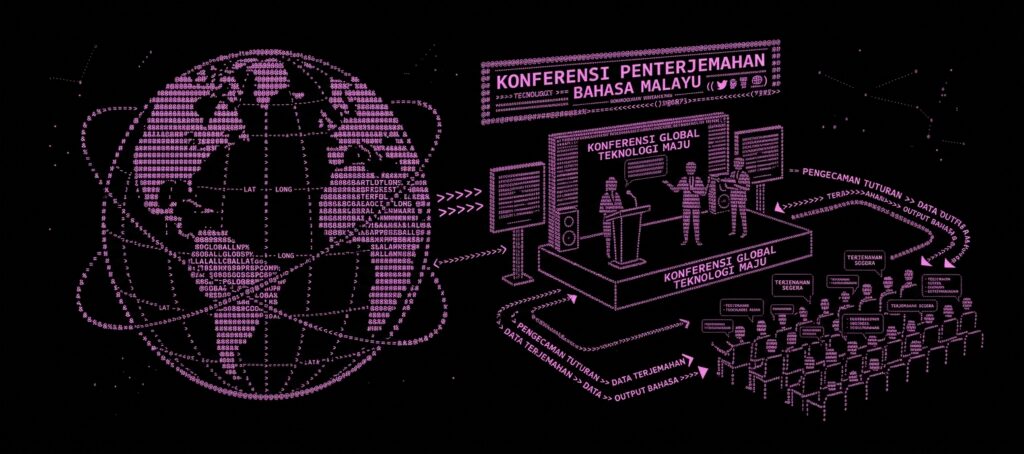
Malaysia hosted 129 international association meetings in 2024, ranking 31st globally and ninth in Asia-Pacific, and Kuala Lumpur jumped six spots to 26th in the ICCA World City Rankings that same year (ICCA, 2024 Country & City Rankings). Those numbers understate the real picture. Malaysia is not just climbing conference rankings; it is building an entire national strategy around business events, with the government projecting RM42.12 billion (US$9.9 billion) in economic contribution from the MICE sector by 2030 (Malaysia Convention & Exhibition Bureau, 2025). Every one of those events operates in a country where Bahasa Melayu is the national language, where 77 million native Malay speakers span four countries across Southeast Asia (Ethnologue, 2025), and where malay event translation is not an afterthought: it is the operational spine of any conference that wants to reach both domestic audiences and the international delegates Malaysia is aggressively courting.
What makes Malaysia’s event landscape distinctive is not just its size but its composition. This is the world’s leading halal economy, the top-ranked nation on the Global Islamic Economy Indicator for over a decade (ICD-Refinitiv, 2024), and a country where oil and gas, palm oil, electronics manufacturing, Islamic finance, and defense converge at trade shows and summits that draw participants from the Middle East, Europe, East Asia, and across ASEAN. The translation challenge is not simply Malay-to-English. It is managing a multiethnic society where Malay, Mandarin, Tamil, and English coexist in professional settings, where the distinction between Bahasa Melayu and Bahasa Indonesia trips up even experienced translators, and where cultural protocols around halal hospitality, prayer scheduling, and royal etiquette shape how events actually run on the ground.
Malaysia’s MICE Ecosystem: From Government Strategy to Global Ambition
The MyCEB Machine
The Malaysia Convention & Exhibition Bureau (MyCEB), established in 2009 under the Ministry of Tourism, Arts and Culture (MOTAC), operates as the national body responsible for positioning Malaysia as a top-tier business events destination. MyCEB has secured 155 business events for the next six years (CMW, 2025), a pipeline that includes international association congresses, corporate incentive programs, and government-hosted summits. KLIA serves 79 airlines and offers visa-free access to nationals of 175 countries, logistics that directly reduce barriers for international event attendance (MyCEB, 2025).
Malaysia’s ICCA ranking trajectory tells a clear story: the country moved up two places to 31st globally in 2024, while Kuala Lumpur climbed to 26th among world cities, hosting 78 international association meetings in that year alone (KLCC Newsroom, 2025). Each of those 78 meetings required multilingual infrastructure, including signage, simultaneous interpretation, captioning, and post-event transcripts, where Malay-English is the default pair and additional languages scale with the international attendance profile.
World-Class Venues Across Three Regions
Malaysia’s venue infrastructure has matured well beyond a single convention center in the capital.
Kuala Lumpur Convention Centre (KLCC) sits at the base of the Petronas Twin Towers and anchors the city’s premium event circuit. It hosts everything from the annual Invest Malaysia conferences organized by CIMB and Bursa Malaysia to international medical congresses. The venue’s expansion added 32,800 square feet of flexible space, and its programming runs year-round across plenary halls, banquet facilities, and exhibition areas (KLCC, 2025).
Malaysia International Trade and Exhibition Centre (MITEC) is the country’s largest trade and exhibition venue, offering 52,000 square meters of event space including a 12,960-square-meter pillar-less exhibition hall. MITEC can accommodate mega-exhibitions for over 100,000 visitors and conventions for 20,000 participants (MITEC, 2025). It serves as the primary venue for defense and security expos like DSA & NATSEC Asia and the massive Malaysia International Halal Showcase (MIHAS).
Borneo Convention Centre Kuching (BCCK) in Sarawak represents Malaysia’s push to distribute events beyond Peninsular Malaysia. BCCK closed 2025 hosting the Asia Pacific Hospice Palliative Care Conference, International Energy Week, and the International Digital Economy Summit (IDECS). A second-phase expansion (BCCK2), breaking ground in 2025 and targeting completion by March 2028, will further expand East Malaysia’s capacity for international events (Sarawak Tribune, 2026).
Major Events Driving Malay Translation Demand
Malaysia’s conference calendar spans industries that map directly to the country’s economic strengths, and each brings distinct multilingual requirements.
Malaysia International Halal Showcase (MIHAS), held annually at MITEC and organized by MATRADE, is the world’s largest halal trade event, drawing exhibitors from over 90 countries. When buyers from the Middle East, Central Asia, and North Africa negotiate with Malaysian halal producers, the language pairs extend well beyond Malay-English into Malay-Arabic, Malay-Turkish, and Malay-Mandarin, reflecting the actual trade corridors of the $7.7 trillion global halal economy (Consultancy.asia, 2025).
Defence Services Asia (DSA) & NATSEC Asia, with the 19th DSA Exhibition and Conference scheduled for April 20-23, 2026 at MITEC, draws defense procurement delegations from across ASEAN, the Middle East, and Europe. Technical briefings on battlefield healthcare, maritime platform systems, and simulation technology require interpreters who can navigate defense jargon in Malay and at least three additional languages.
| Event | Venue | Key Languages |
|---|---|---|
| MIHAS (Halal Showcase) | MITEC | Malay, English, Arabic, Turkish, Mandarin |
| DSA & NATSEC Asia | MITEC | Malay, English, Arabic, Korean |
| LIMA (Maritime & Aerospace) | Langkawi | Malay, English, multi-language defense |
| POC (Palm Oil Conference) | Shangri-La KL | Malay, English, Mandarin |
| Invest Malaysia Series | KLCC / various | Malay, English |
Langkawi International Maritime and Aerospace Exhibition (LIMA), held biennially at the Mahsuri International Exhibition Centre on Langkawi Island, hosts delegations from 40+ countries, making it a high-demand event for malay conference translation across defense, aviation, and maritime technical vocabulary.
Palm & Lauric Oils Price Outlook Conference (POC), organized by Bursa Malaysia, is the flagship event where global commodity traders, plantation companies, and sustainability certification bodies convene. Technical sessions on oleochemistry, sustainability certification (RSPO/MSPO), and futures pricing require precise translation of Malay agricultural and financial terminology.
The Malay Language: Deceptively Simple, Operationally Complex
Event organizers often hear that Malay is “one of the easiest Asian languages,” with no tones, no conjugation, and Latin script. That assessment is dangerously incomplete for anyone planning multilingual event infrastructure.
The Malay-Indonesian Distinction That Breaks Events
Bahasa Melayu and Bahasa Indonesia share a common ancestor in Classical Malay, but three centuries of divergent colonial influence (British in Malaya, Dutch in the East Indies) produced two languages that are mutually intelligible for casual conversation but treacherous for professional contexts (1StopAsia, 2025).
Critical distinction: False cognates between Malay and Indonesian create real risks. The word “tandas” means toilet in Malay but “to accentuate” in Indonesian. “Percuma” means free in Malay but useless in Indonesian (Medium/Jala Translate, 2025). In regulatory, financial, or legal conference sessions, using the wrong variant does not just confuse; it can misrepresent contractual terms or regulatory requirements.
For event organizers hosting ASEAN-wide conferences in KL, this distinction matters operationally. An interpreter who is native in Bahasa Indonesia will sound slightly off to Malaysian ears, and vice versa. Captioning systems trained on Indonesian corpora will produce text that Malaysian readers find awkward or incorrect. For a deeper look at the Indonesian side, see our guide to Indonesian event translation.
Formal Registers and Royal Protocol
Bahasa Melayu maintains distinct registers that event organizers must navigate. Common Malay (bahasa pasar) is what attendees use in networking sessions and at lunch. Standard Malay (bahasa baku) is what speakers use in formal presentations. But Malaysia is a constitutional monarchy with nine state sultans, and events that involve royalty or senior government officials operate in a register where specific vocabulary and forms of address must be observed. Using the wrong honorific for a sultan or a Yang di-Pertuan Agong at a government-hosted opening ceremony is not a linguistic error: it is a protocol failure.
Loanword Density and Code-Switching
Modern Malay is heavily influenced by Arabic (particularly in Islamic finance, law, and religious contexts), Sanskrit (in formal and literary registers), and English (in technology, business, and science). At an Islamic finance conference, a speaker may use Arabic-derived terms like “sukuk,” “mudarabah,” and “takaful” within Malay sentences, then switch to English for market data and regulatory citations. For AI-powered translation systems, this multilingual density within a single language stream is a specific challenge.
Latin Script, With a Jawi Footnote
Malay uses the Latin alphabet (Rumi), which simplifies captioning and display compared to languages with non-Latin scripts. However, Jawi script, an Arabic-derived writing system, remains in official use in certain contexts, particularly in Brunei, in Malaysian Islamic institutions, and on official state documents in several Malaysian states. Event materials for government or religious events may need Jawi versions.
Cultural Considerations for Event Organizers
Halal Hospitality Is Non-Negotiable
At any event with Malaysian government involvement or Malay-majority attendance, all catering must be halal-certified. This is not a dietary preference; it is a regulatory and cultural expectation. Menus, ingredient lists, and food labeling may need Malay translation even at English-language events.
Prayer Room Provision and Scheduling
Events must provide prayer rooms (surau) and schedule breaks that accommodate the five daily prayers, particularly Zohor (midday) and Asar (afternoon). During Ramadan, session scheduling should account for fasting attendees. These scheduling considerations affect interpretation logistics: if sessions shift timing, interpreter rotations and technology setup must shift with them.
Multiethnic Audience Dynamics
A conference in KL is rarely a monolingual Malay event. The audience will typically include Malay-speaking attendees, Chinese Malaysians who may prefer Mandarin or English, Indian Malaysians who may prefer Tamil or English, and international delegates. This creates a translation matrix where Malay-English is the backbone, but Malay-Mandarin and English-Mandarin pairs may be needed for trade-focused sessions.
The Thailand-Indonesia-Malaysia Triangle
Malaysia sits at the center of a geographic triangle with Thailand and Indonesia, and many ASEAN-wide events rotate between KL, Bangkok, and Jakarta. A translation setup that works perfectly in Bangkok will need fundamental reconfiguration for KL, and the KL setup will need careful adjustment, not a simple swap, for Jakarta.
A Scenario: The ASEAN Halal Trade Summit
Imagine you are organizing a three-day halal trade summit at MITEC, expecting 2,400 attendees: 40% Malaysian, 15% Indonesian, 12% from Gulf states (Arabic-speaking), 10% Turkish, 10% from other ASEAN nations, and 13% from Europe and the Americas. Your keynote speakers include the Malaysian Minister of International Trade (who will present in formal Bahasa Melayu), the Secretary-General of an ASEAN economic body (English), a Saudi Arabian Investment Authority representative (Arabic), and a Turkish halal certification executive (Turkish).
Traditional interpretation would require 10-14 interpreters across five language pairs, at a cost exceeding $55,000 for the event, with the Malay-Arabic and Malay-Turkish pairs requiring months of advance booking from specialized agencies.
How Snapsight solves this: Rather than staffing a dozen interpreters across five language pairs, Snapsight’s real-time transcription captures each session in its source language and delivers live translation to every attendee’s device simultaneously. The Malaysian minister’s formal Bahasa Melayu keynote is transcribed and available in English, Arabic, Turkish, and Indonesian within seconds. After the summit, AI-generated summaries synthesize insights across all sessions and all languages. With 627 events and 10,415 sessions already processed across 75+ languages, and 91% autonomous operation requiring minimal human oversight, Snapsight eliminates the staffing bottleneck that makes traditional multilingual events in Malaysia so expensive to produce.
Practical Guidance for Malay Event Translation
- Plan for code-switching. Malaysian conference presenters frequently alternate between Malay and English, sometimes mid-sentence. Your translation system or interpreters must handle this seamlessly rather than treating each language switch as an error.
- Specify Bahasa Melayu, not “Malay/Indonesian.” When briefing translation vendors or configuring AI systems, explicitly specify Malaysian Malay. Generic “Malay” settings may default to Indonesian training data, producing output that reads as foreign to Malaysian audiences.
- Budget for Jawi where required. If your event involves Malaysian government agencies, Islamic institutions, or operates in East Coast states (Kelantan, Terengganu), confirm whether Jawi script versions of key materials are expected.
- Confirm interpreter nationality. For simultaneous interpretation, a Malaysian-national interpreter will navigate local cultural references, government terminology, and royal protocols more fluently than an Indonesian or Singaporean Malay speaker.
- Build the multilingual matrix early. Survey your expected attendee demographics before finalizing language pairs. A MIHAS-style trade event may need Malay-Arabic and Malay-Turkish pairs that a technology conference would not.
Frequently Asked Questions
Mutually intelligible for casual conversation, but significantly different for professional and regulatory contexts. False cognates, divergent loanwords (English-derived in Malay, Dutch-derived in Indonesian), and different formal registers mean that content translated for Malaysian audiences will read as awkward or incorrect to Indonesian audiences, and vice versa. For ASEAN events drawing both populations, separate language tracks or variant-aware AI systems are strongly recommended.
Often yes, particularly if Malaysian government officials are speaking (they may present in Bahasa Melayu), if domestic attendees outnumber international ones, or if the event involves regulatory or policy content where official Malaysian documentation is in Malay. Even at English-dominant events, providing Malay captioning as an option significantly improves accessibility and engagement for Malaysian attendees.
Malay-English is the default. Beyond that, Malay-Mandarin is common at trade and business events given Malaysia’s Chinese business community. Malay-Arabic appears at Islamic finance and halal economy events. Malay-Japanese and Malay-Korean surface at automotive and electronics manufacturing conferences, reflecting Malaysia’s industrial partnerships with Japan and South Korea.
Ramadan shifts session scheduling (shorter days, post-iftar evening sessions), which cascades into interpreter rotation planning and technology setup timing. Some events avoid Ramadan entirely; others adapt. If your event falls during Ramadan, build the adjusted schedule before booking interpretation services, as interpreter availability during Ramadan can be limited.
Jawi (Arabic-derived script) appears on official government documents, at Islamic institutions, and as required signage in several Malaysian states. Most business events operate entirely in Rumi (Latin script), but events with royal patronage or heavy government involvement may require Jawi versions of programs, signage, or certificates. Confirm requirements with your local event partner early in planning.