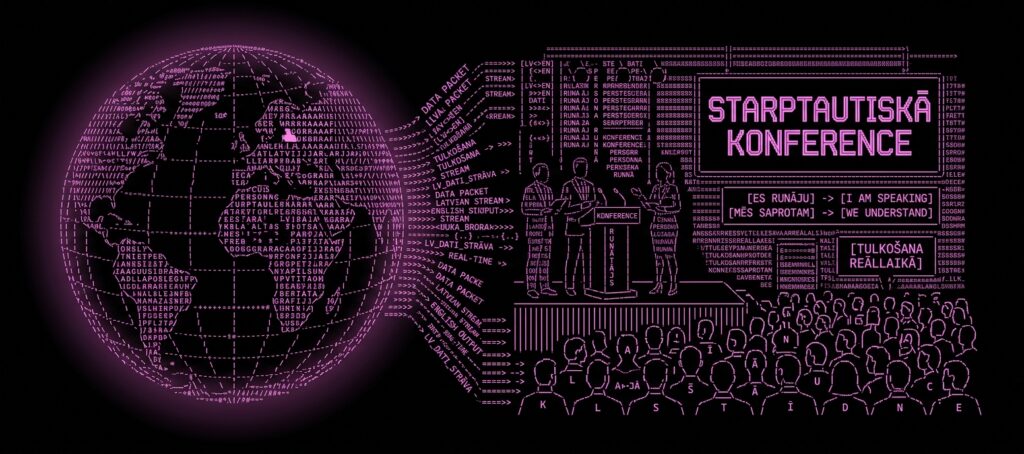
The Riga Conference drew more than 700 participants from 45 countries in October 2025, marking its 20th year as the largest security and foreign policy forum in the Nordic-Baltic region, and every panel, every keynote, every bilateral sidebar ran across at least two languages. Latvian is spoken natively by just 1.75 million people worldwide (Ethnologue, 2024), making it one of the smallest official EU languages. Yet Latvia punches far above its demographic weight in international events, from TechChill’s 2,300-strong founder-investor gatherings to the geopolitical debates at the Riga Conference itself. For event organizers working in or with this market, Latvian event translation is not a niche requirement; it is the gateway to one of northern Europe’s most ambitious conference ecosystems.
Why Latvia’s Event Market Demands Multilingual Infrastructure
Latvia’s economy grew an estimated 1.7% in 2024, with projections of 2.4% in 2025 (European Commission, Economic Forecast for Latvia), driven by rising private consumption and stronger external demand. Three sectors anchor the country’s international event profile.
IT and Fintech
Latvia hosts approximately 130 active fintech companies, contributing 369 million euros in local turnover in 2024 (Crowdfund Insider). The ICT sector overall comprises more than 6,900 companies and contributes roughly 6% of GDP. RIGA COMM runs eight parallel conference tracks, routinely operating in English, Latvian, and often Russian.
Timber and Wood Products
Forest covers almost 50% of Latvia’s national territory, and wood products account for one-third of total exports (Invest in Latvia). Trade fairs like Riga Food bring together food processing and timber-adjacent agribusiness professionals who operate across Latvian, English, German, and Russian.
Transit and Logistics
Latvia’s geographic position as a transit corridor between Western Europe and the CIS countries makes it a natural hub for logistics conferences. The Port of Riga, the services balance driven by road haulage and IT, and the country’s rail connections generate events where Latvian-English and Latvian-Russian interpretation is standard.
The Conference Circuit: Where Latvian Translation Matters Most
The Riga Conference
Organized jointly by the Latvian Transatlantic Organization (LATO), the Ministry of Foreign Affairs, and the Ministry of Defence, the annual Riga Conference is the preeminent security and foreign policy forum in northern Europe. The 2025 edition brought together participants including U.S. Permanent Representative to NATO Matthew J. Whitaker, European Parliament President Roberta Metsola, and former NATO Military Committee Chair Admiral Rob Bauer (MFA Latvia, October 2025). For an event of this diplomatic weight, translation accuracy is non-negotiable.
TechChill
TechChill 2026 runs March 25-27 at Hanzas Perons in Riga, assembling 2,300+ founders and investors with over 50 million euros in opportunities on the table (TechChill.co). With 120+ speakers on main stages and specialized tracks, TechChill attracts a pan-Baltic and pan-European audience. Real-time transcription and translation allow international VCs to follow Latvian-language pitches without losing deal-critical nuance.
RIGA COMM
Held at Kipsala International Exhibition Centre, RIGA COMM 2026 (October 8-9) spans technology, digital transformation, and AI innovation across eight conference tracks. The venue’s two pavilions covering 9,200 sqm and 5,700 sqm, with fixed conference rooms seating 220 and 500, are purpose-built for events that need multilingual infrastructure.
Riga’s Venue Infrastructure
- Kipsala International Exhibition Centre: The largest specialized exhibition complex in the Baltic countries. Located adjacent to the Old City, with two pavilions, dual conference rooms, and parking for 720 vehicles.
- The National Library of Latvia (“Castle of Light”): Opened in 2014, designed by Latvian-American architect Gunars Birkerts. Its modern conference facilities and cultural significance make it a favored venue for diplomatic events and academic conferences.
- Radisson Blu Latvija Conference & Spa Hotel: Hosted Europe Congress’ Events Club Associations Forum, bringing over 150 event planners and service providers to Riga.
The Latvian Language: Why Generic Translation Technology Fails
Latvian belongs to the Baltic branch of the Indo-European language family, a branch with exactly two surviving members: Latvian and Lithuanian. This linguistic isolation matters because it means Latvian shares almost no structural shortcuts with the Romance, Germanic, or Slavic languages that most translation engines are optimized for.
Macrons That Change Meaning
Latvian uses macrons (horizontal bars) over four vowels to distinguish long vowels from short ones. This is not cosmetic. The word kaza means “goat”; kaza with a macron means nothing. Pile means “drop”; pile with a macron means “duck.” For real-time transcription and captioning at events, correctly rendering macrons is essential. The Latvian alphabet comprises 33 letters: 22 standard Latin characters plus 11 modified letters with diacritical marks (Preply, Latvian Alphabet Guide).
Seven cases and no articles: Latvian nouns decline through seven grammatical cases, each altering the word’s ending. Unlike English, German, or French, Latvian has no articles. Meaning depends entirely on case endings and word order. For simultaneous interpretation, the interpreter must hold the entire sentence structure in working memory before rendering it in the target language.
The Tonal Dimension
Standard Latvian distinguishes three tonal contours in some dialects: level, falling, and broken (a glottal interruption mid-syllable). While not as systematically tonal as Mandarin, these pitch patterns affect meaning in certain word pairs. The High Latvian dialects spoken in Latgale (eastern Latvia) differ significantly enough from Standard Latvian that speakers sometimes require separate accommodation at national-level events.
Latvianization of Foreign Names
Latvian orthographic convention requires that foreign names be adapted to Latvian phonology and grammar. “William Shakespeare” becomes “Viljams Sekspirs.” “Angela Merkel” becomes “Angela Merkele.” In conference settings, this creates a peculiar challenge: a Latvian-language transcript will contain Latvianized versions of speaker names that may be unrecognizable to non-Latvian readers. Effective bilingual transcription must map between these naming conventions without losing attribution.
The Baltic Trinity: Cross-Border Events and Shared Challenges
Latvia, Lithuania, and Estonia share deep economic, political, and cultural ties that generate a steady stream of tri-Baltic events. For event organizers, this means Latvian rarely appears in isolation. A conference in Riga may require Latvian-English as the primary language pair, but also Latvian-Lithuanian, Latvian-Russian (for the roughly 37.7% of Latvia’s population whose mother tongue is Russian, per LSM, October 2023), and increasingly Latvian-Estonian as Baltic economic integration deepens.
For more on multilingual event support across the Baltic region, see our guides to Lithuanian event translation and Estonian event translation.
Cultural Context That Shapes Events
The Song Festival Tradition
Latvia’s Nationwide Song and Dance Festival, inscribed on UNESCO’s Intangible Cultural Heritage list since 2008, is the country’s defining cultural institution. The 27th edition in July 2023 drew 40,560 performers from 43 Latvian administrative regions and diaspora communities worldwide, with approximately 500,000 in-person spectators and the world’s largest choir of 16,500 singers (UNESCO ICH, 2023).
Professional Culture
Latvian business culture is often described as reserved but warm, similar to Scandinavian norms but with a formality that reflects the country’s particular history. Punctuality matters. Presentations tend to be data-driven and concise. For event organizers, this means that translation quality carries extra weight: in a culture where precision is valued, sloppy or approximate interpretation undermines the speaker’s credibility and the event’s reputation.
A Scenario: The Riga Fintech Summit
Imagine you are organizing a two-day fintech conference at the National Library of Latvia. You have 400 attendees: 55% Latvian-speaking, 25% English-speaking, 15% Russian-speaking, and 5% Lithuanian-speaking. Your keynote speakers include a Latvian central bank official presenting in Latvian with dense regulatory vocabulary, a London-based fintech VC presenting in English, and a Vilnius-based startup founder who prefers Lithuanian. Traditional RSI would require eight interpreters covering three language pairs, at a cost approaching 15,000 euros for two days.
How Snapsight handles this: Rather than staffing interpreters for every language pair, Snapsight’s real-time transcription captures each session in its source language and delivers live translation to every attendee’s device. The Latvian central bank official’s presentation, dense with regulatory terminology and diacritical-heavy text, is transcribed accurately in Latvian, macrons preserved, and simultaneously available in English, Russian, and Lithuanian. Across 627 events and 10,415 sessions in 75+ languages, Snapsight operates at 91% autonomy. For a language like Latvian, where interpreter supply is structurally limited, AI-powered translation is not a convenience; it is the only way to scale multilingual access.
The Diaspora Dimension
Beyond Latvia itself, approximately 450,000 native Latvian speakers live abroad, with significant communities in the United Kingdom, Ireland, Germany, Australia, the United States, and Canada (Ethnologue, 2024). Diaspora conferences, cultural events, and professional associations generate steady demand for Latvian-English event translation in cities where Latvian interpreters are nearly impossible to source locally. For diaspora events, AI-powered transcription and translation removes the geographic constraint entirely.
Frequently Asked Questions
Traditional Latvian-English simultaneous interpretation typically costs 1,500-2,500 euros per day for a two-interpreter team, plus equipment rental. For multi-language setups (adding Russian or Lithuanian), costs scale to 4,000-7,500 euros per day. AI-powered solutions like Snapsight can reduce this by 60-80% while covering more language pairs simultaneously.
Yes, but only if the system is trained on Latvian-specific language models. Generic European speech recognition often strips macrons or substitutes incorrect characters. Snapsight’s models preserve Latvian diacritical marks, which is essential for producing readable, accurate Latvian text.
Yes. Despite both being Baltic languages, Latvian and Lithuanian are not mutually intelligible. They share structural similarities but diverge significantly in vocabulary and phonology. An event with both Latvian and Lithuanian attendees requires distinct language support for each, or an AI system like Snapsight that handles both simultaneously.
Most Riga conferences require Latvian-English as the primary pair. For events with significant Russian-speaking attendance (common given Latvia’s demographics), add Russian-English. For pan-Baltic events, add Lithuanian-English and Estonian-English. Snapsight handles all of these pairs concurrently from a single deployment.