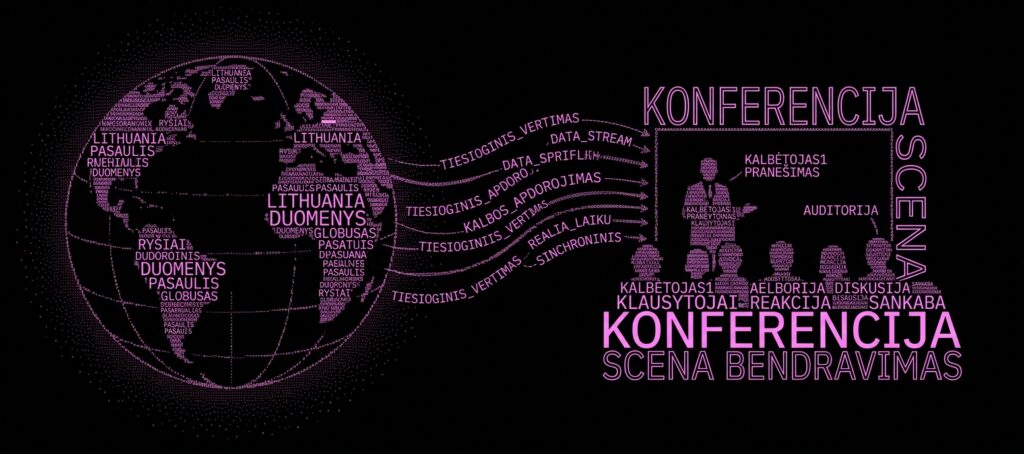
Lithuania holds more electronic money institution (EMI) licenses than any EU country except the UK, hosts a laser technology ecosystem of 60+ companies that exports to 90+ countries, and just drew global headlines when LITEXPO in Vilnius served as the venue for the 2023 NATO Summit. Yet Lithuanian, spoken natively by roughly 3 million people (Ethnologue 2024), remains one of the most linguistically complex languages any event translation system will encounter. Lithuanian event translation is the bridge between a small but fiercely innovative economy and the international conference circuit that fuels it.
This page is for event organizers planning conferences, summits, or corporate gatherings that involve Lithuanian-speaking audiences. It covers the real conferences driving demand, the industries behind them, the specific linguistic challenges that make Lithuanian translation uniquely difficult, and how AI-powered tools handle them.
Why Lithuania’s Conference Scene Punches Above Its Weight
The Fintech and Startup Engine
Lithuania’s startup ecosystem has grown 39-fold in value over the past decade, from EUR 419 million in 2014 to EUR 16 billion in 2024 (China-CEE Institute, 2025). The country is home to three unicorns (Vinted, Nord Security, and TransferGo) and more than 1,000 active startups employing 18,900 people. Vilnius ranks second only to London in the number of licensed EMIs in Europe, with over 80 fintech firms and 282 fintech companies serving more than 30 million customers (Invest Lithuania, 2025).
This fintech density generates constant conference demand. Events like Startup Fair, which returned for its 13th edition at LITEXPO in October 2025 with 2,000+ attendees, 450+ startups, 430+ investors from 65+ countries (Startup Lithuania, 2025), attract a heavily international audience that needs seamless English-Lithuanian communication.
The Laser Nation
Few people outside the photonics community know that Lithuania is a global leader in laser technology. The Lithuanian laser ecosystem consists of more than 60 companies and scientific institutions, exporting 90% of production to over 90 countries (Lithuanian Laser Association, 2025). The annual Lasers. Science and Technologies conference celebrated its 20th edition in 2025, while Baltic Photonics 2025 in Vilnius focused on defence and space applications.
Translation at laser events is not about general business language. It is about femtosecond pulse durations, chirped pulse amplification, and parametric oscillators rendered accurately in real time, with an audience that increasingly includes Korean and Japanese photonics firms seeking Lithuanian partnerships.
Technology Conferences with a Baltic Flavor
Vilnius has built a reputation as a technology conference destination that competes credibly with Tallinn and Riga. DevOps Pro Europe 2026 features 100+ speakers across 6 tracks with 700+ attendees from 35+ countries (DevOps Pro, 2026). DevDays Europe 2026 merges with CyberWiseCon for a joint software development and cybersecurity event. HIPTHER Baltics: Vilnius 2026 brings together iGaming regulation and fintech leaders across the Baltic region (HIPTHER, 2026).
The shared thread: English is the working language for presentations, but networking, side conversations, and local panel discussions happen in Lithuanian. Attendees who cannot follow both streams miss critical context.
Lithuania’s Conference Venues and MICE Infrastructure
LITEXPO: The Baltic States’ Largest Exhibition Center
LITEXPO (Lithuanian Exhibition and Congress Centre) is the anchor venue for Lithuania’s conference industry. With 12 conference and exhibition halls spanning more than 14,000 square meters, a maximum capacity of 8,000 people, and the largest single hall seating 1,800, LITEXPO hosts over 200 events annually attracting more than 100,000 attendees (LITEXPO, 2025). The venue hosted the 2023 NATO Vilnius Summit and the OSCE Ministerial Council meeting in 2011, events that required interpretation across dozens of language pairs simultaneously.
| Venue | City | Capacity | Notable Events |
|---|---|---|---|
| LITEXPO | Vilnius | 8,000 (12 halls, 14,000 sqm) | NATO Summit, Startup Fair, Resta |
| Vilnius Tech Park | Vilnius | 500+ | Tech meetups, fintech networking |
| Compensa Concert Hall | Vilnius | 2,200 seats | Corporate galas, large keynotes |
| Zalgiris Arena | Kaunas | 15,688 seats | Major sporting events, large-scale conferences |
Kaunas, Lithuania’s second city, is emerging as a complementary MICE destination. Its selection as the 2022 European Capital of Culture catalyzed investment in cultural and conference infrastructure.
Industries Driving Lithuanian Event Translation Demand
Fintech and Financial Services
With 282 fintech companies and the EU’s second-largest concentration of EMI licenses, Lithuania’s financial services conference circuit is substantial. The Bank of Lithuania regularly hosts regulatory forums that draw European fintech founders, compliance officers, and regulators. Conferences require precise translation of regulatory terminology: terms like pinigu plovimo prevencija (anti-money laundering) and mokejimo paslaugu direktyva (Payment Services Directive) must be rendered without ambiguity.
Laser Technology and Advanced Manufacturing
The laser sector alone employs thousands and drives an export-oriented conference culture. Technical conferences require interpreters who understand both Lithuanian scientific nomenclature and international photonics standards. Lithuanian researchers publish and present at domestic conferences in their native language, meaning that international attendees need real-time access to content that would otherwise be locked behind a language barrier.
Shared Services and BPO
Nordic companies, particularly Danish (18% of centers) and Norwegian (14%), dominate Lithuania’s shared services sector (Invest Lithuania, 2025). Companies like Nasdaq, Barclays, AIG, and Western Union operate centers in Vilnius. Internal corporate events and training sessions frequently need Lithuanian-English translation, particularly as these centers scale and hire more local talent who are most comfortable presenting operational insights in Lithuanian.
The Lithuanian Language: Why Translation Is Uniquely Challenging
The Most Archaic Living Indo-European Language
Lithuanian holds a singular position in linguistics: it is widely considered the most archaic living Indo-European language, preserving features otherwise found only in ancient Sanskrit and Classical Greek (Britannica, 2024; Antanas Klimas, Lituanus, 1969). This is not a curiosity; it has direct consequences for event translation technology.
Seven Grammatical Cases
Lithuanian nouns decline through seven cases, each with distinct singular and plural forms. A conference title or organizational name must be declined correctly depending on its grammatical role in the sentence. Getting this wrong is immediately obvious to Lithuanian speakers.
Pitch Accent System
Lithuanian retains a pitch accent from Proto-Indo-European. The same syllable can carry a rising or falling tone that changes meaning. Audio processing must be sensitive to pitch contours, not just phoneme sequences.
Complex morphology: Lithuanian verbs conjugate across multiple tenses, moods, and persons, with participial forms that function as subordinate clauses. A single Lithuanian participle can encode information that requires an entire relative clause in English. This morphological density means that Lithuanian text is often 20-30% shorter than its English equivalent, but each word carries more grammatical information, making word-level translation errors more consequential.
Small Speaker Population, Limited NLP Training Data
With approximately 3 million native speakers (Ethnologue 2024), Lithuanian is a low-resource language for natural language processing. The training corpora available for Lithuanian are a fraction of what exists for German, French, or Spanish. The European Language Equality project (ELE, 2022) documented significant gaps in Lithuanian NLP resources, particularly for speech recognition and machine translation in specialized domains.
Why this matters for events: Generic translation engines trained primarily on high-resource languages perform markedly worse on Lithuanian than on Polish or Czech. Event-specific terminology (conference names, institutional titles, industry jargon) is especially vulnerable to mistranslation because these terms rarely appear in general training data. Purpose-built event AI trained on conference-specific Lithuanian audio delivers significantly better results.
Diaspora and Code-Switching
An estimated 800,000-plus Lithuanians live abroad, primarily in the UK, Ireland, the United States, and other EU countries (Lithuanian Ministry of Foreign Affairs, 2024 Diaspora Survey). Diaspora events, such as the Global Lithuanian Leaders Conference, often feature speakers who code-switch between Lithuanian and English mid-sentence. Any translation system handling these events must detect language switches in real time, not just at sentence boundaries.
A Scenario: The Baltic Fintech Summit at LITEXPO
Imagine you are organizing a 2-day fintech summit at LITEXPO in Vilnius. You expect 1,200 attendees: 55% Lithuanian-speaking (including Bank of Lithuania regulators and local fintech founders), 30% English-speaking (Nordic investors, UK-based fintech executives, EU regulatory representatives), 10% from other Baltic states (Latvian and Estonian speakers), and 5% from other European countries.
Traditional interpretation would require 4-6 interpreters covering Lithuanian-English and potentially Lithuanian-Latvian pairs, costing EUR 15,000-25,000 for the two days. Breakout sessions in 4 parallel rooms would double that interpreter count.
How Snapsight changes the equation: Rather than staffing a dozen interpreters across multiple rooms, Snapsight’s AI captures every session in its source language (Lithuanian, English, or the inevitable mix of both) and delivers real-time transcription and translation directly to each attendee’s device. The Bank of Lithuania official’s remarks about elektroniniu pinigu istaigu licencijavimas (electronic money institution licensing) are transcribed in Lithuanian and simultaneously rendered in English with the correct financial terminology. After the event, AI-generated summaries synthesize insights across all sessions regardless of source language.
With 627+ events powered and 10,415+ sessions processed across 75+ languages, operating at 91% autonomy, Snapsight has handled linguistic challenges far more complex than Lithuanian’s case system. But Lithuanian’s low-resource status makes purpose-built event AI particularly valuable: generic tools struggle precisely where specialized systems, trained on event-specific terminology and real conference audio, deliver.
Cultural Context for Event Organizers
Lithuanian Hospitality and Formality
Lithuanian business culture blends Northern European directness with a warmth that emerges over shared meals and social events. Conference networking sessions often include Lithuanian cepelinai (potato dumplings) or local craft beer, and organizers should budget time for informal socializing. Formality matters in official settings: the Lithuanian formal address (jus, equivalent to French vous) is expected in conference presentations and panel discussions, particularly when addressing government officials or senior executives.
Calendar Considerations
- Jonines (Midsummer, June 23-24): A major cultural celebration when many Lithuanians take extended holidays.
- Statehood Day (July 6): Conference attendance may drop.
- Restoration of Independence Day (March 11): Another period of reduced business activity.
- Basketball culture: Lithuania is basketball-obsessed. Corporate events that incorporate basketball references or schedule around Lithuanian Basketball League games resonate with local attendees.
How Snapsight Handles Lithuanian Events
During Your Event
- Attendees scan a QR code or follow a link, no app download required
- Select Lithuanian, English, or any of 75+ supported languages as their preferred output
- Receive real-time content in their chosen language: live transcription with Lithuanian morphological accuracy, simultaneous translation across all active language pairs, session summaries, and bidirectional Q&A translation
After Your Event
- Cross-session synthesis connects insights from Lithuanian-language breakout rooms with English-language keynotes
- Searchable transcripts in both languages, so the Latvian investor and the Lithuanian regulator can both find the moment when the EMI licensing policy was discussed
- Executive briefs delivered in the language each stakeholder prefers
Generic translation tools trained on high-resource languages produce passable results for Spanish or French. For Lithuanian, with its pitch accent, seven cases, and limited NLP corpora, the gap between generic and purpose-built is enormous. Snapsight’s event-specific AI handles femtosekundiniai lazeriai (femtosecond lasers) and reguliacine smelio deze (regulatory sandbox) with the precision that Lithuanian-speaking attendees expect.
Traditional Lithuanian-English simultaneous interpretation typically runs EUR 1,200-1,800 per interpreter per day in the Lithuanian market. A 2-day event with 4 parallel tracks needs 8-12 interpreters (working in pairs for each room), putting the total at EUR 20,000-40,000 before equipment rental. AI-powered solutions like Snapsight can reduce this cost by 60-80% while covering unlimited parallel sessions.
Lithuanian’s seven grammatical cases and pitch accent system make it one of Europe’s most challenging languages for automated translation. Generic tools often produce grammatically incorrect output, including wrong case endings or mishandled participles. Purpose-built event AI trained on conference-specific Lithuanian audio performs significantly better than general-purpose engines, particularly for technical and financial terminology.
No. While Lithuanian and Latvian are both Baltic languages and share a common ancestor, they are not mutually intelligible. A Lithuanian speaker cannot understand spoken Latvian without dedicated study, and vice versa. Events with both Lithuanian and Latvian attendees need separate translation streams. For organizers running Latvian event translation alongside Lithuanian, Snapsight handles both as distinct language outputs from a single platform.
Fintech (Lithuania holds the EU’s second-most EMI licenses), laser technology and photonics (60+ companies exporting to 90+ countries), shared services (Nordic companies operating BPO centers in Vilnius and Kaunas), and life sciences are the primary drivers. Government and EU-related events in Vilnius also generate significant demand, especially following Lithuania’s raised profile from the 2023 NATO Summit.