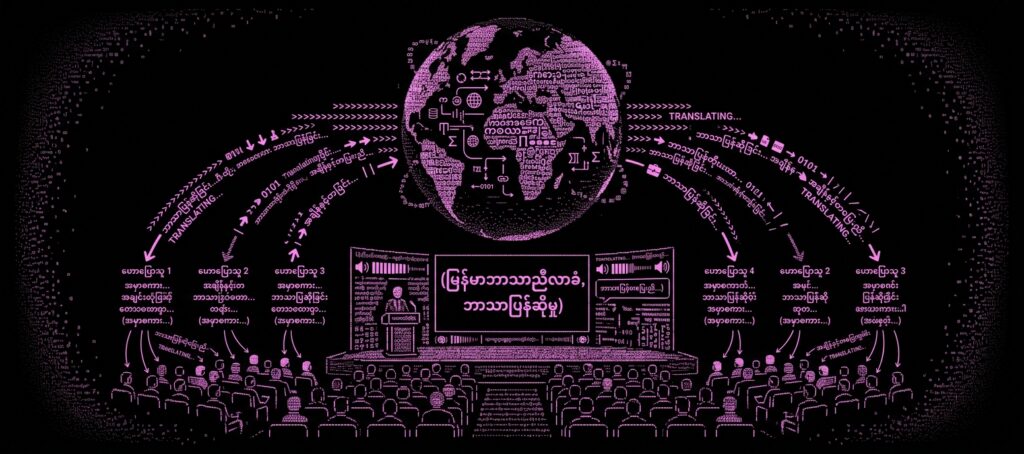
Real-time Burmese translation for conferences, summits, and multilingual events. With 33 million native speakers and 10 million second-language users concentrated in Myanmar and spread across a significant global diaspora, Burmese event translation serves a distinctive audience: ASEAN diplomatic gatherings, humanitarian and development conferences, diaspora community events, and the emerging commercial sectors that connect Myanmar to the wider world. Snapsight delivers AI-powered Burmese translation alongside summaries, takeaways, and cross-session intelligence, handling a language that most translation platforms treat as an afterthought.
Why Burmese Event Translation Matters in 2026
A Language Shaped by Crisis and Diaspora
Burmese occupies a unique position among world languages. It is the official language of Myanmar, spoken as a first language by 32.9 million people and used by approximately 42.9 million total, yet it appears at far fewer international events than languages with comparable speaker populations. The reason is political: Myanmar’s military coup in 2021 and the ongoing civil conflict have disrupted the country’s domestic conference industry, but they have simultaneously amplified the need for Burmese translation at events happening everywhere else.
Consider where Burmese translation is now critical:
- Humanitarian summits, including the High-Level Conference on Rohingya Muslims and Other Minorities in Myanmar at the UN General Assembly in September 2025, which brought together diplomats, NGOs, and affected communities requiring real-time Burmese interpretation
- ASEAN meetings, including the 2025 ASEAN Summits in Kuala Lumpur, which reviewed implementation of the Five-Point Consensus on Myanmar, with Burmese stakeholders participating remotely and in person
- Diaspora conferences, with between 1.5 and 2 million Burmese nationals living in Thailand alone, and significant communities in Malaysia, South Korea (27,000+), Australia (62,000+ of Burmese ancestry), and the United States
- Development sector events, including the IOM Myanmar Crisis Response Plan 2026, which coordinates multisectoral humanitarian assistance, generating conferences across donor capitals
Myanmar was bypassed for the ASEAN chair role in 2026 (the Philippines assumed it instead), but this has not reduced the volume of Myanmar-related events. Every UN Security Council private meeting on Myanmar, every donor roundtable, every civil society gathering requires Burmese language access.
The Diaspora Event Landscape
Myanmar’s diaspora is the world’s fifth-largest refugee population, with 1.2 million refugees and asylum seekers as of 2021. This diaspora is not passive: it organizes.
| Diaspora Hub | Estimated Population | Event Types |
|---|---|---|
| Thailand | 1.5-2 million | Worker rights forums, cultural festivals, Thingyan celebrations |
| Malaysia | 150,000+ | Refugee community conferences, advocacy gatherings |
| Australia | 62,000+ (ancestry) | Professional diaspora networks, cultural associations |
| United States | 180,000+ | Democracy advocacy events, community conferences, academic symposia |
| South Korea | 27,000+ | Migrant worker forums, cultural exchange events |
These events frequently operate in Burmese alongside the host country’s language and English, creating genuine trilingual translation needs.
Myanmar’s Commercial Sectors Still Generate Events
Despite political turmoil, Myanmar’s key industries continue to participate in international events:
- Energy and natural gas: Myanmar holds Southeast Asia’s fifth-largest natural gas reserves, and companies like PTTEP (Thailand) and POSCO International (South Korea) attend regional energy conferences where Burmese-speaking stakeholders participate
- Gems and jade: Myanmar produces approximately 70% of the world’s jade and hosts the Myanmar Gems Emporium, one of Southeast Asia’s most significant gem trading events
- Garment manufacturing: The Myanmar International Textile & Garment Industry Exhibition (MTG) draws international buyers and suppliers to Yangon
- Agriculture: Rice, pulses, and fisheries generate trade events across the Mekong region
Why Burmese Is One of AI Translation’s Hardest Challenges
Burmese is not simply “another Southeast Asian language” for AI systems. It presents a compounding set of technical problems that make it one of the most difficult languages for automated translation, and understanding these challenges is essential for choosing the right technology.
The Zawgyi vs. Unicode Encoding Crisis
This is the single biggest technical obstacle for Burmese digital language processing, and most event organizers have never heard of it.
Over 90% of devices in Myanmar historically used Zawgyi encoding rather than Unicode, creating two competing digital representations of the same language. A Burmese character encoded in Zawgyi looks identical on screen but is represented by completely different byte sequences than the same character in Unicode. The result: search engines return inaccurate results, text processing breaks silently, and translation engines trained on one encoding produce garbage when fed the other.
Myanmar’s government mandated a Unicode transition in 2019, but the reality on the ground remains mixed. Any Burmese translation system must handle both encodings or risk failing for a significant portion of users.
No Word Boundaries
Unlike English, Burmese does not use spaces to separate words. Characters flow together in continuous script, and word segmentation, the act of determining where one word ends and another begins, becomes a prerequisite for any NLP task. Researchers have identified six different segmentation rules based on combinations of root words, prefixes, suffixes, plural markers, possessive particles, and compound word breakpoints.
The Circular Script
Burmese script is visually distinctive: its rounded, circular letterforms evolved from writing on palm leaves (straight lines would tear the leaves). The script is an abugida, where each character represents a consonant with an inherent vowel that can be modified by diacritical marks above, below, before, or after the base character. This stacking behavior creates rendering complexity that simpler scripts do not encounter.
Tonal and Register Complexity
Burmese is a tonal language with three primary tones (low, high, and creaky) plus two special registers (stopped and reduced). Tone changes meaning: the syllable “ma” can mean “hard,” “lift,” “from,” or serve as a negative particle depending on tone. For live event transcription, distinguishing tones from audio input is critical to accuracy.
Additionally, Burmese operates with significant diglossia: formal literary Burmese differs substantially from spoken colloquial Burmese in vocabulary, grammar, and particle usage. Formal speech at conferences draws heavily on Pali and Sanskrit loanwords, while informal discussion uses native Burmese vocabulary.
A Genuinely Low-Resource Language
The BURMESE-SAN benchmark, published in early 2026, found that Burmese performance in large language models “depends more on architectural design, language representation, and instruction tuning than on model scale alone.” Research on Thai-Myanmar-English neural machine translation confirms that regional fine-tuning and Southeast Asia-specific language models yield substantially better results than general-purpose systems.
How Snapsight Handles Burmese Events
During Your Event
- Attendees access via QR code or link, no app downloads, critical for events where attendees may have limited device storage or bandwidth
- Select Burmese as preferred language, interface switches immediately, with Unicode-standard rendering
- Receive real-time translated content: live transcription in Burmese, session summaries in Burmese, key takeaways in Burmese, and Q&A translated bidirectionally between Burmese and the source language
Custom Vocabulary for Myanmar-Related Events
- Humanitarian vocabulary: IDP (internally displaced person), cluster system, protection mandate, repatriation frameworks
- ASEAN diplomatic terminology: Five-Point Consensus, ASEAN Way, non-interference principle, centrality
- Energy and extractive industry terms: PSC (production sharing contract), upstream/downstream, LNG specifications
- Buddhist cultural terms: Thingyan, Waso, Kathina, Theravada terminology that appears at cultural events
Beyond Translation: Burmese Event Intelligence
AI-Generated Summaries
Every session summarized in Burmese with appropriate register: formal for plenary addresses, accessible for workshop discussions. Attendees who miss sessions or need to review content receive comprehensive Burmese-language summaries.
Cross-Session Intelligence
For multi-day conferences on Myanmar issues, from donor coordination meetings to ASEAN track-two dialogues and diaspora conventions, Snapsight identifies themes and patterns across sessions and delivers them in Burmese. A humanitarian worker attending a three-day coordination conference receives synthesized intelligence, not just raw translations of individual sessions.
Personalized Content Delivery
- Diplomats and government officials receive strategic summaries with formal register
- NGO and humanitarian workers receive operational details and action items
- Researchers and academics receive data points and methodology references
- Community members receive accessible summaries in everyday Burmese
Burmese Translation for Different Event Types
Humanitarian and Development Conferences
These are currently the highest-volume category for Burmese event translation:
- UN General Assembly events, including the 2025 High-Level Conference on Rohingya requiring Burmese interpretation for affected community representatives
- Donor coordination meetings by World Bank, ADB, and bilateral donors on Myanmar’s humanitarian crisis
- Civil society forums organized by human rights organizations convening regular events with Burmese-speaking participants
- Academic conferences, including the State of Myanmar Annual Strategic Review (SOM2026) by ISP-Myanmar
ASEAN and Regional Diplomatic Events
ASEAN’s engagement with Myanmar generates year-round multilingual events. The bloc’s decision to bar Myanmar from political representation at summits has not reduced the number of Myanmar-focused side events, working groups, and track-two dialogues. These events typically require Burmese alongside English, Thai, Bahasa Melayu, and other ASEAN languages.
Trade and Commercial Events
Despite challenges, commercial events continue: the Myanmar Gems Emporium (one of the world’s largest jade and gem auctions), MTG (drawing international buyers to Yangon), SMART Myanmar energy events (renewable energy solutions for the garment sector), and regional agricultural trade events across the Mekong region.
Why Choose Snapsight for Burmese Event Translation
Specialized, Not Generic
Burmese requires specialized handling. Snapsight’s custom vocabulary system, encoding-aware processing, and register configuration address the specific challenges that generic platforms ignore.
75+ Languages, One Platform
If your event includes Burmese alongside English, Thai, or Bahasa, one platform handles everything. No separate vendor for each language.
Snapsight has processed 10,415+ sessions across 627+ events in 75+ languages, operating at 91% autonomy. Burmese is part of our Southeast Asian language cluster, supported alongside Thai and Khmer. The world’s most important events trust Snapsight: Reuters, IBM, Siemens, Singapore Government. ISO 27001 and SOC 2 certified, critical for humanitarian and diplomatic events where content sensitivity is paramount.
Frequently Asked Questions
Snapsight processes Burmese content in Unicode, the international standard. For events with attendees using Zawgyi-encoded devices, we recommend ensuring content is delivered through our web-based interface, which renders in standard Unicode regardless of device encoding settings.
Snapsight’s AI is trained to produce Burmese output in an accessible formal register appropriate for conference and event settings. Custom vocabulary configuration allows organizers to add domain-specific terminology for humanitarian, diplomatic, or commercial contexts.
Snapsight’s 75+ language support focuses on major world languages. For events requiring ethnic minority language support from Myanmar, we recommend discussing your specific needs with our team to explore available options.
Yes. Snapsight’s browser-based access is particularly advantageous for events with remote Burmese-speaking participants, who may be connecting from Myanmar, refugee camps in Bangladesh or Thailand, or diaspora locations worldwide, often with limited bandwidth and device capabilities.
Burmese remains a low-resource language for AI, meaning accuracy will generally be lower than for high-resource languages like French or Mandarin. Snapsight provides the best available AI-powered solution and is transparent about capabilities. For high-stakes diplomatic contexts, we recommend AI-assisted translation alongside human interpreters.