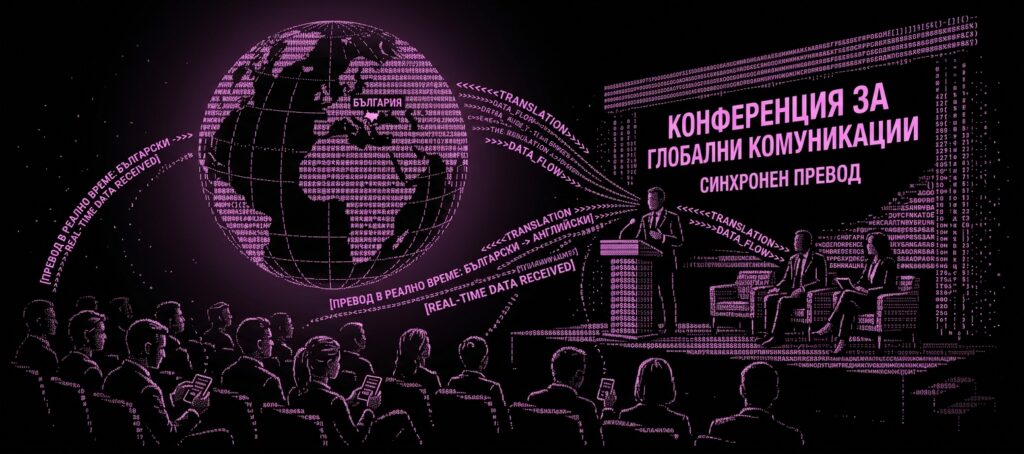
Bulgaria gave the world the Cyrillic alphabet, created in the First Bulgarian Empire during the 9th century at the Preslav Literary School, officially adopted in 893 AD, and now used by over 250 million people across Russia, Ukraine, Serbia, and beyond. Yet when international event organizers think about multilingual challenges, Bulgarian rarely comes to mind. That is changing. Sofia hosted MCE Central & Eastern Europe in February 2026, the National Palace of Culture draws major international congresses with its 123,000 square meters of functional space and 12 halls seating up to 4,000, and the Webit Festival regularly attracts 3,500+ leaders from over 100 countries to discuss technology and innovation. For any organizer running events in Bulgaria or serving Bulgarian-speaking audiences, Bulgarian event translation is no longer a niche concern; it is a practical requirement with unique linguistic complexity most platforms are unprepared to handle.
The Bulgarian-Speaking World: Compact but Concentrated
Bulgarian is spoken by approximately 7-8 million native speakers, the vast majority in Bulgaria itself, where 86.2% of the population uses it as their primary language. But the speaker footprint extends well beyond national borders. According to a study by the Bulgarian Academy of Sciences, around 15 million people worldwide speak Bulgarian when including diaspora communities and the broader Bulgarian language continuum.
Significant Bulgarian-speaking communities exist in Turkey, Moldova, Ukraine, Greece, Spain (an estimated 300,000), and across Western Europe. In the United States, Bulgarian communities concentrate in Chicago, Los Angeles, and New York. Illinois even recognized Bulgarian as an official language in 2005 due to its large Bulgarian population.
Bulgaria’s MICE Landscape: From NDK to Sofia Tech Park
Sofia: The Capital Conference Hub
The National Palace of Culture (NDK) is among the largest multifunctional conference centers in Europe. Opened in 1981, it offers 12 halls with capacity ranging from 100 to 4,000 seats, plus 54 meeting rooms across 123,000 square meters of functional space over eight floors. The NDK hosts the Sofia International Film Festival, international book fairs, and a growing number of business conferences and diplomatic forums.
Sofia Tech Park, Bulgaria’s first science and technology park, has become the anchor for the country’s rapidly expanding tech conference circuit. Bulgaria’s IT sector is a legitimate force in European outsourcing, with Sofia home to offices of major multinationals and a deep talent pool.
Inter Expo Center in Sofia hosts specialized trade exhibitions including the Wine & Spirits Show (seventh edition in 2025) and MastersCONF, a cross-disciplinary conference covering AI, marketing, tech, and management.
Plovdiv: Exhibition Powerhouse
International Fair Plovdiv is the oldest and largest trade fair complex in Southeast Europe. Established in 1892, the complex spans 360,000 square meters with 95,000 square meters of exhibition space, 24 multifunctional pavilions, and a modern Congress Center with 15 halls. It hosts roughly 40 shows annually, drawing 7,000 exhibitors from 58 countries and over 600,000 visitors per year.
Key Industries Driving Bulgarian Event Demand
IT and Outsourcing
Bulgaria has emerged as one of Europe’s most cost-effective IT outsourcing destinations. Events like the SEE ITS Summit, Digitalk, and DEV: Challenge Accepted draw technology leaders to Sofia, with bilingual Bulgarian-English sessions becoming the norm.
Wine and Agriculture
Bulgaria is the world’s largest producer and exporter of rose oil. The Balkans International Wine Competition (now in its 15th edition in 2026) and Vinaria in Plovdiv draw wine professionals from across the Balkans and Western Europe, requiring precise multilingual translation.
Energy and Infrastructure
Bulgaria sits at a strategic crossroads for European energy policy. The country is a transit hub for natural gas pipelines and is pursuing nuclear energy expansion and renewable energy development. Energy conferences in Sofia and along the Black Sea coast bring together policymakers and investors from across the EU, Turkey, and the wider Balkans, requiring Bulgarian-English and often Bulgarian-Turkish and Bulgarian-Greek translation support.
Tourism and Hospitality
Bulgaria’s Black Sea coast (Varna, Burgas, Sunny Beach) and ski resorts (Bansko, Borovets, Pamporovo) drive a tourism industry that generated 5.5% of GDP in recent years. International tourism conferences and hospitality trade fairs held in these resort areas often need multilingual interpretation to serve the diverse mix of Russian, German, British, and increasingly Middle Eastern tourists and investors.
What Makes Bulgarian Linguistically Unique for Events
Cyrillic Script: Born in Bulgaria
Bulgaria is where the Cyrillic alphabet was invented in the 9th century. While this is a point of profound national pride, it creates a practical challenge: any captioning, transcription, or live subtitle system must handle Cyrillic rendering correctly. The Bulgarian alphabet uses 30 letters, including the unique letter “er golyam” (hard sign), which represents a mid-central vowel sound with no direct English equivalent. Display systems, fonts, and text rendering pipelines must be verified for proper Cyrillic support.
The Slavic outlier: Bulgarian is the only Slavic language that has almost entirely eliminated grammatical case declension. While Russian has six cases, Polish seven, and Czech seven, Bulgarian nouns do not change form based on their grammatical role. This simplifies some AI translation tasks, but models trained primarily on Russian or Polish data may over-apply case rules to Bulgarian, producing unnatural output.
Definite Articles as Suffixes
Unlike most European languages, Bulgarian attaches its definite article to the end of the noun rather than placing it before. “Table” is “masa”; “the table” is “masata.” This suffixed article system affects word segmentation in real-time transcription. An AI system that does not properly tokenize Bulgarian words will misidentify where one word ends and another begins, especially in rapid speech.
A Verb System of Unusual Complexity
Bulgarian has nine verb tenses, more than any other Slavic language. Crucially, Bulgarian includes a renarrative mood (preizkazno naklonenie), a grammatical form used to relay events the speaker did not personally witness. In event contexts, a panelist summarizing research findings they did not conduct will naturally use renarrative forms, and a translation system that collapses these into simple past tense loses meaningful nuance. The four distinct past tenses (aorist, imperfect, present perfect, past perfect) each carry different implications about the speaker’s relationship to the events described.
The Head-Shake Problem
Bulgaria is famous for a cultural quirk that confounds international visitors: shaking the head from side to side means “yes” (da), while nodding up and down means “no” (ne). While this is a body language issue rather than a translation issue, it has real implications for hybrid and in-person events where interpreters or moderators must correctly convey agreement and disagreement. Event briefing materials should flag this for international speakers and moderators.
A Scenario: The Southeast European Cybersecurity Conference in Sofia
Imagine you are organizing a cybersecurity conference at the National Palace of Culture in Sofia. You expect 800 attendees: 55% Bulgarian-speaking, 25% English-speaking (from the UK, US, and Western Europe), 10% Turkish-speaking (Bulgaria’s IT sector has strong ties to Turkey), and 10% from other Balkan countries (Serbia, Romania, Greece).
Your keynote speaker is a Bulgarian cybersecurity researcher presenting in Bulgarian with highly technical vocabulary: zero-day exploits, advanced persistent threats, post-quantum cryptography. You have breakout sessions running in parallel across four rooms, with some presenters speaking in English and others in Bulgarian.
Traditional simultaneous interpretation would require at least eight interpreters covering Bulgarian-English, English-Bulgarian, and potentially English-Turkish pairs, at a cost of 15,000-25,000 euros for a two-day event. Finding interpreters who can handle cybersecurity terminology in Bulgarian-English is a thin market.
How Snapsight handles this: Rather than staffing eight interpreters across four language directions, Snapsight’s real-time transcription captures each session in its source language, then delivers live translation to every attendee’s device simultaneously. The Bulgarian researcher’s presentation is transcribed in Bulgarian Cyrillic and made available in English, Turkish, and Greek in real time. After the event, AI-generated summaries synthesize insights from all sessions regardless of source language. Across 627+ events and 10,415+ sessions in 75+ languages, Snapsight’s AI handles the Cyrillic script rendering, suffix-article word boundaries, and complex verb tense system that trip up generic translation tools.
Regional Connections: The Balkan Conference Circuit
Bulgarian event translation rarely exists in isolation. The Balkan conference circuit means that events in Sofia frequently draw attendees from Serbia and Romania, creating multilingual environments where Bulgarian, Serbian, Romanian, Turkish, Greek, and English all coexist.
This regional dynamic matters for translation strategy. Bulgarian and Serbian are closely related South Slavic languages with significant mutual intelligibility in written form, but they diverge substantially in spoken register and technical vocabulary. Romanian, despite geographic proximity, is a Romance language with an entirely different grammatical structure. An event in Sofia serving a pan-Balkan audience needs a translation approach that handles this linguistic diversity without treating all Slavic languages as interchangeable.
The event translation hub covers Snapsight’s full multilingual capabilities across all 75+ supported languages, including the Balkan language cluster.
Planning a Multilingual Event in Bulgaria: Practical Considerations
- Venue technology readiness: Both the NDK and International Fair Plovdiv have modern AV infrastructure, but organizers should verify Cyrillic display compatibility on all screens, projection systems, and digital signage.
- Calendar awareness: Bulgaria follows the Orthodox Christian calendar for many national holidays. Avoid scheduling conflicts with Easter (which often falls on a different date than Western Easter), Liberation Day (March 3), and Bulgarian Education and Culture Day (May 24).
- Networking culture: Business meetings typically begin with coffee and personal conversation. Toasting with rakia (fruit brandy) is common at evening networking events. Wine culture is deeply embedded, with Bulgaria producing wine for over 5,000 years.
- Internet and connectivity: Sofia has strong broadband and 4G/5G coverage, well-suited for hybrid events and cloud-based translation platforms. Plovdiv and Black Sea resort areas have good but sometimes inconsistent coverage.
Frequently Asked Questions
Professional Bulgarian-English simultaneous interpreters in Sofia typically charge 400-600 euros per day per interpreter, with a minimum two-interpreter team required for sessions longer than 30 minutes. For a two-day conference with multiple parallel sessions, costs can reach 15,000-25,000 euros including equipment rental. AI-powered platforms like Snapsight can cover the same scope at a fraction of the cost while supporting additional languages simultaneously.
Yes, but not all platforms handle it equally well. The key challenge is proper tokenization of Bulgarian words with suffixed definite articles (e.g., distinguishing konferentsiyata as the conference rather than treating it as an unknown word). Snapsight’s AI is trained on Bulgarian language patterns and handles Cyrillic rendering, suffix articles, and the complex verb system natively, producing natural output rather than the stilted translations common with generic engines.
Macedonian and Bulgarian are closely related and largely mutually intelligible, particularly in written form. For most conference contexts, Bulgarian translation will be understood by Macedonian speakers. However, political sensitivities around the linguistic relationship are significant, and some Macedonian-speaking attendees may prefer content labeled as Macedonian even if the underlying translation is similar. Discuss this with your event stakeholders before making a decision.
The National Palace of Culture (NDK) in Sofia is Bulgaria’s premier large-scale conference venue, with 12 halls (up to 4,000 seats), 54 meeting rooms, and 123,000 square meters of space. For trade shows and exhibitions, the International Fair Plovdiv offers the largest exhibition complex in Southeast Europe at 360,000 square meters with 24 pavilions. Both venues support multilingual events with modern AV infrastructure.
It can create genuine confusion. In Bulgaria, shaking the head side to side traditionally means yes, and nodding means no, the opposite of most world cultures. While younger Bulgarians in international business settings often adopt the Western convention, mixed audiences can experience miscommunication during live Q&A, panel discussions, and voting. Event moderators should address this explicitly at the start of sessions with international participants, and interpreters should verbalize agreement or disagreement rather than relying on visual cues.