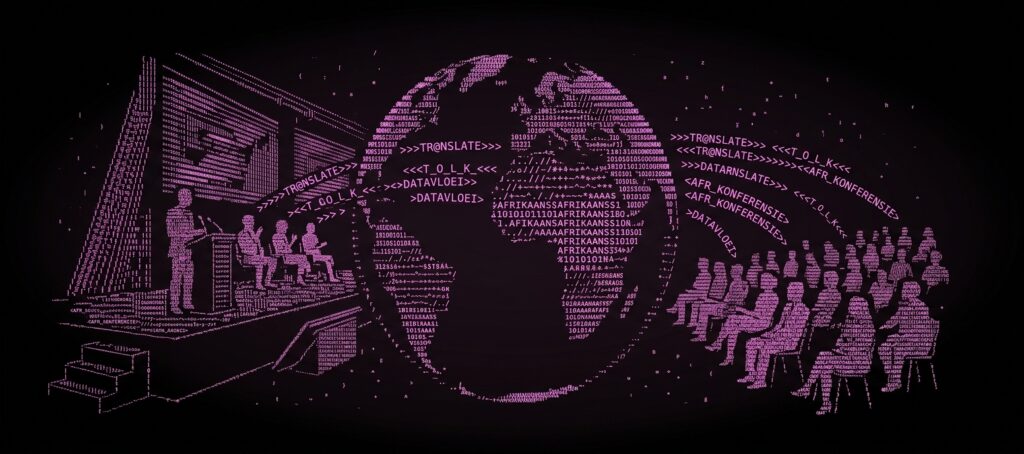
Cape Town jumped 15 places in the 2024 ICCA GlobeWatch rankings to reach 35th globally, hosting 58 qualifying international meetings and retaining its position as Africa’s undisputed leading events city. Johannesburg followed with 23 qualifying meetings. Together, they anchor the continent’s most developed MICE infrastructure, and both operate in a country where 11 official languages shape every conference, every panel discussion, and every delegate interaction (ICCA, 2024 GlobeWatch Rankings).
Afrikaans event translation sits at the center of this multilingual complexity. With approximately 7.2 million native speakers and a total speaker population exceeding 13.5 million across South Africa, Namibia, and a global diaspora stretching to Australia and New Zealand, Afrikaans is the third most spoken home language in South Africa (Census 2022) and the most widely spoken first language in the Western Cape (41.2%) and Northern Cape (54.6%). When Mining Indaba draws record-breaking crowds to the CTICC, when Africa Energy Indaba convenes 1,662 delegates from 37 African countries, when AfricaCom brings 15,000 technology leaders to Cape Town, Afrikaans is not a minority concern. It is the first language of a significant portion of the local business community, academic establishment, and professional workforce that these events depend on.
South Africa’s MICE Market: Scale, Infrastructure, and the 11-Language Reality
World-Class Venues in a Multilingual Nation
South Africa’s conference infrastructure rivals any destination on the planet. The three flagship venues tell the story:
Cape Town International Convention Centre (CTICC) is a 140,855-square-meter complex with two auditoriums (1,500 and 620 seats) that can accommodate up to 10,000 delegates theatre-style. The CTICC sits at the foot of Table Mountain and has hosted everything from Mining Indaba to the World Economic Forum on Africa. Cape Town’s status as Africa’s Best MICE Destination (South Africa Tourism) is built on this venue.
Sandton Convention Centre offers 22,000 square meters of flexible event space across four levels and can host up to 10,000 visitors simultaneously. Located in Africa’s financial capital, it serves as the primary venue for banking, technology, and corporate events where English and Afrikaans are the dominant business languages.
Durban International Convention Centre (Durban ICC) is a 112,000-square-meter facility on Durban’s beachfront, capable of seating 12,000 delegates in plenary configuration. The Durban ICC anchors KwaZulu-Natal’s growing share of international conferences, adding isiZulu to the multilingual equation.
What makes South Africa unique among MICE destinations is not venue quality alone: it is the linguistic environment these venues operate in. No other country hosting international conferences routinely requires translation support across so many official languages. A mining conference in Cape Town might need English, Afrikaans, French (for West African delegates), and Portuguese (for Mozambican participants). A healthcare summit in Durban adds isiZulu. A government policy forum in Pretoria might require Sepedi, Setswana, and Afrikaans alongside English.
The Conference Calendar Driving Translation Demand
South Africa’s event calendar is anchored by conferences that consistently attract international audiences and significant Afrikaans-speaking participation:
Investing in African Mining Indaba is Africa’s largest mining conference, held annually at the CTICC. The 2026 edition delivered record-breaking attendance in its 32-year history, convening mining executives, government officials, and investors from across the continent. Mining terminology in Afrikaans has deep roots: South Africa’s gold and diamond industries were built by Afrikaans-speaking communities, and geological and metallurgical vocabulary retains Afrikaans terms that have no precise English equivalents in local usage.
Africa Energy Indaba, in its 18th edition (March 2026), drew 1,662 conference delegates from 37 African countries, including 15 African energy ministers and 173 expert speakers, with over 4,300 exhibition visitors at the CTICC. Under the theme “Igniting the Power Revolution,” this conference addresses Africa’s energy generation, investment, and infrastructure development, topics where Afrikaans-speaking South African energy professionals are heavily represented (Xinhua, 2026).
Africa Tech Festival (AfricaCom) is Africa’s largest telecoms, media, and technology event, attracting over 15,000 attendees and 300+ exhibitors to the CTICC each November. The 2026 edition is scheduled for November 16-19. Technology conferences in Cape Town draw heavily from the Western Cape’s tech ecosystem, where Afrikaans-speaking developers, entrepreneurs, and investors are a substantial presence (Africa Tech Festival, 2025).
Design Indaba is Cape Town’s annual global creativity conference, simulcast live to cities across South Africa. The creative industries in the Western Cape operate bilingually in English and Afrikaans, and Design Indaba’s audience reflects this dual-language reality.
Beyond these flagships, South Africa hosts Vinexpo (wine industry), the International Commodity Summit at the CTICC, African Mining Week, the World Economic Forum on Africa, and dozens of sector-specific conferences in agriculture, finance, and tourism. The wine industry alone, centered in Stellenbosch, Paarl, and Franschhoek, where Afrikaans is the dominant business language, generates a steady calendar of industry events where English-only coverage misses the technical conversations happening between producers, viticulturists, and export managers.
The Afrikaans Language: Why It Deserves Specialized Attention
Afrikaans is sometimes dismissed as “simplified Dutch,” a characterization that is both linguistically reductive and practically misleading for event translation purposes. Understanding what makes Afrikaans distinct is essential for delivering accurate multilingual coverage.
A Germanic Language with African Roots
Afrikaans evolved from 17th-century Dutch spoken by settlers at the Cape, but it absorbed vocabulary and phonological influences from Malay, Portuguese, Khoisan languages, and Bantu languages over three centuries. The result is a language that is structurally Germanic but culturally African, a combination that creates specific challenges for translation systems trained primarily on European language data.
The grammar is notably streamlined compared to Dutch: no grammatical gender for nouns, no case system, minimal verb conjugation (verbs take the same form regardless of person or number), and a double-negative construction (“Ek kan nie Afrikaans praat nie,” literally “I cannot Afrikaans speak not”) that has no equivalent in Dutch or English. This simplification makes Afrikaans one of the easiest languages for English speakers to learn, but it does not make it easy to translate accurately in technical contexts.
Dutch Mutual Intelligibility: A Trap for Event Organizers
Afrikaans and Dutch share an estimated 90-95% lexical overlap in written form. Dutch speakers generally find it easier to understand written Afrikaans than the reverse, an asymmetry that Oxford Academic research attributes to Afrikaans’s simplified grammar making it more transparent to Dutch readers (Digital Scholarship in the Humanities, 2006).
This mutual intelligibility creates a dangerous assumption for event organizers: that Dutch translation can “cover” Afrikaans, or that Afrikaans speakers will simply use Dutch-language services. In practice, this fails in several ways:
- Spoken comprehension drops significantly. Afrikaans pronunciation, rhythm, and intonation differ enough from Dutch that real-time spoken understanding is unreliable, particularly for technical content.
- False cognates create confusion. Words that look identical in writing carry different meanings: “eventueel” means “eventually” in Afrikaans but “possibly” in Dutch; “robot” means “traffic light” in South African usage.
- Cultural context diverges entirely. South African business culture, regulatory frameworks, and industry terminology have no Dutch equivalent. Mining law, BEE (Black Economic Empowerment) policy, and agricultural terminology are deeply localized.
- Political sensitivity matters. Treating Afrikaans as a dialect of Dutch is perceived by many speakers as dismissive of the language’s distinct identity and its complex political history in South Africa.
The 11-Language Challenge
South Africa’s constitution recognizes 11 official languages: Afrikaans, English, isiZulu, isiXhosa, Sepedi, Setswana, Sesotho, Xitsonga, siSwati, Tshivenda, and isiNdebele. In practice, most professional conferences operate in English with varying degrees of Afrikaans usage. But government events, industry conferences with strong local participation, and academic gatherings increasingly require broader language coverage.
This creates a challenge that few translation providers are equipped to handle. A single conference might require English-Afrikaans interpretation for plenary sessions, isiZulu support for community engagement panels, and French or Portuguese for continental African delegates. Managing these language combinations simultaneously, with the technical vocabulary of mining, energy, agriculture, or healthcare, is precisely the kind of complex multilingual operation where traditional human interpretation hits capacity limits.
How Snapsight Handles Afrikaans Event Translation
Snapsight’s event content intelligence platform has processed 10,415+ sessions across 627+ events in 75+ languages. Afrikaans is among those 75+ languages, and our approach to South African conferences reflects the linguistic complexity described above.
Real-Time Multilingual Coverage
The Operator Agent joins sessions autonomously, monitors audio quality, and delivers real-time transcription and translation without manual intervention. For a typical South African conference with Afrikaans and English presentations, the system handles both languages simultaneously. There is no need for separate “Afrikaans sessions” and “English sessions.” When a speaker switches between languages mid-presentation (common in South African professional contexts), the AI tracks the switch and maintains coherent output in the target language.
Code-switching between English and Afrikaans is pervasive in South African business communication. Speakers will use English for formal presentations but shift to Afrikaans for anecdotes, technical asides, or emphasis. A system that only recognizes one language at a time loses these transitions. Snapsight’s 91% autonomous operation rate means these language shifts are handled without human operator intervention.
Beyond Transcription: Cross-Session Intelligence
For multi-day conferences like Mining Indaba or Africa Energy Indaba, the Analyst Agent synthesizes content across sessions to identify patterns, contradictions, and emerging themes. When 15 energy ministers present in different languages over three days, the cross-session analysis delivers insights that no delegate sitting in a single session could capture, regardless of how many languages they speak.
The Insights Agent then delivers personalized intelligence to each delegate in their preferred language. An Afrikaans-speaking mining executive receives session summaries, key takeaways, and relevant cross-references in Afrikaans, even for sessions originally presented in English, French, or Portuguese.
Handling the Dutch-Afrikaans Boundary
Our language models treat Afrikaans and Dutch as distinct languages with separate processing pipelines. This eliminates the false-cognate errors and cultural mismatches that occur when systems treat Afrikaans as a Dutch variant. For conferences with both Dutch and Afrikaans delegates, plausible at international mining or agricultural events, each group receives output calibrated to their actual language, not a compromise between the two.
Practical Scenarios: Where Afrikaans Translation Makes the Difference
Mining and Resources Conferences
When a geological survey team from the Council for Geoscience presents borehole data using Afrikaans technical terminology at Mining Indaba, English-speaking investors need accurate translation of terms that carry specific local meanings. “Mynbou” (mining), “boorgatdata” (borehole data), and “ertsneerslag” (ore deposit) are precise technical vocabulary, not casual synonyms.
Wine and Agriculture Events
Stellenbosch wine conferences operate primarily in Afrikaans. When cellar masters discuss “malolaktiese gisting” (malolactic fermentation) or “oesjaar” (vintage year), English-language delegates need domain-specific translation that general-purpose systems mishandle.
Government and Policy Forums
South Africa’s National Treasury, Department of Mineral Resources and Energy, and provincial governments conduct proceedings in multiple official languages. Translation here requires understanding of legislative terminology, BEE compliance language, and policy frameworks specific to South African governance.
Academic Conferences
Stellenbosch University, the University of the Free State, and North-West University conduct significant academic activity in Afrikaans. Research presentations in agriculture, geology, law, and theology use specialized Afrikaans academic vocabulary that English-language AI systems typically lack coverage for.
Frequently Asked Questions
No. While Afrikaans and Dutch share high written lexical overlap (90-95%), spoken comprehension is substantially lower, and technical, legal, and cultural terminology diverges significantly. False cognates, different idiomatic expressions, and South African-specific vocabulary make Dutch translation unreliable for professional event contexts.
Most business conferences operate in English and Afrikaans. Government events and conferences with broad domestic participation may require three to five languages (adding isiZulu, isiXhosa, or Sesotho). Continental conferences add French and Portuguese for delegates from other African nations. Snapsight supports all 11 of South Africa’s official languages plus 65+ additional languages.
Afrikaans is structurally one of the simpler Germanic languages (no grammatical gender, minimal conjugation), which makes it relatively accessible for AI systems. The challenges are domain-specific: mining, agriculture, and legal terminology; code-switching with English; and the double-negative construction that differs from both English and Dutch. Snapsight’s models are trained on these patterns.
Afrikaans has a complex political history in South Africa, associated with apartheid-era language policies. In modern South Africa, it is spoken by diverse communities across racial lines: 72.6% of coloured South Africans and 58% of white South Africans list it as their home language (Census 2022). Professional event translation should serve all Afrikaans speakers without political implication, simply ensuring that language is not a barrier to participation.
Yes. Snapsight supports Swahili, Amharic, Yoruba, Hausa, and dozens of other languages. For pan-African conferences in Cape Town, Johannesburg, or Durban, we provide simultaneous coverage across all language combinations without requiring separate interpretation booths for each pair.