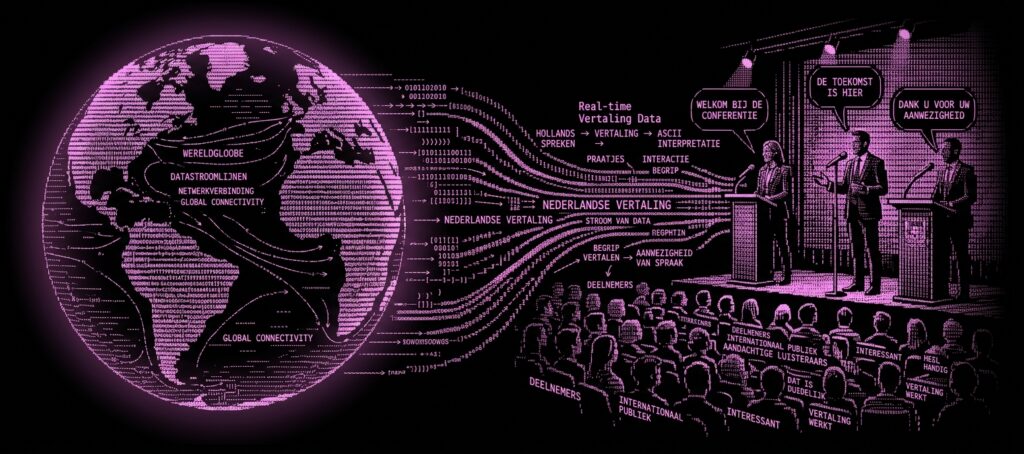
The Netherlands ranked 8th globally in the 2024 ICCA Country and City Rankings, hosting 295 international association meetings (ICCA, 2024). Amsterdam alone hosted 94 of those, generating an estimated EUR 230 million in economic impact. And yet, Dutch event translation is one of the most misunderstood requirements in European event planning, because the Dutch speak English so well that organizers assume translation is unnecessary.
That assumption costs events more than they realize. Dutch event translation matters not because the Dutch cannot understand English, but because the Netherlands sits at the crossroads of a 25-million-speaker language community that extends into Belgium, Suriname, and the Dutch Caribbean, and because the events held on Dutch soil draw audiences far more linguistically diverse than a quick glance at the country’s English proficiency scores would suggest.
The Dutch Paradox: English Fluency Meets Multilingual Reality
1. The Audience Is Not Just Dutch
Amsterdam RAI hosts approximately 50 international conferences and 70 trade shows annually, facilitating some 500 events per year in total. IBC drew 43,858 visitors from 170 countries in 2025. Aquatech Amsterdam attracted 20,483 attendees from 136 countries. These are global gatherings that happen to take place in the Netherlands.
2. The Flemish Factor: 6.5 Million Belgian Dutch Speakers
Approximately 6.5 million people in Belgium’s Flanders region speak Dutch as their first language, roughly 60% of Belgium’s total population. The differences between Netherlandic Dutch and Flemish Dutch are not trivial: vocabulary diverges, pronunciation differs, and formality registers operate differently.
Belgium’s trilingual reality (Dutch, French, German) creates a unique interpretation challenge. For how French fits into this picture, see our French event translation guide.
3. Beyond Business English: Depth Versus Surface
There is a measurable difference between understanding a keynote in a second language and absorbing it in your mother tongue. Research in cognitive processing consistently shows that comprehension, retention, and engagement are higher in a listener’s first language, even when they are functionally bilingual.
The Netherlands as an Event Powerhouse
| Event | Venue | Attendance | Industry |
|---|---|---|---|
| IBC | Amsterdam RAI | 43,858 from 170 countries (2025) | Media, broadcasting |
| Aquatech Amsterdam | Amsterdam RAI | 20,483 from 136 countries (2025) | Water technology |
| Offshore Energy (OEEC) | Amsterdam RAI | 7,000+ from 80+ countries | Energy, maritime |
| TEFAF Maastricht | MECC Maastricht | 277 dealers from 24 countries (2026) | Fine art, antiques |
| INTERCLEAN Amsterdam | Amsterdam RAI | Biennial | Professional cleaning |
Five Event Cities, Five Different Characters
Amsterdam
The international gateway. Amsterdam RAI handles the largest conventions and trade shows. Schiphol Airport puts Amsterdam within two hours of most European capitals.
Rotterdam
Engineering, maritime, and logistics. Rotterdam Ahoy’s dedicated convention centre (RACC), opened in 2020. Events lean toward energy, shipping, and architecture.
The Hague
International law and governance. Home to ICJ, ICC, and 200+ international organizations. Dutch-English-French interpretation is standard here.
Utrecht & Eindhoven
Utrecht’s Jaarbeurs for healthcare and education events. Eindhoven driven by Philips, ASML, and the Brainport ecosystem for innovation-focused events.
Dutch Language Challenges for Event Translation
- Word order: Dutch uses V2 word order in main clauses but verb-final in subordinate clauses, creating translation latency for simultaneous interpretation
- Compound words: like German, Dutch builds compounds freely (evenementenlocatie, simultaanvertaling, congresorganisator)
- The de/het problem: two grammatical genders with no consistent rule for which nouns take which article. Gender assignment errors are the most visible sign of poor Dutch translation
- Formal vs. informal address: u (formal) vs. jij/je (informal). Business events expect u; startup meetups may use jij
- Flemish vs. Netherlandic: vocabulary differences (gsm vs. mobiel), pronunciation, and formality levels differ between Belgian and Dutch variants
Dutch Business Culture and Event Norms
The Poldermodel: Dutch decision-making follows a deeply ingrained cultural preference for consensus-building through discussion. Panels are expected to involve genuine debate. Q&A sessions run long because the audience expects to participate substantively. A system that only translates the speakers and ignores the audience misses a fundamental element of how Dutch events function.
Directness and efficiency: Presentations are expected to be substantive with no padding. If translation introduces ambiguity or softens a speaker’s directness, Dutch attendees will notice and lose trust.
Sustainability as standard: Dutch venues increasingly operate on renewable energy and minimize waste. AI-powered translation delivered through attendees’ own devices aligns naturally with the Dutch sustainability ethos, unlike shipping physical equipment and flying in interpreter teams.
How Snapsight Handles Dutch Events
Snapsight has processed 10,415+ sessions across 627+ events in 75+ languages. Dutch is a core European language in our platform.
During the Event
- Attendees connect via QR code or link: no app installation required
- Select Dutch (or any preferred language) from 75+ options
- Receive real-time: live transcription, AI-generated summaries, key takeaways, and bidirectional Q&A translation
Dutch-Specific Capabilities
- Flemish and Netherlandic handling: processes both variants without separate configuration
- Compound word recognition: technical Dutch compounds are decomposed and translated accurately
- Register awareness: formal (u) and informal (jij) contexts maintained
- Benelux language pairs: Dutch-French, Dutch-German, and Dutch-English handled simultaneously
Beyond Translation: Event Intelligence in Dutch
AI-generated summaries of every session in Dutch, available before the attendee leaves the venue. Cross-session synthesis identifying themes across your entire program. Personalized insights based on each attendee’s role and interests. Post-event content extending the life of your event from three days to three months.
The Operator Agent manages all of this autonomously, with 91% of sessions requiring zero human intervention.
Frequently Asked Questions
Not every Dutch event needs translation, but far more do than organizers assume. Events with Flemish Belgian attendees, EU institutional participants, Southern or Eastern European delegations, or audiences from Suriname benefit significantly from Dutch (and other language) support. Even for fully Dutch audiences, providing native-language AI summaries and takeaways increases content retention and post-event engagement.
Traditional Dutch-English simultaneous interpretation typically costs EUR 800-1,200 per interpreter per day, with a minimum of two interpreters per language pair. For a two-day conference with three language pairs, that translates to EUR 9,600-14,400 in interpreter fees alone, before equipment rental. AI-powered solutions like Snapsight reduce this cost substantially while covering every session, not just plenary presentations.
Yes, though the quality varies by provider. Snapsight’s platform processes both variants and accounts for vocabulary differences (such as gsm vs. mobiel or schoon meaning clean in Flemish vs. beautiful in some Netherlandic contexts). For events serving both Dutch and Belgian audiences, this distinction matters for credibility and engagement.
Dutch-English is the most common pair by volume, but Dutch-French (driven by Benelux events), Dutch-German (driven by cross-border business with Germany), and English-to-multiple-languages (for large international trade shows) are all standard. Events at The Hague’s World Forum frequently require Dutch-French-English-Spanish as a baseline, with Arabic and Mandarin added for diplomatic events.