


A room goes quiet at the end of a session for reasons that have little to do with the talk. Research on hearing, second languages, fear of public speaking and who asks first explains most of why nobody asks questions, and each cause has a fix an organizer can apply before the next session starts.
Key Takeaways
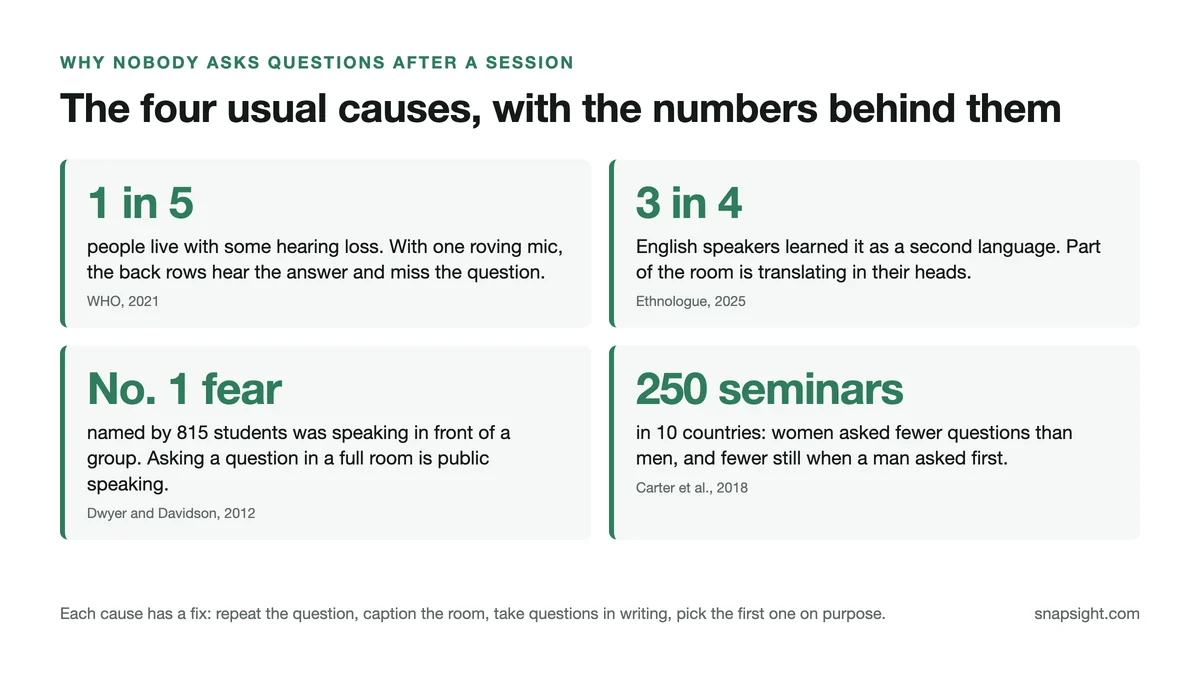
- More than 1.5 billion people live with some hearing loss (WHO, 2021). With one roving mic, the back rows hear the answer and miss the question.
- Of about 1.5 billion English speakers, roughly 3 in 4 learned it as a second language (Ethnologue, 2025). Many people in the room are translating in their heads.
- Asking a question is public speaking, and speaking in front of a group was the most common fear among 815 students (Dwyer and Davidson, 2012).
- Across about 250 academic seminars, women asked fewer questions than men, and fewer still when a man asked first (Carter et al., 2018).
Why Nobody Asks Questions: The Four Usual Causes
Four reasons cover most of why nobody asks questions: part of the room didn’t hear the question, part of the room is listening in a second language, asking means speaking in public, and nobody set the tone with a first question. A quiet room is rarely a bored room. Most of the time it is a room nobody made it easy to speak in.
How Many People Didn’t Hear the Question?
More than you think. The World Health Organization counts more than 1.5 billion people with some degree of hearing loss, nearly one in five people worldwide. With one roving microphone, the question goes into the room and the answer into the stage mic, so the back rows get half the exchange.
The fix: repeat every question into the stage microphone before answering it. It costs five seconds.
Is Half the Room Translating in Their Heads?
Probably. Ethnologue’s 2025 figures put English at about 1.5 billion speakers, and only around 390 million learned it first. At an international event most of the audience is working in a second language, and that costs them: in speech-in-noise studies, non-native listeners needed 1 to 10 dB better signal-to-noise ratio to follow sentences as well as native listeners (Steeneken and others, 2002; Bidelman and Dexter, 2015).
The fix: brief speakers to drop idioms and put the key words on the slide, and give the room a way to read along. Live captions on attendees’ own phones do that without any extra hardware.
Why Don’t People Raise Their Hands?
Because asking a question in front of 300 strangers is public speaking, and that fear is the biggest single reason why nobody asks questions. When Dwyer and Davidson asked 815 students to pick their biggest fears in 2012, speaking in front of a group came up most often, ahead of heights and deep water. And the first question matters more than the rest: in a study of about 250 seminars in 10 countries, women asked fewer questions than men overall, and fewer still when a man asked first.
The fix: let people ask without the mic, by card, text or a link on the screen, and read one of those out first. Then choose the opening question on purpose, not the fastest hand.
What Should the Moderator Say?
Most moderators improvise the Q&A, then wonder why nobody asks questions. These lines fit on a card.
| Moment | Say this |
|---|---|
| At the start | “Questions are open from now, not just at the end. Send them in, with or without your name.” |
| Halfway | “Quick one for the room before we go on.” |
| First question | “Let’s start with one that was sent in.” Read it exactly as written. |
| From the floor | “The question was…” Repeat it into the mic, every time. |
| Silence | “While you think, here’s one I wanted to ask.” |
| Closing | “Before you go: what’s one thing you’ll use this week?” |
Does Asking Halfway Through Help?
Yes, and it deals with one more reason why nobody asks questions at the end: attention has already gone. Bunce, Flens and Neiles tracked attention in lectures in 2010 and found it came and went in cycles that got closer together as the hour went on. A question or a demo slowed the drift, even after it ended.
The closing question matters too. In Roediger and Karpicke’s 2006 study, people who read a text once and then practised recalling it remembered 61% a week later, against 40% for people who read it four times. “What’s one thing you’ll use this week?” is a recall exercise disguised as a goodbye.
FAQ
How do you get a conference audience to ask questions?
Open questions at the start instead of the end, give people a way to ask without standing up (a card, a text, a QR link), repeat every question into the stage microphone, and choose the first question on purpose. Keep two starter questions ready for the silence.
Why do women ask fewer questions at conferences?
A study of about 250 seminars in 10 countries (Carter et al., PLOS ONE, 2018) found women asked fewer questions than men, and fewer still when a man asked first. The first question sets the tone for who feels able to speak, so pick it deliberately.
Should you collect questions before the session?
Yes. Written questions remove the public-speaking fear that stops most people, and reading one out first gives the room permission to follow.
Bottom Line
Why nobody asks questions is a design problem, not an audience problem. Repeat every question, take questions in writing, pick the first one deliberately, ask one halfway and close with a recall question. The honest limit is that none of this rescues a talk nobody wanted to hear. If the room reads along on their phones anyway, Snapsight’s free plan includes basic Q&A and polls beside the live text, so written questions arrive on the same screen. Snapsight is an event content intelligence platform; the Q&A is one small part of it.
Try it in one room
Put a QR code on the holding slide and let the quiet ones type. Start free, or book a demo.