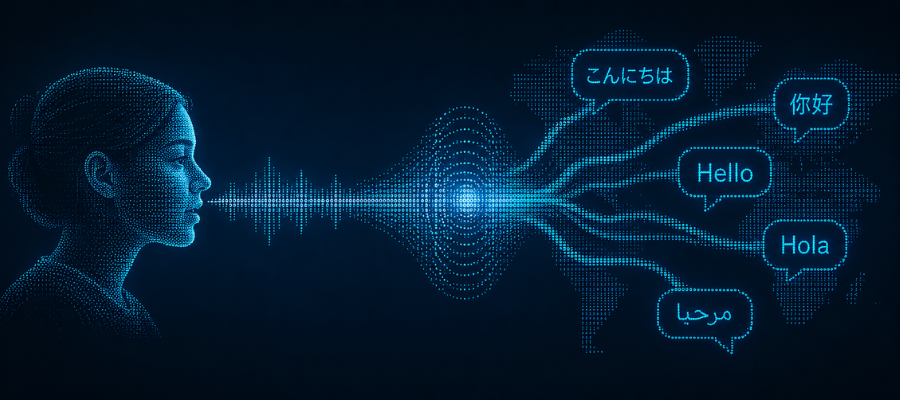

Speech-to-speech translation takes spoken words in one language and produces spoken words in another, streamed back as natural audio in real time. A speaker talks, and seconds later attendees hear a translated voice in their own language through their earphones, with no typing, no reading, and no booth.
For years, “live translation” at events actually meant a relay race of separate technologies stitched together. It worked, but you could feel the seams: a beat of delay, a flat robotic voice, the sense of always being a half-step behind the room. A new generation of speech-to-speech engines is closing that gap. Here is how the technology works and why it matters for anyone running a multilingual event.
What “Speech-to-Speech” Actually Means
Most real-time translation you have heard at events was built as a three-step pipeline. A speech-to-speech engine does the whole job in one continuous stream instead. The difference is easiest to see step by step.
The old way: three separate steps
First, speech is converted to text. Then the text is translated. Then text-to-speech reads it aloud. Each handoff between systems adds delay and strips away tone, so the result is accurate but lagging, and it sounds robotic.
The new way: one real-time stream
A speech-to-speech engine goes directly from spoken input to translated spoken output in a single stream. Removing the handoffs cuts latency dramatically, and far more of the speaker’s natural delivery survives, so the translated voice sounds like a person, not a screen reader.
The practical effect is that translated audio arrives within a few seconds of the original, close enough that attendees experience it as simultaneous. Because the output sounds human, the audience stays emotionally connected to the speaker rather than to a transcript.
Why Latency Is the Whole Game
At a live event, delay is not a minor annoyance. It is the thing that breaks the room. When translation lags by ten or fifteen seconds, attendees laugh after the joke has passed, applaud out of sync, and slowly disengage because they are always reacting late. Cutting latency to a few seconds is what turns translation from a coping mechanism into a genuinely shared experience.
A single-stream engine reduces latency in two ways: it removes the handoffs between separate systems, and it can begin producing translated audio before the speaker has finished a sentence. The best engines also handle the messiness of real speech, continuous talking, natural pauses, strong accents, and speakers who switch language mid-sentence without warning.
What It Means for Your Event
Closer to the speaker
Natural-sounding translated voices keep attendees connected to the person on stage, not a flat readout. The emotion and emphasis of the original carry through.
Ultra-low latency
Translated audio lands within seconds, so the whole room reacts together in real time instead of in scattered waves.
Global by default
Every attendee listens in their own language at once, with no booths, headsets, or per-language setup to manage.
Handles real speech
Continuous talking, accents, and mid-sentence language switches are treated as part of the design, not as rare edge cases that derail the system.
Live Audio vs Live Text: You Want Both
Speech-to-speech powers what Snapsight calls Live Audio, the translated voice attendees listen to. It pairs with Live Text, the translated captions attendees read. They are not competitors. They serve different moments.
- Live audio is best when attendees want to look up at the stage and simply listen. It is the most natural, lowest-effort experience.
- Live Text is best in noisy rooms, for attendees who prefer to read, for accessibility, and for anyone who wants to scan back over a point.
Offering both lets each attendee choose what works for them, instead of forcing one experience on a diverse audience.
What to Ask a Vendor About Speech-to-Speech
- How many input and output languages are live today, versus on the roadmap?
- What is the real latency on continuous speech, not a scripted demo line?
- Does it handle mid-sentence language switching and strong accents?
- Is the session saved as reusable content, or does the audio vanish when the session ends?
Frequently Asked Questions
What is speech-to-speech translation?
Speech-to-speech translation takes spoken words in one language and produces spoken words in another, streamed back as natural audio in real time. At an event, a speaker talks and attendees listen to a translated voice in their own language with only a few seconds of delay.
How is it different from transcribe-then-translate?
The older approach runs three steps: speech to text, then translation, then text-to-speech. Each step adds delay and strips away tone. A speech-to-speech engine collapses this into a single real-time stream from spoken input to translated spoken output, which lowers latency and keeps more of the speaker’s natural delivery.
Should I still offer live captions if I have translated audio?
Often yes. Translated audio is ideal for attendees who want to listen, while live captions help attendees who prefer to read, are in noisy rooms, or need text for accessibility. Offering both lets every attendee choose what works for them.
How Snapsight Brings Speech-to-Speech to Your Stage
Snapsight streams natural translated audio to every attendee in real time, powered by a speech-to-speech engine built for the messiness of live events. Speech goes in, and translated speech comes out, with ultra-low latency and support for speakers who switch language mid-sentence.
Just as importantly, because Snapsight captures every translated session as structured content, the same speech-to-speech session does not disappear when the room empties. Across 627+ events and 10,415+ sessions processed, it becomes summaries, takeaways, and reusable assets, so a single moment on stage keeps working for months.
Key Takeaways
- Speech-to-speech translation turns spoken words into translated speech in one real-time stream
- It replaces the slower three-step transcribe, translate, and read-aloud pipeline
- Lower latency keeps the whole room reacting together and connected to the speaker
- Pair Live Audio (listen) with Live Text (read) so every attendee can choose
- The strongest setups also save the session as reusable content, not just live audio