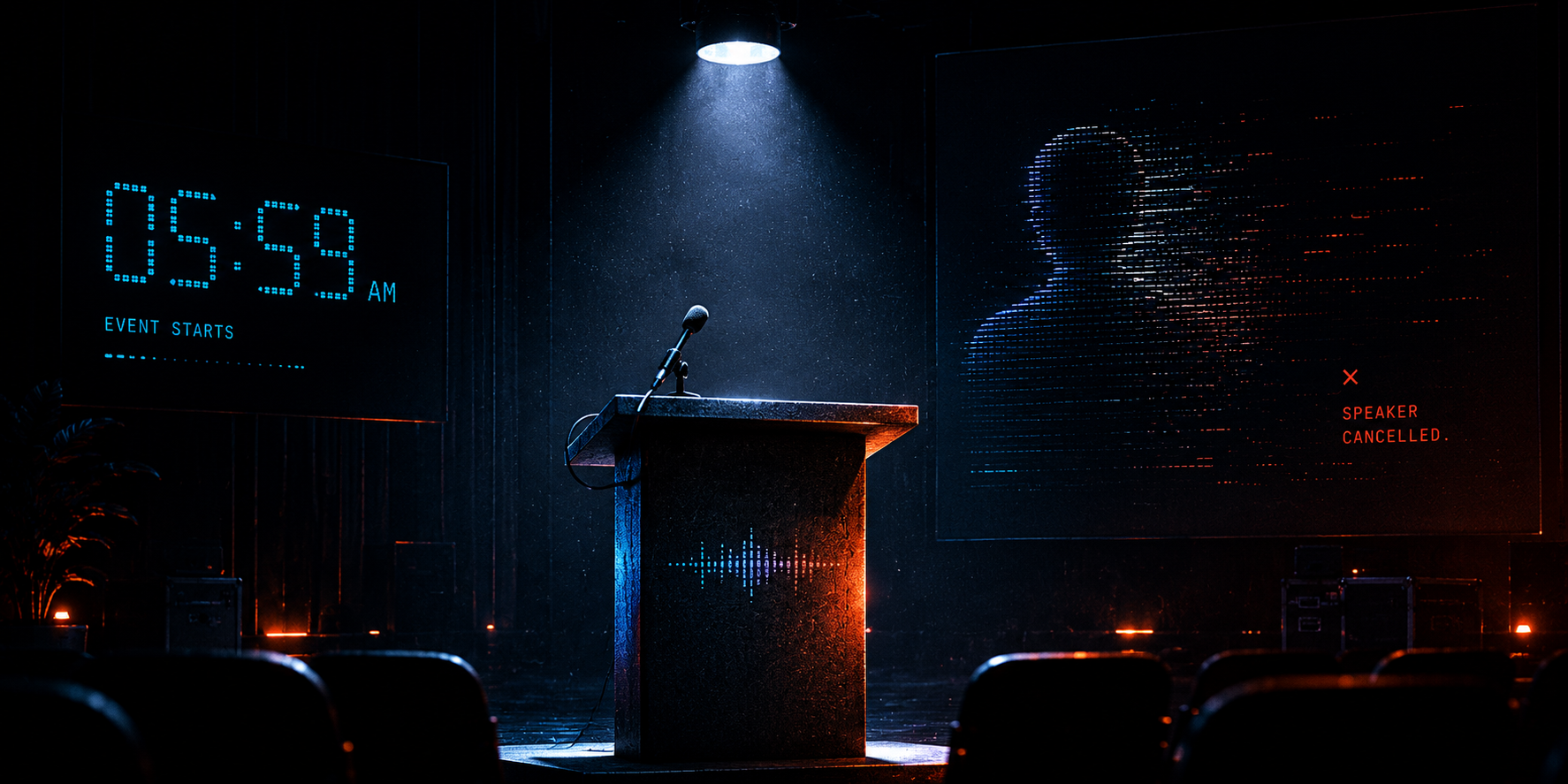

It is 36 hours before your conference opens. Your inbox pings. Your keynote speaker, the name printed on every email blast and registration page for the past four months, has just cancelled. Family emergency. Flight cancelled. Health issue. The reason barely matters. What matters is that 1,200 people are about to walk into a room expecting to hear from someone who is not coming.
This used to be a once-a-year nightmare. In 2026, last-minute speaker cancellations are happening more often than ever. Travel disruption, illness waves, geopolitical shifts, and burnout are all driving up the rate. Most event teams still respond the way they did a decade ago, which is exactly why these moments feel so painful.
Here is the modern playbook for handling a last-minute keynote cancellation without losing your audience or your reputation.
Why Speaker Cancellations Are More Common Now
Cancellations used to be rare enough that most events did not plan for them. That changed quickly. Today, the average major conference deals with one significant speaker drop every 18 months. Three reasons stand out.
Travel is less reliable. Weather disruptions, airline staffing issues, and visa delays have made international travel a daily gamble. A speaker confirming six months out has no idea whether their flight will actually take off.
Senior speakers are stretched thin. The same handful of well-known voices are booked at dozens of events a year. When something has to give, a free speaking slot is the first thing to go.
Health awareness has shifted. Speakers who would have powered through a cold ten years ago now stay home. Audiences expect this and appreciate it.
Accept that cancellations are now part of normal event operations. Plan accordingly.
The Four Worst Things to Do
Before getting into what works, here are the panic moves that make every cancellation worse. Avoid these.
1. Pretending it is not a big deal
Some event teams downplay a major cancellation hoping nobody will notice. Attendees always notice. The headliner was the reason many of them registered. Acknowledge the change quickly and directly.
2. Scrambling to find a “name” replacement at any cost
Reaching out to any famous person who happens to be free 24 hours before your event almost always backfires. The replacement is unprepared, the audience can tell, and you end up with a session worse than what you would have created with a thoughtful pivot.
3. Stretching an existing speaker into the slot
Asking a panel moderator to deliver a 60-minute keynote with 24 hours’ notice burns out a good person and produces a weak session. Save them for what they were brought in to do well.
4. Apologizing without offering value
Sending out a “we regret to inform you” message without explaining how the slot will be filled signals panic. Attendees want to know what will happen now, not just what will not.
The First 60 Minutes After a Cancellation
What you do in the first hour shapes everything that follows. Here is the right sequence.
Step 1: Confirm the cancellation in writing. Get the cancellation in an email, not just a text or call. You need a record.
Step 2: Tell your team before the public. Loop in your production team, MC, and key sponsors before any external announcement. They need to be on the same page when questions start coming.
Step 3: Decide on the replacement strategy. Pick one of the three options below and commit. Hesitation makes everything harder.
Step 4: Communicate to attendees within four hours. Speed matters. The longer the silence, the more rumors fill the void.
Three Creative Replacements That Actually Work
Forget chasing a celebrity stand-in. The strongest replacements are usually formats, not people.
Option 1: The recorded conversation
Reach out to the cancelled speaker and ask for 25 minutes of recorded conversation over video that same day. Most are willing because they feel guilty about the cancellation. You play the recorded conversation in the keynote slot, then have a moderator lead a live discussion of it. Many audiences prefer this format anyway.
Option 2: The audience-driven session
Convert the slot into a structured audience workshop on the same topic. Pick three or four practitioners from your attendee list who have hands-on experience. Use a strong moderator. The energy is often better than a polished keynote because the conversation is real.
Option 3: The deep-dive replacement
Pull one of your existing speakers from a later slot and extend their session into a longer deep-dive in the keynote position. Backfill the smaller slot they leave behind. This works best when one of your speakers has more to say than their original 30-minute slot allows.
How AI Speeds the Recovery
The hardest part of any cancellation is communicating it. AI tools now make this faster and more personalized than was possible even two years ago.
If your event content is already being captured and processed in real time, you can produce updated session summaries, replacement speaker bios, and revised agenda materials within an hour. Attendees get clear, professional updates instead of a chaotic flurry of emails. Sponsors get tailored explanations of how the change affects their visibility. International attendees get communications in their preferred language.
Speed and clarity at this moment is what separates events that handle cancellations well from those that suffer.
Building a Cancellation-Proof Event in Advance
The best response to a cancellation is preparation that happens months earlier. Three habits make every event more resilient.
- Keep a list of three vetted backup voices for each major slot, refreshed quarterly
- Get a 15-minute pre-recorded segment from every keynote speaker as part of their contract, in case they cannot make it live
- Build your communications templates for cancellation in advance, ready to personalize in 15 minutes
This is not pessimism. It is professionalism.
How Snapsight Helps Events Stay Resilient
When plans change at the last minute, the event teams who recover fastest are the ones with strong content intelligence already in place. Snapsight captures every session, generates real-time summaries, and supports translation in 75+ languages, which means a cancelled slot can be replaced or repackaged without scrambling.
Across 627+ events and 10,415+ sessions processed, the platform helps event hosts respond to surprises with calm authority instead of chaos. The Operator Agent handles content capture autonomously, freeing your team to focus on the human work of managing the moment.
Key Takeaways
- Last-minute speaker cancellations are now part of normal event operations
- The worst responses are downplaying, panic-booking, and apologizing without a plan
- The first 60 minutes after a cancellation shape everything that follows
- Recorded conversations, audience-driven sessions, and deep-dive replacements work better than scrambling for a celebrity
- Build resilience in advance with backup lists, pre-recorded segments, and ready-to-go templates