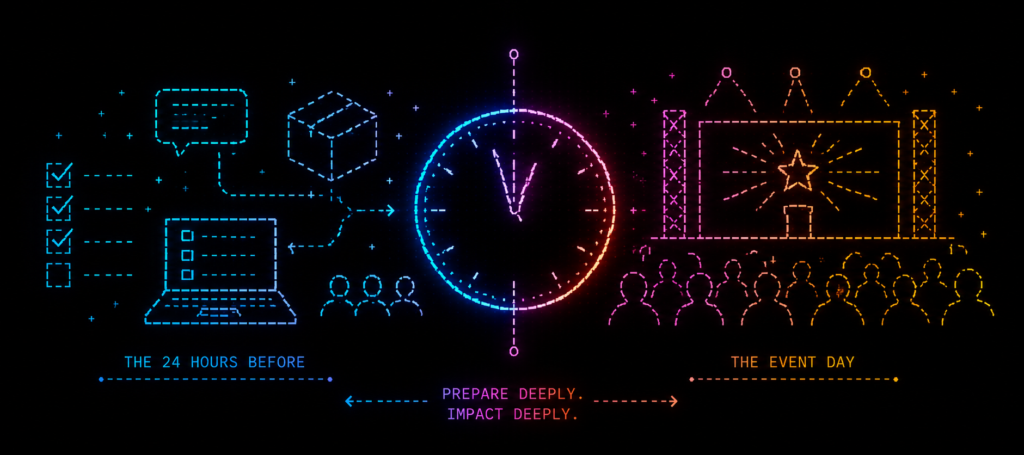

A senior executive flies into the host city on Sunday evening, not Monday morning. She attends a curated 30-person dinner at the host hotel that night. She joins a private roundtable Monday morning before the main conference even opens. By the time the official keynote begins on Monday afternoon, she has already had the three conversations she came for. The rest of the event is, in her words, “a bonus.”
This is the rise of the pre-conference day. The 24 hours before your event opens are quietly becoming more valuable than the agenda you spent six months planning. Senior attendees know it. Sponsors are starting to figure it out. Most event organizers are still treating the pre-day as logistics rather than as the most important content window of the entire program.
Here is what the pre-conference day actually is, why it matters more in 2026 than ever, and how to design one that justifies a senior leader’s trip on its own.
What the Pre-Conference Day Means
The pre-conference day is everything that happens between the moment attendees arrive in the host city and the official kickoff of the main agenda. Welcome dinners. Private receptions. Industry roundtables. VIP briefings. Founder breakfasts. Sponsor activations. Casual coffee meetups in the hotel lobby that turn into 90-minute conversations.
For most events, this window is treated as overhead, the unscheduled space between people landing and the show starting. For the events that are pulling ahead, it is the most carefully designed part of the entire program.
Three Reasons the Pre-Conference Day Is Winning
1. Senior leaders are time-strapped
A VP cannot easily justify three full days at a conference. But she can justify flying in Sunday evening, attending one curated dinner, hitting one strategic morning meeting, and leaving by Monday afternoon. The pre-day is the slice of the event that matches her actual calendar. When you design the pre-day well, you capture the senior audience your main agenda struggles to keep.
2. The most valuable conversations need intimacy
A 30-person dinner produces conversations a 1,500-person conference cannot. The pre-day is naturally smaller, quieter, and more relationship-driven. Attendees who would never approach each other on the main floor will sit down together if the setting is right. Intimacy creates value that volume cannot.
3. AI summaries make the main agenda optional
When every keynote and panel will be available as a summary the next morning, the live attendance value of the main agenda drops. The pre-day is the part that cannot be summarized. It is the part you have to show up for. This is why senior attendees increasingly prioritize it over the main event.
What a Strong Pre-Conference Day Looks Like
The events that get this right are running a parallel mini-program on the pre-day that includes a mix of formats.
- One curated dinner of 25 to 40 people, with assigned seating designed for cross-pollination
- One small roundtable on a specific industry topic, capped at 15 participants
- One social activation in a memorable venue: a museum, a rooftop, a tasting room
- One optional working session for partners and sponsors to align before the public agenda begins
- Open hours in a designated lobby or lounge where attendees can drop in for unstructured conversation
None of these need to be expensive. They need to be intentional. A great pre-day is the difference between attendees who feel they joined a community and attendees who feel they attended a series of sessions.
The Risk: Creating Tiers Without Acknowledging Them
The biggest pitfall of investing in the pre-day is creating an invisible class system inside your event. The senior attendees who get invited to the Sunday dinner walk into Monday with relationships and context. The attendees who arrived Monday morning never quite catch up.
The solution is not to hide this. It is to design it openly. Different attendee tiers should have different experiences. The pre-day can be VIP without being secret. The trick is making sure non-VIP attendees still have meaningful pre-day options of their own, even if those options look different.
How to Design a Powerful Pre-Conference Day
Step 1: Treat it as content, not logistics
Assign the same level of programming attention to the pre-day as to the main agenda. Pick themes for dinners. Curate guest lists carefully. Write briefings for hosts. The pre-day fails when it is left to whoever happens to be on the venue contract. It succeeds when someone owns it as program design.
Step 2: Keep formats small and varied
Resist the temptation to make pre-day events large. The value comes from intimate scale. Run three different 30-person events instead of one 90-person reception. Vary the formats: a meal, a panel, an activity. Variety pulls different types of attendees into different conversations.
Step 3: Design for the right people, not the most people
A pre-day dinner with 30 perfectly matched attendees beats a reception with 200 mixed ones. Curation is what makes the pre-day worth attending. Be willing to leave seats empty rather than fill them with the wrong people.
Step 4: Bridge the pre-day to the main agenda
The strongest events design the pre-day to feed into Day 1. A theme that comes up at the Sunday dinner gets referenced in the Monday keynote. A question raised at the morning roundtable becomes a panel topic that afternoon. When the pre-day is connected to the rest of the event, attendees who joined both feel their early arrival was rewarded.
The New Conference Timeline
For events that take this seriously, the entire conference timeline shifts. The pre-day stops being optional and starts being central. A typical mature event in 2026 looks like this.
T-minus 1 day: VIP and partner pre-day with two to four curated events
Day 1: Main agenda kickoff, building on pre-day conversations
Days 2 to 3: Main programming with smaller breakout intensity
Closing day: Optional smaller working sessions for select attendees
The center of gravity has moved. The pre-day is no longer the warm-up. It is the headline.
How Snapsight Supports the Pre-Day Strategy
The pre-conference day produces conversations that are often more valuable than anything on the main agenda. Snapsight respects that. The platform captures sessions where capture is welcomed and stays out of the way where it is not. Pre-day dinners and confidential roundtables can stay off the record, while main agenda content gets fully processed in 75+ languages across the rest of the event.
Across 627+ events and 10,415+ sessions processed at 91 percent autonomous operation, Snapsight gives event teams the flexibility to treat different parts of their program differently, which is exactly what the new pre-day strategy requires.
Key Takeaways
- The 24 hours before your event are quietly becoming more valuable than the event itself
- Senior attendees are time-strapped, intimacy beats volume, and AI summaries make the main agenda increasingly optional
- A strong pre-day combines curated dinners, small roundtables, social activations, and open lounge hours
- The risk is creating invisible class systems. Address tiered experiences openly
- Treat the pre-day as content design, keep formats small and varied, curate ruthlessly, and bridge it to the main agenda