


In a typical international conference room, most people are non-native English speakers listening in a second language, nearly one in five lives with some hearing loss, and most of the under-30s would rather read along even in their own language. Nobody publishes a count for conferences, so here are the numbers that exist, with sources.
Key Takeaways
- Of about 1.5 billion English speakers, roughly 3 in 4 learned it as a second language (Ethnologue, 2025).
- More than 1.5 billion people live with some hearing loss, nearly 1 in 5 worldwide (WHO, 2021).
- Non-native listeners need 1 to 10 dB better signal-to-noise ratio to follow speech as well as native listeners (Steeneken and others, 2002; Bidelman and Dexter, 2015).
- 63% of US adults under 30 prefer subtitles on, even in a language they know (YouGov, 2023).
- More than 100 studies show captions improve comprehension, attention and memory for everyone (Gernsbacher, 2015).
How Many Conference Attendees Are Non-Native English Speakers?
Most of them, at any event that calls itself international. There is no survey of conference audiences by first language, but Ethnologue’s 2025 figures put English at about 1.5 billion speakers, of whom only around 390 million learned it first. Three in four are non-native English speakers, working in a learned language.
Conferences skew further in that direction than the general population. ICCA counted 12,438 international association meetings in 2025, and those meetings rotate between countries by design, so the audience changes nationality every year while the stage language usually stays English. Often the speaker is the only native English speaker on the microphone.
How Many People in the Room Have Hearing Loss?
Nearly one in five. The World Health Organization counts more than 1.5 billion people with some degree of hearing loss, about 430 million of them with disabling hearing loss, and expects the total to reach 2.5 billion by 2050. Hearing loss rises with age, and conference audiences skew older than the population, so a professional congress is likely above the average, not below it.
Most of them will never say so. They sit nearer the front, read the slides harder, and miss every audience question asked away from a microphone.
How Much Harder Is It to Follow a Speaker in a Second Language?
Measurably harder for non-native English speakers, and the gap widens with noise. Researchers add background noise until listeners can no longer repeat sentences, then compare where native and non-native listeners fail.
| Study | What it found |
|---|---|
| Steeneken, Houtgast and van Wijngaarden, 2002 | Dutch listeners needed 1 to 7 dB better signal-to-noise ratio than native listeners to reach 50% sentence intelligibility in German and English. |
| Bidelman and Dexter, 2015 | Late bilinguals needed about 10 dB more favourable signal-to-noise ratio to match monolinguals on speech in noise. |
In plain terms: the hum of a 600-seat hall and a speaker who turns from the mic cost a second-language listener words a native listener never notices losing. The main explanation is context: native listeners fill gaps from the words around them, non-native listeners have less to fill with.
Do People Who Can Hear Still Want to Read Along?
Increasingly, yes. When YouGov asked 1,000 US adults in 2023 how they watch TV in a language they know, 63% of those under 30 preferred subtitles on, against 29% of those aged 45 to 64. Of people who ever use subtitles, 40% said they understand more, 40% said it helps with accents, 33% said their surroundings are noisy and 30% mentioned hearing difficulties. A conference hall has all four at once.
The research agrees with the habit. Gernsbacher’s 2015 review counted more than 100 studies showing captions improve comprehension, attention and memory, for children, adults, native and non-native speakers alike.
What Does This Mean for a Room of 500?
These are estimates from the sources above, not a survey of any one event.
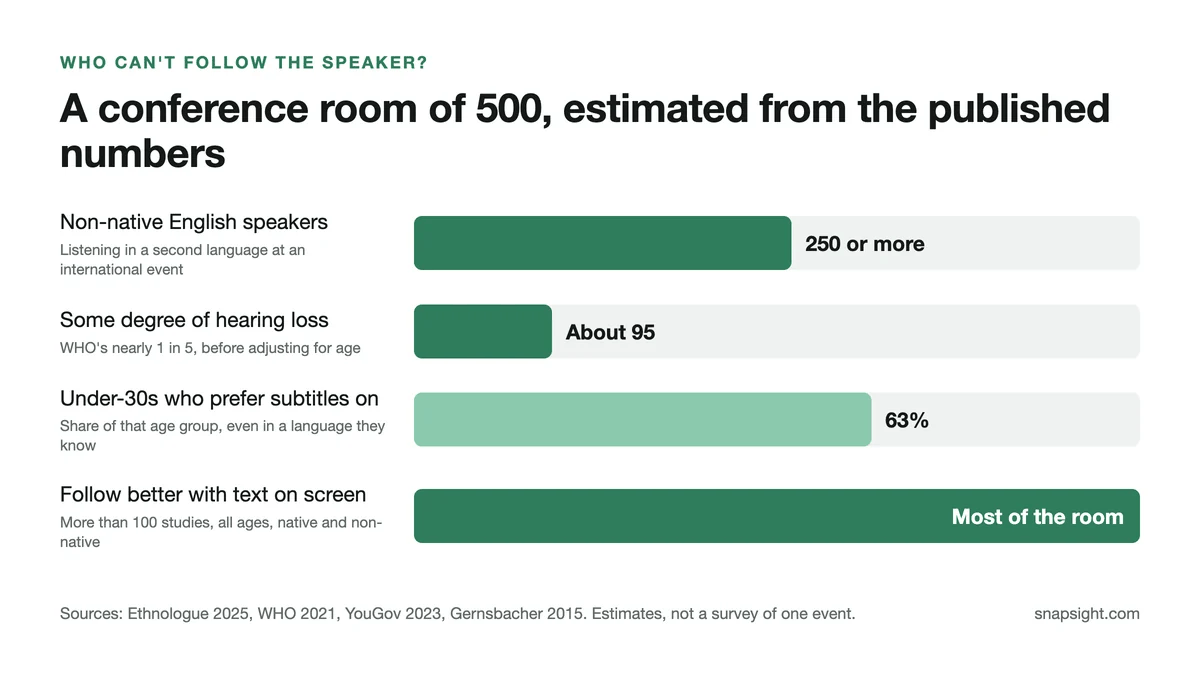
| In a room of 500 | Estimate | Based on |
|---|---|---|
| People with some hearing loss | About 95 | WHO’s nearly 1 in 5, before adjusting for age |
| Non-native English speakers | 250 or more at an international event | Ethnologue’s 3 in 4, applied to a mixed room |
| Under-30s who would prefer to read along | Roughly 6 in 10 of them | YouGov, 2023 |
| People who would follow better with text on screen | Most of the room | Gernsbacher’s review of 100+ studies |
FAQ
What share of conference attendees speak English as a second language?
Nobody publishes a count for conferences, but the language data gives the shape. Of about 1.5 billion English speakers worldwide, roughly 3 in 4 learned it as a second language (Ethnologue, 2025). At an international event, where ICCA counted 12,438 association meetings rotating between countries in 2025, most of the audience is listening in a second language.
How many people have hearing loss?
More than 1.5 billion people live with some degree of hearing loss, nearly one in five worldwide, and about 430 million have disabling hearing loss (WHO, 2021).
Do captions help people who can hear?
Yes. A 2015 review by Morton Ann Gernsbacher found more than 100 studies showing that captions improve comprehension, attention and memory for everyone, not only people with hearing loss. A 2023 YouGov poll found 63% of US adults under 30 prefer subtitles on even in a language they know.
Bottom Line
The person who cannot follow the speaker is not a rare case at the edge of the room; between non-native English speakers, hearing loss and a generation that reads along by habit, they are most of the audience. The fixes are cheap: one microphone per voice, every question repeated into it, key numbers on the slide, and the words as text on a screen people already hold. The honest limit is that text helps people follow; it does not make a bad talk good. Snapsight gives every session live text in up to 10 languages for free, which is one way to cover the whole room at once, and the paid layers turn the same sessions into takeaways and summaries. Our accessibility page covers the reading use case in more detail.
Count the room at the next event
Add one question to the feedback form: “Could you follow every session?” Then track the answer. To see live text in a real session, start free or book a demo.