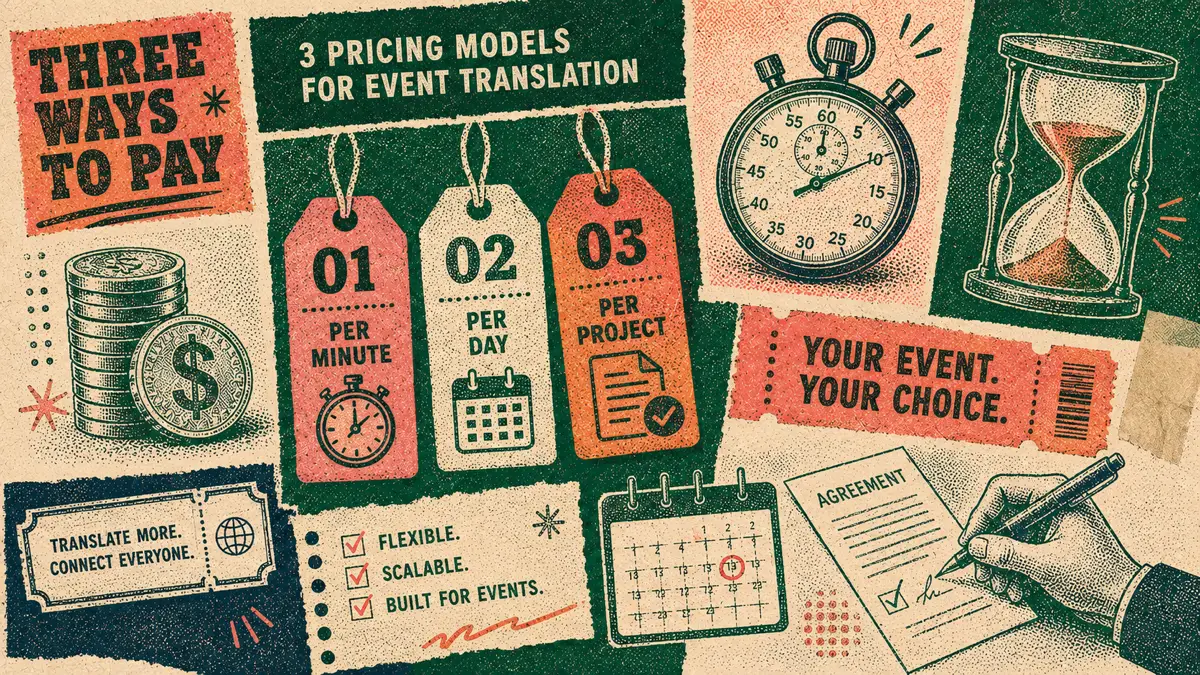

Ask three translation vendors for a quote and you will get three prices that cannot be compared. One quotes per session, one sells a package of hours, one charges per interpreter per day. None of them is lying. They are just selling different shapes of the same thing. This guide explains the three pricing models used in event translation, what each one really includes, and how to work out which shape fits your event calendar.
Key Takeaways
- Event translation is sold in three shapes: per session (flat price per talk), per hour (annual packages drawn down over time), and per interpreter day (human interpreting).
- Per-session pricing starts around $95 and is easiest to budget for teams that run a few events a year.
- Hourly packages reward high-volume programs with discounts of 10% to 30%, but you carry the risk of unused hours.
- Human interpreter day rates run $900 to $2,500 per interpreter, doubled by the industry rule that interpreters work in pairs.
- The hidden costs live outside the headline number: minimum bookings, setup fees, per-language multipliers, and what happens to transcripts after the event.
The Three Pricing Models
Model 1: Per session
You pay a flat price for each session you translate, whatever its audience size. Snapsight Live works this way, from $95 up to $250 per session depending on plan, with 25+ languages, captions, transcripts, and AI summaries included in the one price. You can check the numbers on the pricing page.
The strength of this model is that the quote is the budget. A 10-session conference costs ten session fees, and a client or CFO can see the total before you sign. The weakness shows up at very high volume: if you run hundreds of sessions a year, a flat per-session rate can pass the cost of a bulk hour package.
Model 2: Hourly packages
Some AI platforms sell a bucket of hours for the year. You draw it down session by session, usually with all languages included, and bigger buckets earn volume discounts of 10% to 30% or more. Multi-year deals push rates lower again.
This model rewards organizations with steady, heavy usage: weekly council meetings, global town halls, year-round webinar programs. The catch is sizing. You are guessing next year’s usage in advance, and unused hours are money spent on nothing. If your event calendar is lumpy or uncertain, the guess usually lands wrong.
Model 3: Per interpreter day
Human interpreting is priced per person per day. In-person simultaneous interpreters charge $1,200 to $2,500 each, remote interpreters $900 to $2,200, and every language needs two of them because interpreters swap every 20 to 30 minutes. Equipment, a technician, and travel sit on top. Our full cost breakdown walks through those numbers line by line.
This is the premium model, and for legal, medical, or diplomatic content it is the right one. For everything else, it is the most expensive way to buy translation by a wide margin.
Side by Side
| Per session | Hourly package | Per interpreter day | |
|---|---|---|---|
| Typical price | $95 to $250 per session | Quoted, volume discounts | $900 to $2,500 per interpreter |
| Languages | All included | Usually all included | Each language adds a pair |
| Best for | A few events a year | Heavy year-round use | High-stakes sessions |
| Budget risk | None past booked sessions | Unused hours | Scope growth per language |
| What you keep | Transcripts, summaries | Varies by vendor | Usually nothing written |
The Hidden Costs to Ask About
The headline price never tells the whole story. Before you sign anything, ask about minimum bookings, because some vendors will not sell a single hour. Ask whether extra languages change the price, since that is where interpreter models explode. Ask about setup or onboarding fees on annual deals. And ask who owns the transcripts.
That last question matters more than most buyers realize. A translated session produces transcripts in every language, and those transcripts are the raw material for recap posts, clips, and reports. Vendors that keep or discard them are quietly deleting the most reusable thing your budget produced. Our guide on how to repurpose event content shows what that material is worth.
Which Model Fits You?
Count your sessions honestly. Under roughly 20 sessions a year, per-session pricing almost always wins: no commitment, no sizing guess, a number you can put in front of a client. Hundreds of hours a year with steady cadence points to a package deal, and the discounts are real if your forecast is. And whichever model you lean toward, keep interpreter-day spending for the sessions where a human voice genuinely changes the outcome, then cover the rest of the agenda with AI.
FAQ
How is event translation usually priced?
Three ways: a flat fee per session (from around $95), prepaid hourly packages drawn down over a year, or per interpreter per day ($900 to $2,500 each) for human interpreting.
Which pricing model is cheapest for a single conference?
Per-session pricing, in almost every case. A two-day conference is a countable list of sessions, so the quote equals the budget, and no annual commitment is involved.
Do more languages cost more?
With AI platforms, usually no: languages are included in the session or hour price. With human interpreters, every language adds a team of two, so cost scales linearly with language count.
Bottom Line
Translation quotes look incomparable because vendors sell different shapes: per session, per hour, or per interpreter day. Convert every quote to one number, the cost of your actual next event, and the comparison gets easy. Count your sessions, be honest about your yearly volume, and reserve human interpreter budgets for the few sessions that truly need them. Snapsight prices per session, from $95 with languages, captions, transcripts, and summaries included, so the quote you get is the budget you spend. See pricing or book a demo. Purchases run through our sales team, so the demo is also where pricing questions get answered.