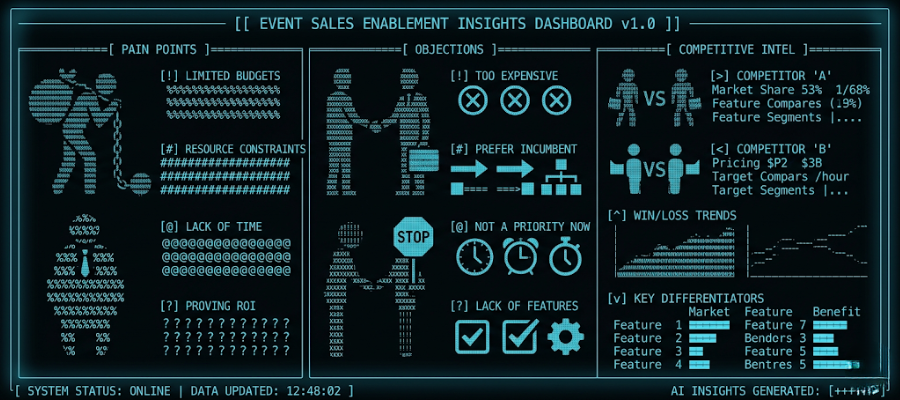

Your sales team did not attend the conference. However, your prospects did.
This is the gap most B2B companies miss. Every customer conference, industry event, and trade show generates content that should flow directly into your sales process. It includes battle cards, objection handlers, customer language, and competitive intel. Yet, this content rarely reaches the sales floor.
Event sales enablement closes this gap. It turns conference content into practical tools your sales team can use every day.
Why Sales Teams Miss Out on Event Content
Three things usually go wrong.
First, sales is not invited. Event teams plan for marketing, executives, and product, but sales reps rarely get a seat unless they run a booth.
Second, recordings sit unused. Even when teams record sessions, they upload them to portals nobody visits. As a result, a sales rep will not watch a 45-minute panel discussion just to find one useful insight.
Third, there is no translation. Even if a rep watches a session, nobody connects what was said on stage to how it should shape a sales conversation the next day.
Because of this, companies invest heavily in events, yet their most customer-facing team never benefits.
What Sales Actually Needs From Your Events
Sales reps do not need full transcripts. Instead, they need short, specific tools they can use in calls. Here is what to extract from every event.
Customer Language
First, capture the exact words your prospects use to describe their problems. For example, when an attendee says, “we are drowning in data nobody uses,” that becomes a powerful sales line. As a result, using this language in scripts makes outreach feel relevant instead of generic.
Live Objections
Next, focus on Q&A sessions. These reveal the objections buyers are actively working through. If multiple attendees push back on the same point, your sales team needs to prepare for that objection in their own calls.
Competitive Intelligence
In addition, competitor sessions reveal roadmap signals, positioning, and weaknesses. You can then turn this intel into battle cards that help reps win deals.
Industry Benchmarks
Finally, speakers often share data and benchmarks. Reps can use these insights to position your solution against industry standards.
How to Build a Sales-Ready Event Workflow
Here is a simple system any company can run.
Step 1: Capture every session. Use AI transcription to record everything instead of relying on human note-takers.
Step 2: Tag for sales relevance. As content gets processed, flag moments that include customer pain points, objections, competitor mentions, or useful data.
Step 3: Create one-page sales briefs. Within 48 hours of the event, produce a short brief for the sales team. Include three customer pain points, two objections to prepare for, one competitor signal, and three quotes reps can use.
Step 4: Run a 30-minute training. Then, walk the sales team through the brief so they understand how to apply each insight in real conversations.
Step 5: Measure adoption. Finally, track whether reps use the new language, talking points, and competitive intel. Based on this, refine the next event brief.
The Result: Events That Pay for Themselves
When sales reps quote customer pain points using the buyer’s own words, win rates improve. Similarly, when they address objections raised at recent industry events, they sound more informed. Moreover, when they clearly explain how your solution compares to a competitor’s latest announcement, they close more deals.
This is what event ROI actually looks like. It is not attendance numbers or satisfaction scores, but closed revenue tied directly to insights captured at the event.
How Snapsight Powers Event Sales Enablement
Snapsight captures every session in real time with transcription and summarization across 75+ languages. As a result, the Analyst Agent surfaces customer pain points, objections, and competitive moments automatically. This allows your sales enablement team to build briefs in hours instead of weeks.
With 627+ events and 10,415+ sessions processed, the platform turns conference content into a sales tool teams actually use. Since the AI runs 91% autonomously, you do not need additional staff to extract sales-ready insights.
Key Takeaways
- Sales teams miss event content because nobody translates it for them
- Sales needs customer language, objections, competitive intel, and benchmarks
- Build a workflow that produces a sales brief within 48 hours
- Measure ROI by tracking how sales teams use event insights
- AI makes event sales enablement scalable without adding headcount