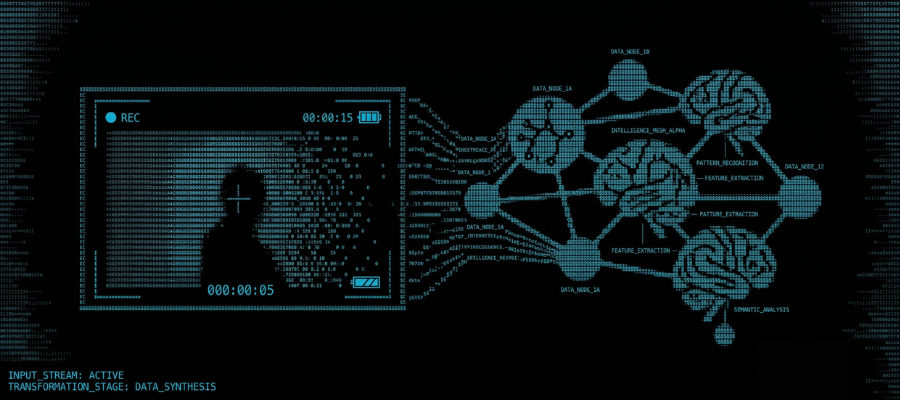

Your event recordings are sitting in cloud storage, gathering digital dust. Hundreds of hours of expert discussions, strategic debates, and institutional knowledge are captured but rarely used.
Industry research consistently shows that most event content is never reused after the event concludes. Organizations invest heavily in bringing together their smartest people, record everything, and then allow it to disappear into archives no one searches.
The problem is not capturing content. The problem is extracting intelligence from it.
The Event Recording Problem
Traditional event recordings suffer from three structural flaws.
1. Volume Overload
A three-day conference with 30 sessions can easily generate more than 90 hours of video. Realistically, no stakeholder has time to watch it all. Consequently, valuable insights remain buried in recordings that no one revisits.
2. Lack of Searchability
Video files are inherently difficult to search. You cannot quickly locate “what speakers said about AI adoption challenges” without manually reviewing multiple sessions and hoping relevant moments surface.
3. No Context or Structure
Raw recordings do not clarify importance. Was a statement a key insight or a casual aside? Did multiple speakers reinforce the same idea, or did they disagree? Without structure, context disappears.
As a result, event recordings become compliance artifacts rather than strategic assets.
From Recordings to Intelligence: The Transformation
Converting event recordings into business intelligence requires four distinct layers of transformation.
Layer 1: Transcription (Making It Text)
AI transcription converts spoken content into searchable text with high accuracy. Platforms such as Snapsight process recordings in real time or batch mode and support multilingual environments.
What you gain is foundational searchability and accessibility compliance. However, transcripts alone do not reveal patterns, priorities, or strategic meaning.
Layer 2: Analysis (Extracting Insights)
Natural language processing evaluates transcripts to extract structured insights, including key takeaways per session, speaker attribution, topic clustering, sentiment analysis, and entity recognition.
At this stage, you gain structured insight from individual sessions. Nevertheless, cross-session patterns and strategic synthesis remain undeveloped.
Layer 3: Synthesis (Finding Patterns)
Cross-session analysis identifies relationships across the entire event. Recurring themes surface. Contradictions become visible. Regional differences emerge. Momentum around specific trends becomes measurable. Content gaps—topics attendees asked about but were not addressed—are revealed.
Here, you gain intelligence that no single recording can provide in isolation.
Layer 4: Activation (Making It Useful)
Intelligence becomes valuable only when activated. Structured insights can be transformed into executive briefings, content marketing assets, sales enablement materials, training resources, or gated lead-generation content.
At this point, event content begins generating ROI long after the event ends.
Five Types of Intelligence You Can Extract
1. Competitive Intelligence
Event discussions often contain direct and indirect competitor references. You can extract competitor mentions, positioning insights, customer complaints about alternative solutions, and industry predictions. In practice, this intelligence informs messaging, differentiation strategy, and product roadmap decisions for months following the event.
2. Content Strategy Intelligence
Analyzing recordings reveals which topics generated the most engagement, which questions attendees asked repeatedly, and which themes were underrepresented. Over time, this analysis improves agenda design, speaker selection, and editorial planning.
3. Product and Innovation Intelligence
Customers frequently share use cases, feature requests, and integration needs during sessions or Q&A segments. When systematically extracted, these signals guide product prioritization with real-world evidence rather than anecdotal feedback.
4. Sentiment and Brand Intelligence
Tone and sentiment analysis reveal how audiences feel about your organization, initiatives, or announcements. Monitoring sentiment trends across multiple events enables proactive leadership communication and reputation management.
5. Institutional Knowledge Capture
Expert panels and internal workshops often contain best practices, lessons learned, and strategic reasoning that are never formally documented. Structuring this knowledge into a searchable repository preserves intellectual capital and accelerates onboarding for new team members.
Implementation: A Four-Week Roadmap
Week 1: Audit Your Content
Begin by inventorying recordings from the past one to three years. Identify high-value sessions such as keynotes, executive briefings, and customer panels. Assess current usage patterns and quantify storage costs. The outcome should be a prioritized list of recordings to process first.
Week 2: Choose Your Platform
Evaluate platforms based on transcription accuracy, language support, cross-session intelligence capabilities, integration compatibility, and security compliance. If your objective is strategic intelligence, choose a platform that performs synthesis rather than basic transcription alone.
Week 3: Process and Extract
Upload priority recordings, configure custom vocabulary for product names and industry terminology, and generate initial intelligence reports. Review outputs for accuracy and refine configurations as needed. While AI handles transcription and primary analysis automatically, allocate time for human validation and interpretation.
Week 4: Activate and Distribute
Convert insights into actionable outputs. Develop executive summaries, publish blog content derived from sessions, create sales enablement documents, and establish a searchable knowledge base. Assign clear ownership for distribution so insights do not remain unused.
ROI Expectations
Organizations that systematically repurpose event content frequently achieve significant ROI improvements through sustained utilization.
Consider a conference with 50 sessions and a total cost of $500,000. By repurposing sessions into blog posts, webinars, sales materials, and gated content, organizations can generate substantial content value and lead generation impact. Additionally, automated intelligence reduces manual review time, creating measurable operational savings.
When combining content value, lead acquisition savings, and time efficiency, the return on an event intelligence platform can far exceed the initial investment. Beyond quantifiable gains, strategic value emerges through competitive insight, product direction clarity, and long-term knowledge preservation.
Common Mistakes to Avoid
Processing all content equally reduces efficiency. Prioritize high-impact sessions first.
Stopping at transcripts limits value. Intelligence requires analysis and synthesis.
Failing to distribute insights wastes investment. Assign ownership for activation.
Ignoring custom vocabulary reduces transcription accuracy. Small configuration efforts can meaningfully improve output quality.
Treating event processing as a one-time initiative prevents compounding value. Intelligence grows stronger as more events are analyzed over time.
The Strategic Shift
Traditionally, organizations recorded events to ensure no one missed content. Leading organizations now treat recordings as raw material for business intelligence.
The technology required to extract insights already exists. The operational frameworks are proven. The differentiation lies in execution.
Your next event will generate hundreds of hours of expert discussion. The critical decision is whether those recordings remain archived files or become strategic assets that inform marketing, product, and leadership decisions long after the closing session ends.