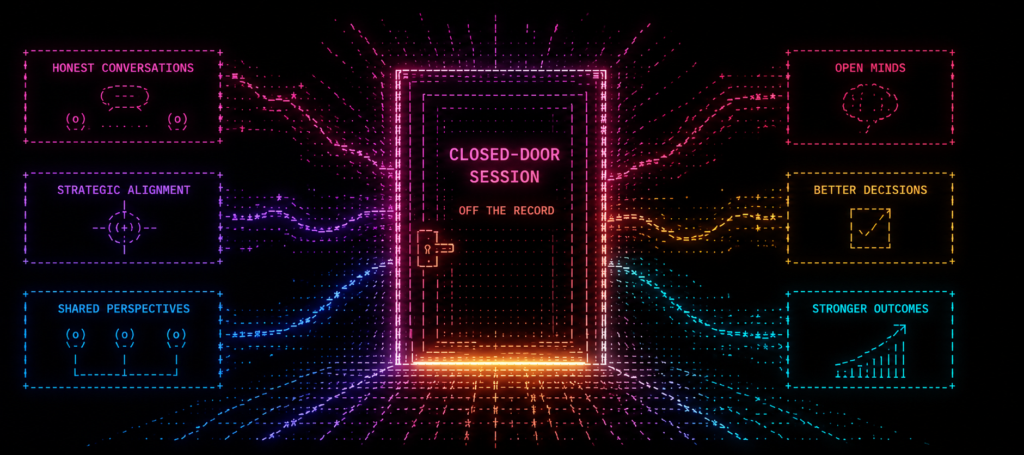

An executive looks at two invitations on her desk. One is a flagship industry conference with 2,000 attendees, full session recording, livestreams, AI summaries, and a podcast deal. The other is a 40-person closed-door retreat in a remote location with one rule printed on the invitation: nothing said in this room leaves this room.
She accepts the second one.
This is happening more often than the event industry wants to admit. Closed-door sessions are quietly making a comeback in 2026, even as the rest of the world races toward more capture, more sharing, and more AI processing of everything. The most senior people in any industry are choosing the events where their words will not be recorded.
Here is what is driving the comeback, when closed-door makes sense, and how smart event teams are building it into their programming.
What Closed-Door Sessions Actually Are
A closed-door session is any conference or meeting where the content is intentionally not recorded, transcribed, or shared outside the room. Attendees can speak freely because they know their words will not appear in a transcript, a clip, or an AI summary the next day.
Many of these events use the Chatham House Rule. Participants can use the information they hear, but they cannot reveal who said it. The rule has been around for nearly a century, but it is finding new relevance in an era where every other event is fully captured by AI.
Three Reasons Closed-Door Is Making a Comeback
1. Speakers are tired of being quoted forever
When every word gets transcribed, every offhand comment becomes searchable in perpetuity. A senior leader making a thoughtful but speculative observation in 2026 may find it screenshotted and reshared out of context in 2029. The chilling effect is real. Closed-door sessions let speakers think out loud again.
2. The most valuable conversations are now hidden
When everything is captured and shared, the genuinely useful content moves into private channels. The deals, the candid feedback, the real strategy discussions all happen off the agenda. Closed-door events bring this hidden conversation back to a stage where multiple people can benefit from it.
3. AI makes “off the record” harder, which makes it more valuable
In a world where any phone can transcribe a conversation in real time, the events that genuinely protect privacy stand out. Closed-door sessions in 2026 are not just about preference. They are about being one of the few places left where senior leaders can have unguarded conversations.
When Closed-Door Makes Sense
Not every session needs to be off the record. Most should not be. But certain content types benefit enormously from a closed-door format.
Sensitive industry discussions. Topics like regulatory strategy, competitive positioning, and crisis management are nearly impossible to discuss honestly on the record.
Peer roundtables. When 12 CEOs sit down to compare notes on shared challenges, the content is gold for the participants but useless if everyone knows it will be public.
Early-stage thinking. Leaders working through new ideas need a space to be wrong. Closed-door sessions let them try out hypotheses without committing to them publicly.
Conflict and disagreement. Real debate dies under cameras. Productive disagreement needs privacy to happen.
Cross-industry confidential sharing. Events where competitors share data for industry-wide benefit work only if no one can attribute the data back to its source.
The Hybrid Approach Most Events Will Adopt
The future is not all-recording or no-recording. The smartest events are blending both. A typical 2026 conference might look like this.
- Keynotes and main-stage panels: fully captured, AI summaries published
- Workshops and educational sessions: recorded for attendee replay, not shared publicly
- Executive roundtables: closed-door, Chatham House Rule, no recording, no AI
- Sensitive industry topics: closed-door with optional anonymized written report
- Networking and hallway track: never recorded, always private
This is what mature event design looks like in 2026. Different content types deserve different levels of capture. Treating every session the same is the mistake.
How to Run a Closed-Door Session Well
Step 1: State the rules clearly upfront
Open every closed-door session with one minute on the ground rules. What can be shared, what cannot, and what happens if the rule is broken. Clarity at the start prevents drift later. Participants need to know exactly where the line is.
Step 2: Physically remove recording capability
Phones face down on the table or in a basket at the door. No laptops out unless specifically allowed. No event AI tools running in the room. The signal matters as much as the rule. Participants need to see that the privacy is real.
Step 3: Curate the room carefully
Closed-door sessions work because of who is in the room. Invite by application or curation. Keep the group small, often 15 to 30 people. Make sure participants are peers who can speak honestly with each other. One mismatched attendee can shut down the whole conversation.
Step 4: Produce a clean public output
After the session, produce a Chatham House summary. Themes and insights, no names. This gives the broader audience value while protecting the specifics that made the conversation work. It also justifies the session’s existence to sponsors and stakeholders who need to see outcomes.
How Snapsight Approaches Closed-Door Sessions
The premium position for an AI event platform in 2026 is not “capture everything.” It is “capture what should be captured and respect what should not be.” Snapsight is built with consent-aware workflows, session-level recording controls, and retention policies that make it easy to run closed-door sessions inside the same event as fully captured ones.
Across 627+ events and 10,415+ sessions processed in 75+ languages, Snapsight handles the spectrum between full capture and full privacy with the same trust that has made it the choice of organizations like Reuters, IBM, and the Singapore Government, where the line between what gets shared and what stays private matters more than anywhere else.
Key Takeaways
- Closed-door sessions are quietly growing in 2026 even as the rest of events trend toward full capture
- Speakers are tired of being quoted forever, valuable content is moving private, and AI is making “off the record” rare enough to be valuable
- Different content types need different capture levels. Treating every session the same is the mistake
- Run closed-door sessions with clear rules, removed recording capability, curated rooms, and clean public outputs
- The best event AI platforms are the ones that know when to step back, not just when to capture