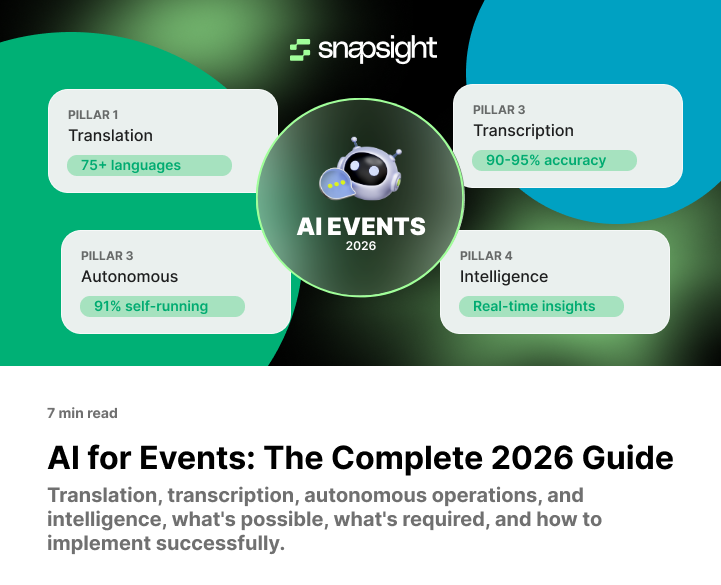

AI for events platform technology has moved from experimental tools to mission-critical infrastructure for global conferences and hybrid events. An AI-for-events platform now delivers real-time translation, high-accuracy transcription, autonomous session management, and cross-session intelligence at enterprise scale.
By 2026, AI for events is no longer a competitive advantage. It is an operational infrastructure. This guide explains the market landscape, compliance requirements, implementation strategy, and ROI benchmarks for successfully deploying AI event technology.
The AI for Events Market in 2026
The rapid growth of AI event technology reflects structural shifts in the events industry.
Market Data
AI Translation and Transcription Market
Valued at 18.89 billion dollars in 2024, projected to reach 82.35 billion dollars by 2030 with a CAGR of 28.3 percent.
Source: Grand View Research
Virtual and Hybrid Events
236.69 billion dollars in 2025, growing to 537.18 billion dollars by 2029.
74.5 percent of planners are adopting hybrid formats.
Source: Bizzabo
Enterprise AI Adoption
78 percent of organisations have integrated AI into at least one business function.
92 percent plan to invest in generative AI within three years.
Source: Netguru
The implication is clear. AI for events is becoming embedded into enterprise operations rather than treated as an experiment.
The Four Pillars of AI for Events
Pillar 1: AI Translation for Events
AI translation events technology now supports:
- 75 plus language pairs with sub-two-second latency
- Context-aware translation understanding industry terminology
- Custom vocabulary training
- Speaker attribution across languages
In regions such as the Middle East and APAC, adoption rates for AI translation and captioning exceed 80 per cent.
For large-scale conferences, AI translation replaces dozens of interpreter teams at a fraction of the cost.
Pillar 2: AI Transcription for Conferences
Modern AI transcription conference solutions deliver:
- 90 to 95 percent accuracy
- Real-time captions within two to three seconds
- Speaker identification
- Noise filtering for live environments
Accessibility requirements are tightening.
In the United States, ADA Title II mandates WCAG 2.1 Level AA compliance and live captions for public entities by April 2026.
Source: Accessibility Laws
AI transcription becomes both a compliance necessity and the foundation for intelligence extraction.
Pillar 3: Autonomous Event Systems
Autonomous event systems represent the operational backbone of advanced AI for events.
Capabilities now include:
- 90 percent plus autonomous session operation
- Automatic session joining
- Real-time quality monitoring
- Multi-track handling across 50-plus concurrent sessions
AI agent adoption in enterprises has increased sharply in recent years, with organisations reporting strong ROI from automation investments.
Autonomy reduces ongoing labour costs while improving consistency across large event portfolios.
Pillar 4: Event Intelligence
Event intelligence converts captured content into strategic insight.
Capabilities include:
- Real-time key takeaway extraction
- Cross-session pattern detection
- Sentiment analysis
- Automated executive brief generation
Research frequently cited in performance studies shows that data-driven organisations outperform peers by 23 times in customer acquisition, 6 times in retention, and 19 times in profitability.
Source: Passive Secrets
This is where AI for events transitions from operational support to strategic advantage.
For a deeper comparison, see /event-intelligence-vs-event-transcription.
The 2026 Compliance Landscape for AI Event Technology
United States: ADA Title II
Deadline April 24, 2026, for large public entities.
Requirements include:
- WCAG 2.1 Level AA compliance
- Live captions for audio content
- Accessible navigation
Europe: European Accessibility Act
Now in force since June 2025.
Requirements include:
- Accessibility for digital services
- Multilingual support across EU languages
- Real-time text alternatives
Compliance accelerates AI for events adoption, but the strategic value extends far beyond regulatory alignment.
Implementing an AI Event Platform
Phase 1: Assessment
Duration: 2 to 4 weeks.
- Audit event volume and scale
- Identify language and compliance requirements
- Calculate current human transcription and interpretation costs
- Define ROI targets
For understanding intelligence layers, review /what-is-event-content-intelligence.
Phase 2: Pilot
Select a mid-sized multi-track event.
Measure:
- Transcription accuracy
- Translation quality
- Autonomous operation percentage
- Staff time savings
- Attendee engagement
Phase 3: Scale
Roll out across the event portfolio over 3 to 6 months.
Track:
- Cost reduction
- Staff efficiency gains
- Lead generation impact
- Content repurposing output
Industry benchmarks from EntrepreneursHQ indicate strong ROI when AI is implemented systematically rather than partially.
Choosing the Right Event AI Platform
Evaluate platforms based on:
- Autonomous operation above 90 percent
- 50-plus languages with full translation matrix
- Sub-three-second real-time performance
- Cross-session intelligence capabilities
- WCAG 2.1 AA, SOC 2, and GDPR compliance
- REST APIs and integration flexibility
- Proven experience with large-scale events
ROI Benchmarks for AI for Events
A modern AI for events platform must operate autonomously while delivering real time intelligence across every session.
Cost Savings
- 42,000 dollars average savings per event compared to human services
- 32 hours of staff time saved per event
- 80 percent of planners report ROI outperforming traditional models
Strategic Gains
- 200 to 400 percent increase in event ROI through sustained content utilization
- 3 to 5 times more leads from repurposed content
Sample Calculation
Four events per year, 30 sessions each.
Traditional approach: 172,000 dollars annually
AI event platform: 42,400 dollars annually
Savings: 129,600 dollars
Additional value from content repurposing and lead generation significantly increases total return.
Common Pitfalls
- Skipping vocabulary training before events
- Operating AI systems in isolation from marketing workflows
- Ignoring intelligence dashboards
- Treating accessibility only as compliance
- Failing to build a content repurposing strategy
AI for events delivers maximum value when integrated into marketing, operations, and strategy functions.
The Future of AI for Events
Emerging trends include:
- Voice-based search across conference archives
- Predictive session planning using historical data
- Fully personalized agendas at scale
- Real-time sentiment-triggered interventions
- Cross-organization knowledge graphs
AI for events is moving toward predictive and autonomous ecosystems rather than reactive tools.
Snapsight powers over 627 events with 91 percent autonomous operation, 75-plus languages, and real-time intelligence across more than 10,000 sessions. Explore case studies or request a demo to implement enterprise-grade AI event technology.