
The role of a great conference moderator is invisible until you watch a bad one. The good ones keep panelists in their lane, pull out the most interesting threads, surface audience questions at exactly the right moment, and end on time without anyone feeling rushed. It is harder than it looks. And until now, it has always been a human job.
That is starting to change. In 2026, AI moderators are quietly entering the picture. Not as gimmicks or as full replacements for human hosts, but as silent co-pilots who help live sessions run smoother than any human could manage alone.
Here is what AI moderators actually do, where they work well, and where event hosts should still hold the line.
What an AI Moderator Actually Does
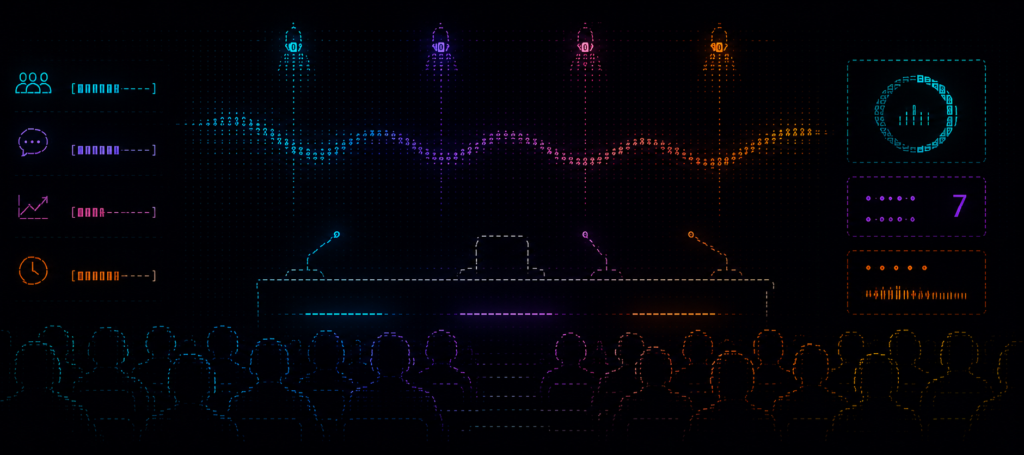
An AI moderator is not a robot voice on stage. It is a real-time intelligence layer that runs alongside a human moderator, processing the conversation as it happens and surfacing prompts, questions, and signals that help the session stay sharp.
Think of it as the moderator’s earpiece. The human still drives the conversation. The AI listens to every word, watches the audience reaction, and whispers the right cue at the right moment.
Three Things AI Moderators Are Already Doing
This is not a future scenario. It is already in production at major events. Here are the three roles AI is starting to take on.
1. Curating audience questions in real time
When a panel opens Q&A, an AI moderator can scan every question submitted through the event chat or app, group them by theme, identify the strongest ones, and rank them for the human moderator to read aloud. No more reading the first three random questions that come through. The audience gets to feel like the best questions actually surfaced.
2. Tracking time and topic balance
Panels go off the rails when one speaker dominates or when the conversation drifts. An AI moderator can quietly track how much each panelist has spoken, flag when one is monopolizing, and prompt the human moderator to redirect. It can also notice when the conversation has wandered far from the planned topic and suggest a graceful pivot.
3. Surfacing what the audience cares about
AI can detect which moments of a session sparked the most engagement: when people started taking notes, when chat activity spiked, when reactions clustered. This data feeds back to the human moderator in real time, so they know which thread to pull on next instead of guessing.
Where AI Moderators Work Well
Not every session is a fit. AI moderators add the most value in specific contexts.
Multi-track conferences. Human moderators can only watch one track. AI can monitor all of them and surface the standout moments across the whole event in real time.
Panel-heavy formats. Panels are the natural home for AI moderation because they have multiple speakers, audience questions, and a need for time management.
International events with multilingual audiences. AI can pull questions from attendees who submitted them in their native language, translate them, and present them to the moderator in English. This unlocks audience participation that was previously lost to language barriers.
Large audience events. When 500 people are submitting questions, no human can read them all. AI sorting becomes essential just to handle the volume.
Where Human Moderators Still Win
AI moderators are not the answer for every session. They struggle in some clear places.
Sensitive or emotional topics. A discussion about grief, loss, or conflict needs human judgment about pacing and tone. AI cannot read the room the way a skilled human can.
Live debates and unscripted conflict. When two panelists genuinely disagree, the human moderator’s job is to manage the energy in the room. AI is not ready to step into that space.
Intimate or small-group sessions. A 20-person workshop is built on personal connection. Adding an AI layer can feel cold and disrupt the human dynamic that makes small sessions work.
The principle is simple. Use AI to handle volume, structure, and signal. Keep humans in charge of emotion, energy, and judgment.
The Ethical Questions Worth Asking
Adding AI moderation raises real questions every event team should answer before deploying it.
- Do panelists know an AI is helping moderate? Should they be told?
- Does the audience know? Should it be disclosed during the session?
- If the AI surfaces a question that turns out to be inappropriate, who is responsible?
- What happens to the AI’s data after the session ends?
- How does the AI handle controversial or off-topic questions? Does it filter, or does it surface them honestly?
There are no industry-standard answers yet. The events that handle these questions transparently will build trust. The ones that hide the AI involvement will lose it the moment someone notices.
How to Start Small With AI Moderation
Step 1: Pick one panel session
Do not roll AI moderation across an entire event on first try. Choose one panel session with a moderator who is open to experimenting. A 45-minute panel with active Q&A is the perfect first test.
Step 2: Start with Q&A curation only
The lowest-risk, highest-value use is letting AI sort and rank audience questions during Q&A. The human moderator stays fully in control. The AI just makes their job of picking which question to ask next much easier.
Step 3: Add a single disclosure line
Have the human moderator open the session with one sentence: “Audience questions today will be sorted in real time with AI assistance to surface the most relevant ones.” Honest, simple, no drama. Most audiences appreciate the transparency.
Step 4: Debrief afterward
After the session, sit down with the moderator and the AI’s session report. What did the AI catch that they missed? What did they wish the AI had done differently? This is how you build the right blend for your future events.
How Snapsight Powers AI Moderation
Snapsight’s architecture is built for exactly this kind of co-pilot role. The Operator Agent monitors every session in real time. The Analyst Agent identifies themes, audience engagement spikes, and standout moments as they happen. The Insights Agent can surface curated questions and signals to a moderator’s screen during the live session.
Across 627+ events and 10,415+ sessions processed in 75+ languages, the platform has the data foundation to support intelligent moderation without replacing the human at the center. The AI runs 91 percent autonomously, which means moderators get help without having to manage the help.
Key Takeaways
- AI moderators are real-time intelligence layers, not robotic stage replacements
- They work best for Q&A curation, time tracking, and surfacing audience engagement signals
- They are not a fit for sensitive topics, live debates, or intimate small-group sessions
- Disclosure builds trust. Hiding AI involvement loses it the moment anyone notices
- Start with one panel, one moderator, and Q&A curation only. Expand from there