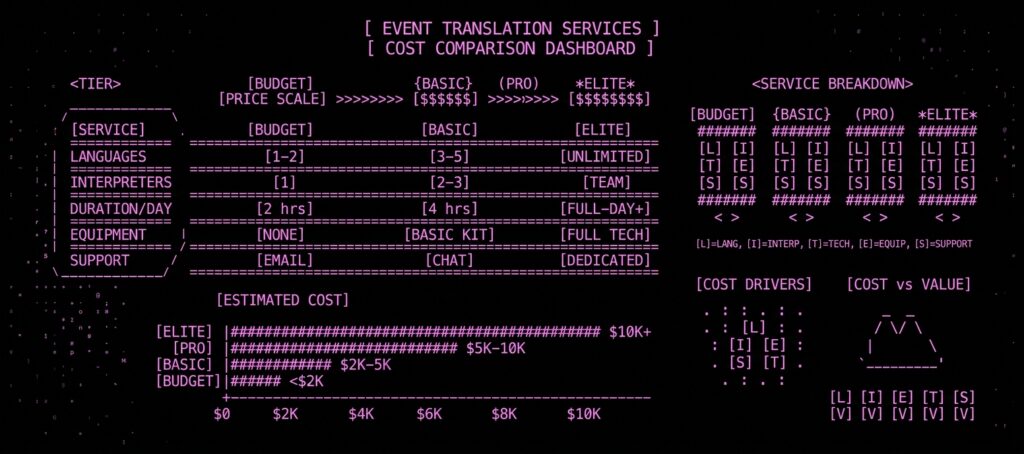
Poland ranked 19th worldwide and 12th in Europe for international association meetings in 2024 with 191 qualifying events, up from 179 in 2023 (ICCA, 2024 Country Rankings). The European Economic Congress in Katowice alone draws 17,000 participants and 1,200 speakers across 180 sessions. If you are running an event in Warsaw, Krakow, Katowice, or Poznan, or hosting Polish-speaking attendees anywhere, this page gives you the costs, accuracy benchmarks, platform options, and a decision framework.
What Will This Cost? Real Scenarios, Real Numbers
Human Interpreters
Simultaneous interpretation requires two interpreters per language pair, rotating every 20-30 minutes (AIIC standard, non-negotiable).
- Interpreter hour rate (in Poland): PLN 300-400/hr each (EUR 70-95, $75-$100). Warsaw rates; Katowice/Krakow 10-15% lower.
- Interpreter day rate (in Poland): PLN 2,400-3,200/day each (EUR 560-750, $600-$800). 8-hour day.
- Interpreter day rate (outside Poland): PLN 3,200-4,800/day each (EUR 750-1,120, $800-$1,200).
- Equipment (booth, receivers, mics): PLN 5,100-17,000/day ($1,300-$4,400). Wireless receivers PLN 50-85/attendee.
- Sound technician: PLN 1,700-3,400/day ($440-$880).
- Travel and per diem: PLN 850-2,500/day ($220-$630). If interpreters are not local.
Sources: przysiegly-angielski-miw.pl (Warsaw, 2026), AIIC rate surveys (2025-2026), connect-translations.com, bireta.pl
AI Platform Costs
- Per-hour rate: $60-$200/hr. Wordly starts at ~$75/hr for 10-hour packages.
- Per-event flat rate: $500-$3,000.
- Per-attendee rate (RSI): $2-$15/attendee.
- Equipment: $0. Attendees scan a QR code.
- Operator/technician: $0-$500.
Side-by-Side: 5 Event Scenarios
| Your Event | Human Interpreters | AI Platform | Hybrid |
|---|---|---|---|
| Half-day corporate meeting in Warsaw, 80 people, EN-PL | PLN 4,500-8,000 (EUR 1,050-1,870) | $250-$500 | Overkill for this |
| 2-day EEC satellite event in Katowice, 300 people, EN-PL + DE | PLN 25,000-50,000 (EUR 5,850-11,700) | $800-$2,000 | PLN 17,000-30,000 |
| 3-day medical congress in Warsaw, 600 people, EN-PL + DE + RU | PLN 85,000-190,000 | $2,000-$6,000 | PLN 42,000-75,000 |
| Impact CEE Poznan-scale tech event, 7,000 attendees, 6+ stages | PLN 130,000+ | $3,000-$8,000 | PLN 25,000-45,000 |
| 5-day international congress, 2,000 people, 5 languages | PLN 235,000-470,000+ | $4,000-$10,000 | $18,000-$30,000 |
The inflection point: At 1 language pair for a single-track event, human interpreters are competitive. Add a second language or a second concurrent track and AI becomes 5-10x cheaper. At Impact CEE scale (7,000 attendees, 6+ stages), human-only interpretation is physically impossible for full coverage.
Will AI Actually Work? Accuracy by Session Type
Polish Is Surprisingly Strong for AI
A 2025 study found that Polish prompts yield 88% accuracy on demanding AI tasks, outperforming English (83.9%) and ranking first globally (Quasa.io, 2025). Polish’s rigid grammatical structure gives neural networks clearer signals. However, speech recognition faces different challenges: consonant clusters (like “szcz,” “prz,” “chrz”), complex morphology, and fast conversational speech.
- Controlled (clear audio, single speaker): 88-93% accuracy, 2-4 seconds latency.
- Real conference (moderate accents, some noise): 82-89%, 3-5 seconds.
- Challenging (fast speech, consonant-heavy terms, crosstalk): 71-81%, 4-7 seconds.
Consonant Cluster Challenges That Trip AI
- Triple/quadruple consonant onsets (szczegol, przestrzen): ASR misparses word boundaries. Mitigation: custom glossary.
- Rapid consonant sequences in technical speech (przeksztalcenie): Latency spikes of 1-2 extra seconds. Brief speakers to moderate pace.
- Sibilant clusters (szczyt, uszczelnienie): Confusion between sz/cz/szcz in noisy rooms. High-quality directional microphones essential.
- Case endings on technical terms: Same word, 7 different endings. Wrong case = wrong meaning. AI models trained on Polish handle this well.
- Fast-speech consonant reduction: Formal speech stays clear; informal drops sounds. 5-8% accuracy drop in casual panels.
Bottom line: Polish AI accuracy is strong for prepared speeches and controlled conditions. The risk zone is fast, informal speech with heavy consonant clusters, exactly what happens during Polish panel Q&A sessions.
When AI Works and When It Does Not
- CEO keynote (scripted): Excellent (89-93%). AI is fine.
- Panel discussion (3-4 speakers): Good (82-88%). Test first.
- Workshop (interactive): Moderate (78-85%). AI with monitoring.
- Medical/CME session: Human required. Polish CME often requires certified interpretation.
- EU regulatory/legal session: Human required.
- Q&A with floor mics: Poor-Moderate (67-79%). Human if critical.
- Expo floor/networking: Moderate (74-82%). AI on attendee devices is the only option at scale.
Platform Comparison
During Your Event
All four major platforms (Wordly, KUDO, Interprefy, Snapsight) support Polish. Key differentiators: Snapsight offers Polish consonant cluster optimization, Pan/Pani register awareness, and per-event pricing. None of the competitors have a Polish-specific page.
After Your Event
Wordly, KUDO, and Interprefy: basic transcript export. No AI summaries, no cross-session analysis, no searchable knowledge base. Snapsight: full multilingual searchable transcripts, AI session summaries in Polish, cross-session thematic analysis, personalized attendee content feeds, and full event intelligence.
The European Economic Congress runs 180 sessions across 3 days. Impact CEE runs 6+ stages over 2 days. Infoshare Gdansk packs 250+ speakers into 2 days. With most platforms, that content disappears when the speaker stops. With Snapsight, a 3-day congress becomes a searchable, multilingual knowledge base, and your translation spend becomes a content investment.
10 Questions to Ask Any Vendor
Logistics
- What is the latency for English-Polish specifically? Acceptable: 2-5 seconds. Red flag: “varies.”
- What do attendees need to do? Simpler = higher adoption. Polish conference attendees are tech-literate but resistant to downloading unfamiliar apps mid-event.
- How many operator staff do I need on-site per room? AI platforms should be 0-1 for the whole event.
- Can I upload a custom glossary for Polish technical terminology? Critical for energy, manufacturing, fintech, and pharma.
Risk
- What happens if the AI mistranslates during a keynote? Some platforms offer real-time human QA overlay.
- What is the backup plan if audio quality drops? Newer venues (ICE Krakow, PTAK Warsaw Expo) have excellent acoustics. Older halls vary wildly.
- Do you offer a test run with our actual speaker audio? Any vendor who says no is a red flag.
Value
- What content do I get after the event ends?
- Can I search the translated transcripts by topic or keyword?
- What is the total cost including post-event content?
The Hidden Cost Nobody Budgets For
- Transcription of 30 sessions: PLN 12,800-21,300 (EUR 3,000-5,000). 2-3 weeks.
- Translation of transcripts: PLN 17,000-34,100 (EUR 4,000-8,000). 2-4 weeks.
- Session summaries: PLN 6,400-12,800 (EUR 1,500-3,000). 1-2 weeks.
- Thematic analysis: PLN 8,500+ (EUR 2,000+) or 40 hours of internal staff. 2-3 weeks.
- Total post-event content: PLN 44,700-76,700 (EUR 10,500-18,000). 3-6 weeks.
AI platforms with built-in content intelligence eliminate this entirely. Your translation cost IS your content cost.
Decision Flowchart
- Regulatory/legal (medical CME, EU regulatory, legal proceedings): Human interpreters. Full stop.
- Reputational (EEC keynote, investor pitch): Hybrid: human for high-visibility sessions, AI for the rest.
- Low consequences (tech conference, trade fair): AI-only.
- 1-2 languages, single track: Either works. Budget PLN 17,000-64,000.
- 3-5 languages or multi-track: AI is 5-10x cheaper.
- 6+ languages: AI is the only realistic option.
- Need post-event content? Choose a platform with built-in content intelligence.
Poland’s Key Conference Hubs
- Warsaw: Government summits, financial conferences, EU presidency events. Venues: PTAK Warsaw Expo, Palace of Culture. Language pairs: EN-PL, DE-PL, FR-PL.
- Katowice: European Economic Congress (17,000 attendees, 180 sessions), mining/energy events. Venues: MCK Katowice, Spodek. Language pairs: EN-PL, DE-PL, RU-PL.
- Krakow: Medical congresses, academic conferences, tech events. Venues: ICE Krakow (2,150-seat auditorium), EXPO Krakow. Language pairs: EN-PL, DE-PL.
- Poznan: Impact CEE (7,000 attendees), Poznan International Fair, MTP trade events. Language pairs: EN-PL, DE-PL.
- Gdansk: Infoshare (7,000 attendees), maritime/logistics conferences. Language pairs: EN-PL.
- Wroclaw: IT conferences, shared services/BPO events. Venues: Centennial Hall (UNESCO site, 10,000 capacity). Language pairs: EN-PL, DE-PL.
Setup Timeline: 6 Weeks to Event Day
- 6 weeks out: Choose approach. EN-PL interpreters are well-supplied in Warsaw and Krakow. DE-PL interpreters are plentiful. RU-PL and FR-PL are scarcer.
- 4 weeks out: Upload custom glossary. Polish technical vocabulary uses many English loanwords but declines them with Polish endings (startupy, meetingi).
- 2 weeks out: Run a test session in the real venue. Newer venues (ICE Krakow, PTAK) have excellent acoustics. Older halls vary.
- 1 week out: Distribute attendee instructions in Polish AND English.
- Day of: Monitor dashboard. Polish speakers accelerate during Q&A.
- Day after: Download transcripts, summaries, distribute to stakeholders.
Two human simultaneous interpreters for English-Polish in Poland: PLN 14,400-19,200 for 3 days (PLN 2,400-3,200/day each). Add PLN 15,300-51,000 for equipment (booth, receivers, technician). Total for a 3-day EN-PL only conference: PLN 29,700-70,200 (EUR 6,950-16,400). AI platforms: $2,000-$6,000 total for unlimited languages.
For prepared keynotes and panel presentations with clear audio, yes. AI achieves 82-93% accuracy depending on conditions. The EEC’s 180 sessions across 3 days make AI the only way to cover the full program. For the opening plenary with government ministers and high-profile economic debates, use human interpreters or hybrid. For the 170+ parallel sessions, AI is both the practical and economical choice.
Polish text is exceptionally clear for AI, ranked #1 globally for AI task accuracy at 88% (Notes From Poland, October 2025). But spoken Polish introduces consonant clusters like szcz, prz, and chrz that challenge automatic speech recognition, especially in noisy conference environments. The gap between Polish text accuracy and Polish speech accuracy is wider than for most European languages.
Germany is Poland’s largest trade partner, and German-Polish is the second most requested language pair at Polish conferences after English-Polish. At the European Economic Congress in Katowice (near the German border), DE-PL interpretation demand is high. The good news: DE-PL interpreters are well-supplied in Poland, and AI handles the German-Polish pair well due to large parallel training corpora.
Polish uses Pan/Pani (formal “you”) universally in professional and conference contexts. AI platforms typically default to formal register, which works for 95%+ of conference content. The risk surfaces in workshops and networking where speakers switch to informal ty. For formal events, AI’s formal default is actually an advantage.
Warsaw has the largest capacity (PTAK Warsaw Expo) and the most international conference infrastructure, but venues spread across the city. Krakow’s ICE Congress Centre is purpose-built (opened 2014) with world-class acoustics, so AI performs consistently here. Katowice’s MCK (opened 2015) is modern and built specifically for the European Economic Congress scale. All three cities have strong AV infrastructure. Older university and government buildings in any city require on-site audio testing.
Wordly, KUDO, and Interprefy all support Polish for real-time translation. The difference: none of them have a Polish-specific page, Polish-optimized glossaries, or post-event content intelligence. Snapsight delivers translation during the session AND generates searchable multilingual transcripts, AI session summaries in Polish, cross-session thematic analysis, and personalized attendee content feeds. Snapsight operates at 91% autonomy across 10,415+ sessions, with no dedicated operator needed per room.