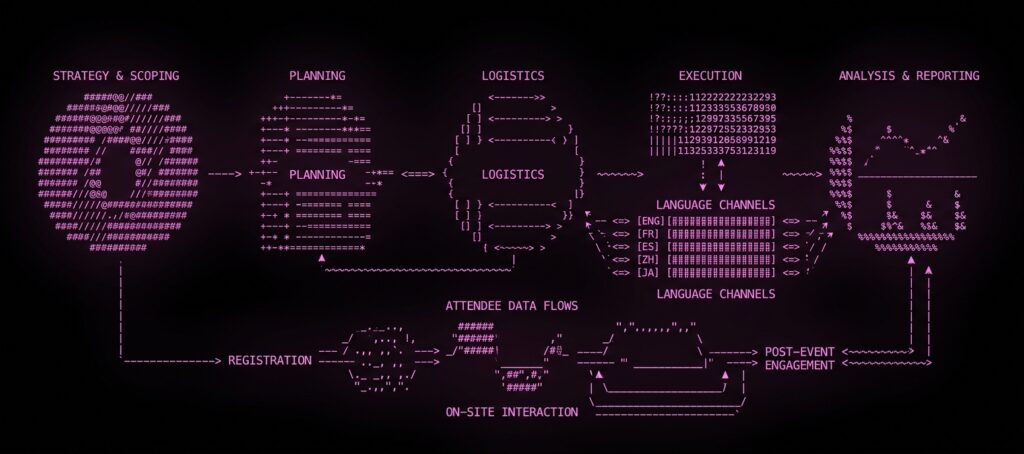
Planning a multilingual event is a logistics problem with a 12-week critical path. Miss the booking window for interpreters and you pay rush rates. Skip the WiFi load test and your AI translation crashes mid-keynote. This page is your operational checklist: print it, hand it to your AV lead, and work from it week by week.
The 12-Week Countdown
This is the master timeline. Every task has a reason for its placement and a common mistake that costs money or quality when ignored.
Weeks 12-10: Foundation Decisions
- Week 12: Language audit. Survey registered attendees for language preference. Pull country-of-origin data from registration. Identify regulatory language requirements. Common mistake: Guessing based on event location instead of actual attendee data. A “London conference” may have 40% non-English speakers if your membership is international.
- Week 10: Decide delivery model. Human interpreters, AI translation platform, or hybrid. Begin vendor outreach with your language list and session count. Get 3 quotes minimum. Common mistake: Choosing based on cost alone. A $300/day AI platform that crashes during your CEO’s keynote costs more than $2,400/day interpreters who deliver flawlessly.
Weeks 8-6: Booking and Preparation
- Week 8: Book interpreters and sign platform contracts. Confirm interpreter pairs (always 2 per language). Execute AI platform agreement. Reserve interpretation equipment. Common mistake: Booking a single interpreter per language. Solo interpreters fatigue after 30 minutes; accuracy drops measurably in afternoon sessions.
- Week 6: Submit speaker materials to vendors. Send all confirmed slide decks, technical glossaries, acronym lists, and session abstracts. Common mistake: Waiting until “final” slides are ready. Send drafts now; send updates later. Interpreters with draft slides outperform interpreters with final slides received 24 hours before.
Weeks 4-2: Technical Setup and Testing
- Week 4: AV and equipment coordination. Conduct venue site visit with AV provider. Confirm booth placement (sightlines to stage), power circuits, direct audio feed from soundboard to booths. Run WiFi load test for AI platforms. Common mistake: Assuming venue WiFi will handle AI translation. General-use event WiFi is shared with 500 attendees streaming, posting, and emailing. AI translation needs a dedicated SSID with guaranteed bandwidth.
- Week 3: Test run with actual speakers. Schedule 15-minute rehearsal with each keynote/plenary speaker. Test interpretation flow, speaker accent clarity, and speaking speed. Common mistake: Skipping rehearsal for “experienced speakers.” Even veteran presenters rarely understand interpretation constraints. A 15-minute rehearsal prevents 3 hours of poor-quality translation.
- Week 2: Attendee communication. Send logistics email: how to pick up headsets, how to access AI translation, WiFi network name, QR codes for mobile access. Common mistake: Announcing language services only on-site. Attendees who discover translation mid-session have already disengaged.
Week 1 Through Event Day
- Week 1: Final tech rehearsal and backup plans. Full end-to-end test: interpreter audio, headset distribution, AI platform on dedicated WiFi, booth monitors. Document backup plan for each failure mode. Common mistake: Testing only the tech, not the workflow. Test the headset pickup process, the attendee QR code scan, and the interpreter handoff.
- Day before: On-site equipment check and interpreter briefing. Walk every room. Verify booth sightlines, power, audio feeds. Brief interpreters on speaker order, topic changes, VIP terminology. Common mistake: Relying on the AV company’s word that “everything is set.” Walk every room yourself with the language coordinator.
- Day of: Monitor and troubleshoot. Language coordinator checks audio quality from an audience seat every session start and every 30 minutes. Monitor AI translation output for drift. Common mistake: Assigning language monitoring to someone who also has 12 other event-day responsibilities. Dedicate one person to language operations full-time.
- Day after: Content delivery and feedback. Export all transcripts and translations. Send attendee feedback survey segmented by language. Debrief with interpreters on terminology gaps. Common mistake: Treating event content as “done” when the event ends. The translated transcripts, summaries, and searchable archives are the highest-ROI assets from your language investment.
Language Audit Template
Run this audit at the 12-week mark. The output determines every budget, staffing, and technology decision downstream.
What to Ask Attendees
- “What is your preferred language for event content?” Gives you primary language need by count. Use it to rank languages by audience size.
- “Can you follow presentations in English comfortably?” Identifies attendees who need translation vs. those who prefer it.
- “Will you attend with colleagues who need translation?” Captures unregistered language needs from accompanying delegates and guests.
- “Do you need translated printed materials?” Determines document translation budget.
Language Priority Decision Tree
- Tier 1, Full service (20%+ of attendees OR host-country official language OR regulatory requirement): Simultaneous interpretation for all sessions, all materials translated, signage, app localization.
- Tier 2, Core sessions (10-19% of attendees OR major sponsor requests it OR keynote speakers deliver in this language): Simultaneous interpretation for plenaries and top-tier breakouts; key materials translated.
- Tier 3, AI-supported (5-9% of attendees OR secondary sponsor language): AI-powered real-time translation and captions; digital materials only.
- Tier 4, Self-service (under 5%, no contractual obligation): Provide AI translation app access; no dedicated interpretation.
Human vs. AI Decision by Language
Lean Human
- High-stakes sessions (CEO keynote, regulatory, board)
- Technical density (medical, legal, engineering)
- Speaker crosstalk (panels, debates)
Lean AI
- 4+ languages needed (cost scales marginally)
- Hybrid/virtual attendees (native digital delivery)
- Breakout sessions (20-80 people per room)
- General content (low technical density)
Venue Requirements Checklist
Print this. Walk through it with your AV provider during the site visit at the 4-week mark.
- Interpreter booth space: Minimum 2.5m x 2.5m per booth, ISO 4043:2016 compliant. Undersized booths cause interpreter fatigue and poor audio isolation. Ask: “Do you have permanent or mobile interpretation booths? What are the dimensions? Are they ISO-compliant?”
- Booth sightlines: Clear view of stage, screens, and speaker. Interpreters must see the speaker’s gestures, slides, and visual aids. Ask: “Can we position booths with direct sightline to stage? If not, will you provide dedicated booth monitors?”
- Ventilation: Independent air supply, 7 air renewals/hour, 18-22C controllable per booth. Two interpreters in a sealed booth generate heat. Ask: “Is booth ventilation on a separate system from the main hall?”
- WiFi bandwidth: Minimum 5 Mbps dedicated per AI translation channel; 2 Mbps per RSI stream. Shared attendee WiFi will not work. Ask: “Can you provide a dedicated SSID with guaranteed bandwidth, separate from attendee WiFi?”
- Dedicated power circuits: Separate circuit per booth, minimum 2 outlets each. Ask: “Are booth power outlets on dedicated circuits?”
- Direct audio feed: Soundboard output to each booth, not room microphone pickup. Room mic pickup includes echo, audience noise, and HVAC rumble. Ask: “Can you run a dedicated audio line from the main soundboard to each interpretation booth?”
- Sound isolation: Verify room-to-room bleed in breakout areas. Ask: “What is the sound rating between breakout rooms? Are partitions floor-to-ceiling with acoustic sealing?”
- Screen placement for captions: Secondary screens visible from all seating areas. Minimum 50-inch display per 50 attendees. Ask: “Can we add caption display screens at the front-sides of the room?”
- Headset distribution point: Table near main entrance with space for queuing. You need 1 distribution point per 200 attendees with 2 staff each. Ask: “Is there table space near the main entrance for a headset station?”
Speaker Preparation Checklist
Send this to every speaker at the 6-week mark. Attach it to the speaker confirmation email.
- Speak at 100-130 words per minute. Practice with a timer. Most people default to 150-170 wpm. Interpreter accuracy peaks at 100-120 wpm source speech. At 160+ wpm, interpreters reduce their output to 71-74% of source content. Deadline: Rehearsal (3 weeks out).
- Submit slides 2 weeks before the event. Drafts are fine. Send updates later. Interpreters need terminology preparation time. Deadline: Event minus 14 days.
- Provide a glossary of 10-20 specialized terms. Include acronyms, brand names, technical vocabulary with definitions. Without a glossary, each interpreter invents their own translations inconsistently. Deadline: Event minus 14 days.
- Avoid idioms, slang, and culture-specific humor. “Knocked it out of the park” has no equivalent in most languages. Use concrete language. Deadline: Slide review (4 weeks out).
- Do not read slides verbatim. Read-aloud pace is 160-180 wpm, too fast for quality interpretation. Speak from notes, using slides as visual support. Deadline: Rehearsal.
- Pause 3 seconds after key points. Gives interpreters a buffer to complete the thought before you introduce the next concept. Deadline: Rehearsal.
- Repeat audience questions into the microphone. Interpreters typically cannot hear audience questions from the booth. Deadline: Day-of briefing.
- Number your slides. Interpreters follow along visually. Slide numbers let them track your position if you skip ahead. Deadline: Final slides.
- Confirm your presentation language 3 weeks out. If your native language differs from your presentation language, notify the team. Interpreters prepare differently for native vs. non-native speakers. Deadline: Event minus 21 days.
Attendee Communication Plan
Events that communicate language services in advance see measurably higher adoption. This timeline ensures attendees know what is available, how to access it, and what to do if something is not working.
- 8 weeks before: Language services announcement in registration confirmation email. “This event will offer interpretation in [languages]. Select your preferred language in your registration profile.”
- 6 weeks before: Detailed service breakdown on event website + dedicated email. Specify which sessions have simultaneous interpretation vs. AI-powered translation.
- 4 weeks before: App language settings notification. “Set your language preference in the event app now.”
- 2 weeks before: Logistics and access instructions email with visual guide. Specify headset pickup location, WiFi network, and QR code access.
- 1 week before: Final details with floor map showing headset pickup, booth positions, QR code stations, and WiFi network name.
- Day of (arrival): Multilingual welcome signage. Dedicated “Language Services” desk near registration. QR code posters at every room entrance.
- Day of (session start): MC/moderator announces interpretation availability and how to access it.
- Day after: Feedback request: “How was your experience with the language services? Were any languages missing? Rate translation quality 1-5.”
Budget Planning Matrix
All figures are per event day, USD, based on 2025-2026 industry rates from JR Language, LingualInx, and Langpros. Multiply by event duration for total budget.
| Budget Line Item | Human Interpretation | AI Translation Platform | Hybrid Approach |
|---|---|---|---|
| Interpreters (per language, pair required) | $1,600-$3,500/day | $0 | $1,600-$3,500 for Tier 1; $0 for Tier 3-4 |
| Interpretation equipment | $1,500-$5,000/day | $0 | $1,500-$5,000 for rooms with human interpreters only |
| Platform license | $0 | $300-$1,500/day | $300-$1,500/day |
| Equipment technician | $500-$1,200/day | $0 | $500-$1,200/day |
| WiFi upgrade | $0-$500 | $500-$2,000 | $500-$2,000 |
| Document translation | $0.15-$0.35/word | $0.05-$0.15/word | $0.10-$0.25/word |
| On-site language coordinator | $800-$2,000/day | $800-$2,000/day | $800-$2,000/day |
| Post-event content | $2,000-$8,000 | Included or $500-$2,000 | $500-$2,000 |
| Contingency | 15% of total | 10% of total | 12% of total |
Quick Budget Estimates
Bilingual Event (200 attendees, 1 added language)
- Human only: $6,000-$12,000/day
- AI only: $1,500-$4,000/day
- Hybrid: $4,000-$8,000/day
Multilingual Conference (500 attendees, 3 languages)
- Human only: $18,000-$35,000/day
- AI only: $3,000-$8,000/day
- Hybrid: $10,000-$20,000/day
International Congress (2,000+ attendees, 6+ languages)
- Human only: $70,000-$160,000/day
- AI only: $8,000-$20,000/day
- Hybrid: $30,000-$65,000/day
The hybrid cost advantage becomes decisive at 4+ languages. Human interpretation costs scale linearly per language. AI platform costs scale marginally. A hybrid approach, human interpreters for Tier 1 languages, AI for the rest, typically saves 30-50% compared to fully human interpretation while maintaining quality where it matters most.
For detailed pricing breakdowns by technology type, see the Language Translation Pricing Guide.
Risk Mitigation
- Interpreter no-show (likelihood: low, impact: high): Book a backup interpreter on standby (remote or local). Confirm attendance 48 hours and 24 hours before. Have AI platform ready as emergency fallback.
- WiFi failure (likelihood: medium, impact: high): Dedicated SSID separate from attendee WiFi. Cellular/5G failover device. Load-test 1 week before with simulated concurrent users.
- Speaker talks too fast (likelihood: high, impact: medium): Speaking pace in speaker prep packet. Rehearsal at 3-week mark. Moderator empowered to signal speakers to slow down. Printed reminder card on podium.
- Unexpected language need (likelihood: medium, impact: medium): AI platform with broad language support as safety net. Pre-event survey at 12-week mark. On-site QR code for AI translation in 75+ languages.
- Equipment malfunction (likelihood: medium, impact: medium): Carry 15% extra headsets. Spare receivers charged and ready. Backup audio cable for each booth. Battery swap schedule during every break.
- Attendee cannot access AI platform (likelihood: medium, impact: low per attendee): QR code access (no app download required). On-site staff at Language Services desk. Printed 3-step instruction card in 4 languages.
- Interpreter terminology gap (likelihood: medium, impact: medium): Glossary submitted at 6-week mark. Pre-event interpreter briefing with subject matter expert.
- Power outage to booth (likelihood: low, impact: high): Booth on dedicated circuit. UPS backup for critical equipment. Test circuit breaker load during site visit.
Post-Event Content Checklist
Most translation vendors stop at the event. The content generated during a multilingual event, transcripts, translations, cross-session insights, is the highest-ROI asset from your language investment. Capture it.
- Session transcripts in original language: 1-2 days post-event. All attendees (on-demand). Searchable text, timestamped, speaker-attributed.
- Translated session summaries (per language): 3-5 days post-event. 500-800 word summary per session in each supported language.
- Searchable session archive: 5-7 days post-event. Indexed by speaker, topic, keyword, searchable across all sessions and languages.
- Cross-session intelligence reports: 5-10 days post-event. “What the event said about [topic]” reports synthesized across multiple sessions.
- Attendee follow-up in their language: 2-3 days post-event. Thank-you email, feedback survey, and key takeaways in each attendee’s selected language.
- Speaker Q&A documentation: 1-2 weeks post-event. Questions and answers extracted and organized by topic.
- Social content library: 1-2 weeks post-event. Key quotes, data points, and insights in multiple languages for regional social channels.
- Terminology database: 1-2 weeks post-event. Glossary of all specialized terms and their agreed translations for consistency at next event.
Where most organizations stop: Raw recordings in a shared drive that nobody accesses. Where the value is: A structured, searchable, multilingual content library that serves your organization between events. Snapsight automates this pipeline across 627+ events and 10,415+ sessions in 75+ languages, delivering searchable, translated session archives with 91% autonomous operation.
FAQ
Book 3-6 months ahead for large events (500+ attendees or 4+ languages). Peak conference seasons, September through November and March through May, see the highest demand and the smallest available pool. For rare language pairs (Icelandic-Japanese, Welsh-Mandarin), start 6+ months out because the qualified interpreter pool may be fewer than 10 people nationally. AI translation platforms can typically be provisioned 2-4 weeks before the event.
With human interpreters only, budget and booth space typically cap practical support at 4-6 languages. Each language requires 2 interpreters, a booth, equipment, and a dedicated audio channel. At 8+ languages, the logistics and cost become prohibitive for most organizations. With AI translation, the ceiling rises to 20-30+ languages at marginal per-language cost. The hybrid model, human for top 2-3 languages, AI for the rest, is how most international congresses practically support 6+ languages today.
No. AI translation platforms deliver audio and text directly to attendees’ devices. No booths, receivers, or headsets required. Attendees access translation through a mobile app, web browser, or QR code scan. This eliminates the single largest venue logistics item. However, if you are using human interpreters for any sessions, those sessions still require booths with ISO-compliant specifications.
Plan for 5 Mbps of dedicated bandwidth per AI translation language channel, plus 2 Mbps per remote simultaneous interpretation (RSI) stream. This must be on a dedicated SSID, not shared with attendee general WiFi. A 3-language AI setup needs approximately 15-19 Mbps of guaranteed (not “up to”) bandwidth. Load-test one week before the event with simulated concurrent users.
This is more common than most planners expect. Three steps: (1) Confirm each speaker’s delivery language at the 6-week mark and communicate it to interpreters. (2) Brief interpreters on which sessions will have mixed-language delivery so they can prepare for relay interpretation if needed. (3) For AI platforms, ensure the system supports automatic language detection or manual channel switching. Notify attendees in the session introduction which languages will be spoken and how to access each translated channel.