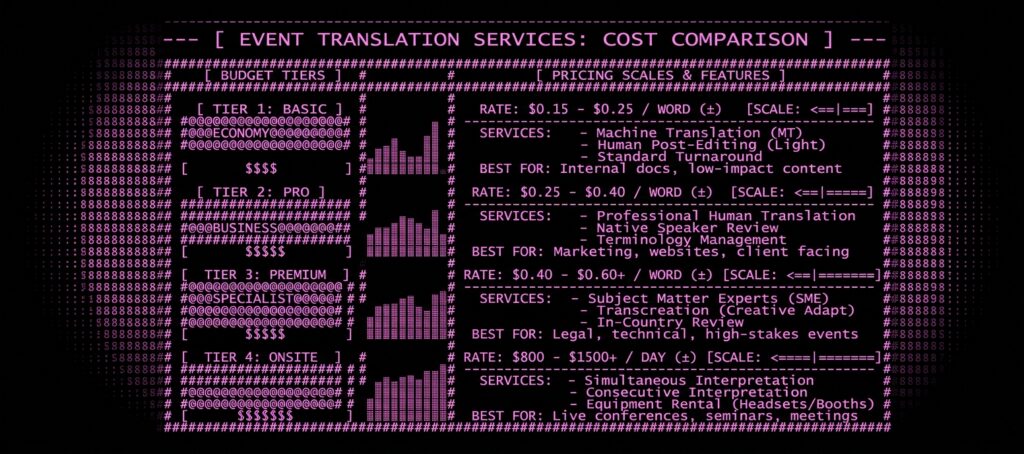
The Netherlands ranked 8th globally for international association meetings in 2024, hosting 295 conferences, and Amsterdam climbed to 17th worldwide, generating EUR 230 million in economic impact from the congress industry alone (ICCA, 2024 Country & City Rankings). The Hague sits in the ICCA Top 50 European congress cities, driven by its status as the international city of peace and justice. If your event touches the Dutch-speaking world, you need interpretation that handles both Netherlands Dutch and Belgian Flemish. This page gives you real costs, AI accuracy benchmarks, and a framework to decide.
What Will This Cost? Real Scenarios, Real Numbers
Dutch interpreters follow European market norms. The NGTV (Nederlands Genootschap van Tolken en Vertalers) publishes recommended rates, and most professionals quote day rates inclusive of standard preparation.
Human Interpreters: Dutch Market Rates
Simultaneous interpretation requires two interpreters per language pair. They rotate every 20-30 minutes. This is an AIIC standard enforced across the Netherlands and Belgium.
- Full-day rate (up to 8 hrs): EUR 750-1,100/day each ($815-$1,195). Dutch-English is well-supplied in the Randstad; fewer options outside Amsterdam/The Hague.
- Half-day rate (up to 4 hrs): EUR 400-650/day each ($435-$710). Most agencies enforce half-day minimums.
- Remote/RSI session (under 4 hrs): EUR 300-500 each ($325-$545). No booth needed.
- Booth rental: EUR 800-1,800/day ($870-$1,960). ISO 4043-compliant; Dutch venues typically have in-house options.
- Wireless receivers: EUR 5-15/unit/day ($5.50-$16). Budget 10-15% buffer above headcount.
- Sound technician: EUR 350-700/day ($380-$760). Required at RAI Amsterdam, World Forum The Hague, Ahoy Rotterdam.
- Travel and per diem: EUR 100-350/day ($110-$380). Low within the Randstad; Amsterdam-The Hague is 65km.
Sources: NGTV rate guidance, Raccourci interpreting rates (2025), Presence Group Amsterdam, AIIC rate recommendations, OVS Translations (2025)
Key difference from the US market: The Netherlands is compact. Amsterdam, The Hague, Rotterdam, and Utrecht are all within 80km of each other. Travel costs are minimal compared to US or German events. This density also means the Randstad interpreter pool is deep: you rarely pay premiums for Dutch-English pairs unless booking during major conference weeks.
AI Platform Costs
- Per-hour rate: EUR 50-180/hr ($55-$195). Wordly starts at ~EUR 70/hr for 10-hour packages.
- Per-event flat rate: EUR 400-2,500 ($435-$2,720).
- Per-attendee rate (RSI hybrid): EUR 2-12/attendee ($2-$13). KUDO, Interprefy use this model.
- Equipment: EUR 0. Attendees use their own phones via QR code.
- Operator/technician: EUR 0-400 ($0-$435). Most AI platforms run autonomously.
Side-by-Side: Your Event, Your Cost
| Your Event | Human Interpreters | AI Platform | Hybrid |
|---|---|---|---|
| Half-day board meeting, 25 people, NL-EN only | EUR 1,800-3,000 | EUR 200-450 | Overkill for this size |
| 2-day congress at RAI Amsterdam, 400 people, NL-EN, 6 sessions | EUR 4,800-9,500 | EUR 600-1,600 | EUR 3,000-5,500 |
| International law conference at the Peace Palace, 600 people, NL-EN-FR, 3 days | EUR 18,000-38,000 | EUR 1,500-4,500 | EUR 8,000-15,000 |
| EU-themed summit, 1,000 people, 4 languages, 4 days, 20+ sessions | EUR 45,000-90,000 | EUR 3,000-8,000 | EUR 15,000-25,000 |
| RAI-scale trade show, 5 days, 3,000+ attendees | EUR 30,000-60,000 | EUR 2,500-7,000 | EUR 12,000-22,000 |
The inflection point: Dutch-English is one of the best-supplied interpreter pairs in Europe, and most educated Dutch speakers are already bilingual or near-bilingual in English. The moment your event adds French (common for Belgium-based or EU events) or a third language, costs triple and AI becomes 5-10x cheaper.
Will AI Actually Handle Dutch? An Honest Accuracy Breakdown
Dutch is a Germanic language closely related to both English and German. This shared lineage makes Dutch one of the stronger-performing AI language pairs.
Why Dutch Is Relatively Strong for AI
- Shared Germanic roots: English and Dutch share approximately 60% lexical similarity. Word order patterns, vocabulary overlap, and grammatical structures give neural machine translation a head start.
- Latin script, no tonal system: Speech recognition error rates for Dutch are 15-25% lower than for tonal or non-Latin-script languages (KUDO, 2025).
- High bilingual population: 93% of Dutch adults speak English (Eurobarometer, 2024). AI training data for Dutch-English is abundant and high-quality.
Why Dutch Still Trips Up AI
- Compound nouns: Like German, Dutch builds compounds: volksgezondheidsbeleid (public health policy), arbeidsmarktanalyse (labor market analysis). A challenge for AI decomposition.
- Pronunciation clusters: Dutch consonant clusters like schr- and the guttural g create speech recognition issues in noisy conference environments.
- False friends with English: Eventueel means “possibly” (not “eventually”), actueel means “current” (not “actual”). In real-time translation, these false cognates produce confidently wrong output.
Accuracy by Session Type
| Session Type | AI Accuracy (NL to EN) | AI Accuracy (EN to NL) | Recommendation |
|---|---|---|---|
| Keynote, clear speaker, prepared text | 90-95% | 88-93% | AI viable; human for ministerial speakers |
| Panel discussion, multiple speakers | 78-87% | 75-84% | Human preferred; AI struggles with code-switching |
| Technical, legal, medical, maritime | 75-85% | 72-82% | Human required for ICC/ICJ proceedings |
| Workshop/Q&A, rapid dialogue | 72-82% | 68-78% | Human preferred; floor mic audio degrades AI |
| Networking/expo floor | 60-75% | 55-70% | AI is the only option at scale |
| Pre-recorded content, studio quality | 93-97% | 91-95% | AI excellent; massive cost advantage |
Bottom line: Dutch-English is one of AI’s better language pairs. For general business content, AI delivers solid results. For legal proceedings at the International Court of Justice or pharmaceutical terminology at a clinical trials conference, human interpreters remain essential.
Platform Comparison: Who Does What for Dutch Events
- Wordly: AI only, per-hour packages starting ~$75/hr. Best for large audiences needing captions in many languages. No dialect differentiation for Flemish.
- KUDO: AI + human interpreter marketplace. Human interpreters can be selected by region (Netherlands vs. Belgian). Hybrid pricing model.
- Interprefy: Human interpreter network + AI assist. Interpreters selected by region for Flemish handling. Custom quotes.
- Snapsight: AI transcription + translation across 75+ languages. Flemish variance handled at transcription level. Full post-event content intelligence: summaries, cross-session synthesis, searchable content library.
For a 3-day congress at RAI Amsterdam with 30 sessions across 4 parallel tracks, live interpretation is half the value. Snapsight captures every session in its source language, then delivers AI-generated summaries, searchable transcripts, and cross-session synthesis. With 10,415+ sessions transcribed across 627+ events in 75+ languages, Snapsight handles the Dutch conference circuit’s specific demands.
10 Questions to Ask Any Dutch Interpretation Vendor
- Do you differentiate between Netherlands Dutch and Flemish Dutch? Critical for Belgium-origin or Benelux-wide events.
- What is your interpreter day rate, and is preparation time included? Dutch market rates typically include standard prep.
- Can you staff interpreters for my specific language combination? NL-EN is easy. NL-FR is common but thinner. NL-DE or NL-ES requires more lead time.
- What happens during major conference weeks in Amsterdam? IBC (September), Money20/20 (June), and ICCA Congress weeks strain the local pool.
- Are your interpreters experienced with EU/institutional terminology? The Hague’s international organizations use specific procedural language.
- Do you provide post-event transcripts and in what format? SRT, VTT, searchable text, or raw audio?
- How do you handle Dutch-English code-switching? Dutch speakers frequently mix English terms into Dutch presentations.
- Can you cover concurrent sessions at RAI Amsterdam or World Forum? A 4-track conference needs 8 interpreters or an AI platform.
- What is your cancellation policy? Dutch professional norms expect 30-day cancellation notice.
- Can you provide references from events at Dutch venues (RAI, Ahoy, World Forum, Jaarbeurs)? Venue-specific experience matters for AV compatibility.
Hidden Costs That Will Blow Your Budget
- VAT (BTW) at 21%: All services in the Netherlands. Non-EU buyers can reclaim VAT but must file paperwork. Always confirm if quotes are exclusief or inclusief BTW.
- Weekend/evening surcharges: 125-200% of standard rate after 18:00 or on weekends. Dutch interpreters enforce this strictly.
- Equipment at RAI Amsterdam: EUR 500-2,500 depending on hall and power requirements. Use RAI’s preferred AV partners.
- Last-minute language additions: 200-300% premium if within 2 weeks. Lock language list 4+ weeks out.
- Parking at Dutch venues: EUR 25-60/day per interpreter. Budget for it or provide public transport passes.
- Rush transcript delivery: EUR 0.50-1.50 per minute of audio. Snapsight delivers AI transcripts in real-time, no rush fee.
- Hotel rates during IBC week (September): Amsterdam hotels triple in price during the International Broadcasting Convention. Book interpreter accommodations 3+ months early.
- Belgium travel for Flemish interpreter: EUR 200-400 if bringing Brussels-based Flemish interpreters to Amsterdam. Use Amsterdam-based interpreters who handle both variants.
Decision Flowchart: What Does Your Dutch Event Need?
How many language pairs do you need?
- 1 pair (NL-EN only), single-track, under 200 people: Human interpreters (EUR 1,800-3,500).
- 1 pair (NL-EN only), multi-track, 200-500 people: Hybrid (human for plenaries, AI for breakouts).
- 1 pair (NL-EN only), 500+ people or 3+ concurrent tracks: AI platform.
- 2-3 pairs (e.g., NL-EN-FR for Benelux events): AI or hybrid.
- 4+ pairs (EU/international events in The Hague): AI platform is the only scalable option.
Is the content legally or diplomatically sensitive (ICJ, ICC, EU proceedings)? Human interpreters, no exceptions. For general Dutch business content, AI handles it well.
Do you need post-event content? Snapsight delivers post-event content intelligence as the core product.
Dutch vs Flemish: What Event Planners Must Know
This is the section most interpreter guides skip, and it matters for any Benelux or EU event.
- Pronunciation: Netherlands Dutch has a hard guttural g and ch with fast tempo. Flemish has softer consonants and slightly slower delivery. AI speech recognition performs slightly better on Flemish due to clearer consonants.
- Vocabulary: Thousands of differences. Mobiel vs. GSM (mobile phone), pinnen vs. bancontact (pay by card). Critical for customer-facing content but manageable for conference interpretation.
- Formality: Flemish speakers use Gij/ge for “you” (more formal register). Netherlands Dutch uses Jij/je. Flemish speakers may perceive Netherlands Dutch as informal.
- French influence: Flemish speakers use French loanwords that can confuse AI trained on Netherlands Dutch.
- Written standard: Same (Standaardnederlands per the Taalunie). Formal written content serves both audiences; spoken interpretation is where differences surface.
Practical advice: For a Benelux-wide event, use standard Dutch (Standaardnederlands) for all formal interpretation. A qualified Netherlands-based interpreter handles Flemish attendees without difficulty. The real complication arises when your event also requires French (Belgium’s other major language), which requires a separate NL-FR language pair.
Setup Timeline for Dutch Events
- 12+ weeks out: Book interpreters for major conference periods (IBC September, Money20/20 June, ISE January).
- 8-10 weeks out: Confirm language pairs and session schedule. NL-FR interpreters need more lead time than NL-EN.
- 6-8 weeks out: Equipment and booth logistics with venue. RAI, World Forum, and Ahoy all have preferred vendor lists.
- 4-6 weeks out: Share presentation materials with interpreters. Include any English-Dutch mixed terminology.
- 2-3 weeks out: Technical rehearsal. Test audio in the venue.
- 1 week out: Final briefing call. Confirm speaker pronunciations, especially Flemish or Surinamese Dutch speakers.
- Day of: 60-minute sound check before doors open. Dutch events start punctually.
For a 2-day, single-language-pair (NL-EN) conference, budget EUR 4,800-9,500 ($5,220-$10,330) for two simultaneous interpreters including booth rental, receivers, and a sound technician. For AI-only coverage: EUR 600-1,600 ($650-$1,740). A hybrid approach typically runs EUR 3,000-5,500 ($3,260-$5,980).
Yes. Dutch-English is one of AI’s stronger language pairs due to shared Germanic roots, Latin script, and abundant training data from the Netherlands’ highly bilingual population. AI accuracy for general Dutch keynotes reaches 90-95% (NL to EN), compared to 80-88% for Japanese or Arabic. The gap narrows for technical content, where compound nouns and domain-specific terminology still challenge AI systems.
Not for most conference settings. Standard Dutch (Standaardnederlands) serves both audiences. The differences are comparable to British vs American English: noticeable but mutually intelligible. Exception: if your event specifically targets the Flemish business community and cultural alignment matters, a Flemish-native interpreter better matches the regional register.
September (IBC Amsterdam, 55,000+ attendees), June (Money20/20 Europe and The Next Web Conference), and January (ISE, Integrated Systems Europe at RAI Amsterdam, 70,000+ attendees). During these weeks, the Randstad interpreter pool tightens and rates may increase 15-30%. Book 12+ weeks in advance for September or January events.
93% of Dutch adults speak English (Eurobarometer, 2024), the highest rate in continental Europe. However, comprehension and professional fluency are different things. Senior executives, technical specialists, and government officials often prefer to present and negotiate in Dutch. Flemish Belgian attendees, Surinamese Dutch speakers, and Antillean Dutch speakers may have lower English proficiency. Never assume universal English fluency based on Netherlands statistics.
Traditional interpretation vendors deliver raw audio and basic transcripts. Snapsight delivers real-time transcripts in the source language, live translation into 75+ languages, AI-generated session summaries, and a searchable content library that synthesizes insights across every session. For a multi-track Dutch conference at RAI or World Forum, this means your team gets a complete intelligence briefing, not a stack of recordings in Dutch that nobody will review.
Belgium’s linguistic divide means any national Belgian event or EU event in Brussels needs both Dutch and French, and often English as a third language. This requires two separate language pairs (NL-EN and FR-EN, or NL-FR directly). Human interpretation for three language pairs across a 2-day event can cost EUR 18,000-38,000. AI platforms handle this at a fraction of the cost, making them the practical choice for multilingual Belgian or EU events.