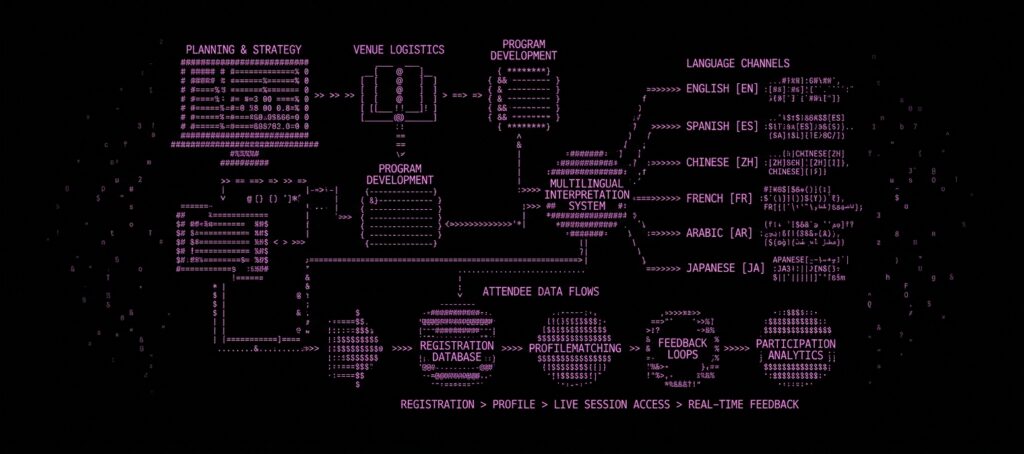
Multi-track event capture is the simultaneous recording, transcription, and processing of content across multiple parallel sessions at a conference or event, enabling organizations to capture every presentation, panel, and workshop happening at the same time rather than choosing which sessions to cover. It combines audio/video recording, real-time transcription, and AI-powered content processing to ensure that no session content is lost, regardless of how many tracks run concurrently.
Why Multi-Track Capture Matters Now
Modern conferences do not run in a single stream. A mid-size technology conference might run 8-12 parallel tracks. The World Statistics Congress has run as many as 20 simultaneous sessions. Medical conferences like ASCO and RSNA routinely operate 15+ concurrent sessions.
The problem is straightforward: an attendee can only be in one room at a time. An AV team can only staff so many rooms. Traditional event recording focused on the mainstage keynote and perhaps one or two high-profile sessions. Everything else was never captured.
The global event management software market is projected to grow from $11.52 billion in 2025 to $36.42 billion by 2035, growing at 12.2% CAGR (Research Nester). Much of that growth is driven by organizations demanding comprehensive content capture across their entire event, not just the headline sessions.
The Three Components
- Simultaneous recording. Audio and/or video capture running in every session room at the same time.
- Real-time transcription. Converting spoken content to text as it happens, across all tracks simultaneously.
- Automated processing. AI-powered systems that monitor, quality-check, and process captured content without requiring a human operator in every room.
Without all three components, you have partial capture, not multi-track capture. Recording without transcription produces video files nobody searches. Transcription without automation requires a human operator per room, which does not scale past 3-4 tracks.
Multi-Track Event Capture vs. Traditional Event Recording
| Dimension | Traditional Recording | Multi-Track Capture |
|---|---|---|
| Coverage | 10-20% of sessions | 100% of sessions |
| Staffing per room | 1-2 AV crew members | 0 (autonomous) |
| Transcription timeline | 2-4 weeks post-event | Real-time |
| Cross-session search | Not possible | Full-text search across all sessions |
| Marginal cost per track | $2,000-$5,000 per room | Near zero |
| Scalability ceiling | Limited by crew and equipment | Limited only by bandwidth |
The takeaway: Traditional recording treats capture as a service. Multi-track capture treats it as infrastructure. The cost curve for traditional recording is linear (more rooms = proportionally more cost), while multi-track capture has high fixed costs but near-zero marginal costs.
Why Multi-Track Capture Matters for Event Professionals
Attendee Experience
46% of event tech budgets now go to engagement tools. Multi-track capture eliminates FOMO. Attendees choose sessions based on interest rather than scarcity.
Content ROI
88% of businesses report positive ROI from events. Multi-track capture multiplies ROI by ensuring every session contributes to content output, generating 5-10x more repurposable content.
Getting Started
Assess your current capture gap. Most organizations discover they capture less than 25% of their event content. The technology cost is the same whether you capture 5 tracks or 15; the difference is mostly operational setup.
Snapsight pioneered autonomous multi-track event capture, with the Operator Agent managing sessions across 627+ events and 10,415+ sessions. The system handles simultaneous capture across parallel tracks in 75+ languages with 91% autonomous operation. See multi-track capture in action.
Modern AI-powered systems can handle 20+ simultaneous tracks without degradation. The constraint is typically network bandwidth and audio quality, not processing capacity. For most conferences running 4-12 parallel tracks, the technology handles capture comfortably. Large international congresses running 20+ tracks may require distributed infrastructure, but this is an operational consideration rather than a technical limitation.
Traditional AV recording costs $2,000-$5,000 per room per day (crew, equipment, setup). Multi-track capture platforms typically charge per-event or per-session fees that work out to significantly less per room because there is no crew requirement. For an event with 10 parallel tracks running 3 days, traditional recording might cost $60,000-$150,000. An AI-powered multi-track capture platform might cost $5,000-$15,000 for the same coverage.
It depends on the platform and event format. For virtual and hybrid events, multi-track capture works through the existing video platform with no additional hardware. For in-person events, most platforms require reliable audio input, which can be as simple as a quality microphone connected to the capture system. Full video capture requires cameras, but audio-only capture with transcription provides most of the content value at a fraction of the equipment cost.
AI transcription accuracy has improved significantly, reaching 95-98% word-level accuracy for clear audio in supported languages. Accuracy depends on audio quality, speaker clarity, and technical terminology. Most platforms offer post-event transcript editing to correct remaining errors. For events with specialized terminology (medical, legal, engineering), custom vocabulary training can improve accuracy for domain-specific terms.
Yes. Platforms with multilingual support can transcribe sessions in different languages simultaneously. Snapsight supports 75+ languages, meaning a conference with English sessions in one track, French in another, and Mandarin in a third can capture and transcribe all three in real time. Some platforms also provide real-time translation, making content from any language session accessible to speakers of other languages.