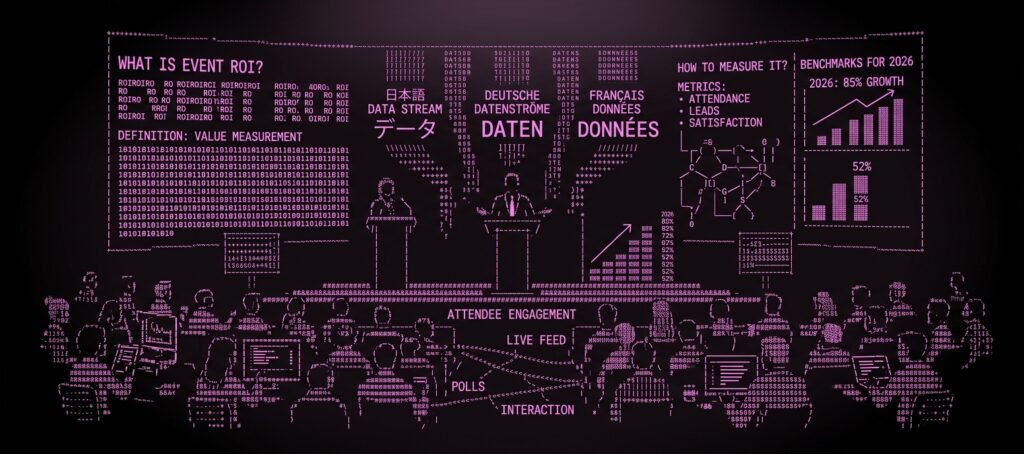
Event ROI (Return on Investment) is the measurement of the financial and strategic value an event generates relative to its total cost, expressed as a ratio or percentage that helps organizations determine whether conferences, trade shows, meetings, and other events are worth the investment. The basic formula is (event revenue or value minus total event cost) divided by total event cost, multiplied by 100, but in practice, event ROI encompasses both quantifiable returns (pipeline, revenue, leads) and strategic value (brand awareness, customer retention, content assets).
Measuring event ROI has been one of the event industry’s most persistent challenges. According to Bizzabo’s 2026 Event Industry Trends report, 40% of organizers still report difficulty proving event ROI, though this is a meaningful improvement from 70% in 2025. The progress reflects better analytics tools, clearer attribution models, and growing organizational pressure: 95% of event teams now prioritize demonstrating ROI, and 52% of business leaders say events provide the greatest ROI of any marketing channel.
Event ROI Defined
Event ROI measures the return generated by an event against the resources invested. Unlike ROI for digital campaigns (where revenue attribution is relatively straightforward), event ROI involves multiple value types, longer timeframes, and more complex attribution.
Event ROI = [(Event Value – Event Cost) / Event Cost] x 100
If an event costs $100,000 and generates $400,000 in attributable pipeline, the ROI is 300%.
Event value includes:
- Direct revenue: Ticket sales, sponsorship income, exhibitor fees
- Pipeline generated: Sales opportunities created through event interactions
- Pipeline influenced: Existing opportunities accelerated or expanded through event touchpoints
- Customer retention value: Revenue retained from customers who attended and renewed
- Content value: Repurposable content assets (recordings, transcripts, summaries) that would have cost money to produce separately
- Brand value: Awareness, perception, and positioning gains that are real but harder to quantify
Why Event ROI Is Difficult
Multi-touch attribution. An attendee who later becomes a customer was influenced by many touchpoints. Isolating the event’s contribution requires sophisticated attribution modeling.
Long sales cycles. In B2B, deals close months or even years after event contact. A deal attributed to a January conference might not close until September. Most event ROI calculations undercount because the measurement window is too short.
Intangible value. Some of the most important event outcomes, strengthening customer relationships, building brand reputation, generating thought leadership, are real but difficult to assign dollar values.
How Event ROI Works
The Three Phases of ROI Measurement
Phase 1: Pre-event (set targets and tracking). Before the event, define what success looks like. Set specific, measurable targets for registration, attendance, leads, pipeline, and satisfaction. Configure your CRM to track event touchpoints.
Phase 2: During-event (capture data). Track engagement in real time. Session attendance, booth visits, content downloads, meetings booked, Q&A participation, and networking connections all contribute to the ROI picture.
Phase 3: Post-event (attribute and report). After the event, connect event data to business outcomes. Match attendee lists against CRM records. Set a measurement window (90-180 days for B2B) and report results at the end of that window, not immediately after the event.
Attribution Models for Events
- First-touch attribution: The event gets full credit if it was the attendee’s first interaction. Overcounts event value for attendees who already knew the brand.
- Last-touch attribution: The event gets full credit if it was the last touchpoint before a deal closed. Rarely applies because events are almost never the final touchpoint.
- Multi-touch attribution: The event shares credit with other touchpoints. This is the most accurate model for events.
- Influence attribution: The event is tagged as an influence on any deal where an attendee was involved. Bizzabo and Salesforce Campaign Influence reporting support this model.
Multi-touch and influence attribution are the recommended models for event ROI. They acknowledge that events are part of a larger buyer journey without undercounting their contribution.
Event ROI for Events: Why It Matters
Budget Justification
Events are expensive. A mid-size conference costs $100,000-$500,000. Leadership demands proof that these investments generate returns. Trade shows deliver an average of $20.98 for every $1 spent, and 86% of B2B organizations report positive ROI within 7 months.
Strategic Planning
ROI data informs future event decisions. Which events are worth repeating? Which formats deliver the best returns? Which audience segments generate the most value? Without ROI data, these decisions are made on gut feeling.
Stakeholder alignment: Different stakeholders measure event value differently. Marketing wants leads. Sales wants pipeline. The C-suite wants revenue. Sponsors want exposure and engagement. A comprehensive ROI framework provides each stakeholder with the metrics they care about, connected to a unified business case.
Event ROI Benchmarks for 2026
| Metric | Benchmark |
|---|---|
| Registration rate (paid events) | 5-15% |
| Attendance rate (premium in-person) | 80-90% |
| Attendance rate (virtual) | 40-60% |
| Registration-to-lead conversion | 5-15% |
| Purchase conversion (post-event) | 20-40% |
| CLTV lift (event-engaged customers) | 25-50% |
| Target ROI range (B2B events) | 300-500% |
Follow-up ROI multiplier: Companies following up within 24 hours generate 3x higher pipeline value than those waiting a week or more (Bizzabo, 2026). 67% of event professionals expect increased event budgets in 2026.
How to Calculate Event ROI: A Practical Approach
Step 1: Define Total Event Cost
Include all costs, not just the obvious ones.
- Venue and catering: Rental, food, beverages, AV equipment
- Technology: Event platform, app, registration system, streaming, Wi-Fi
- Marketing: Promotion, advertising, email campaigns, design
- Staff: Internal team time (calculate as salary cost), travel, and accommodation
- Speakers: Fees, travel, accommodation
- Content production: Recording, transcription, post-event editing, graphic design
- Miscellaneous: Insurance, permits, accessibility services, contingency
Step 2: Quantify Direct Revenue
Sum all revenue directly generated: ticket/registration fees, sponsorship revenue, exhibitor fees, and merchandise or product sales at the event.
Step 3: Quantify Pipeline and Influenced Revenue
- Leads generated: Count net-new contacts who meet lead qualification criteria. Assign a value based on your average lead-to-customer conversion rate and average deal size. Example: 100 leads x 10% conversion rate x $50,000 average deal = $500,000 pipeline value.
- Pipeline influenced: Identify existing opportunities where an attendee engaged during the event. Tag in CRM as event-influenced. Report with a weighted percentage (typically 20-40% credit to the event).
- Accelerated deals: Track deals that advanced in stage during or shortly after the event.
Step 4: Estimate Strategic Value (Optional but Recommended)
- Content assets produced: Calculate the cost to produce equivalent content through other means
- Brand awareness lift: Pre- and post-event brand awareness surveys
- Customer retention: Revenue from customers who attended and renewed versus those who did not
Step 5: Calculate and Report
Minimum ROI calculation: (Direct Revenue + Pipeline Value – Total Cost) / Total Cost x 100
Comprehensive ROI calculation: (Direct Revenue + Weighted Pipeline Influenced + Strategic Value Estimate – Total Cost) / Total Cost x 100
Report both the minimum (conservative) and comprehensive ROI to stakeholders.
Common Event ROI Mistakes
- Measuring too soon. Many organizations calculate ROI in the week after the event when pipeline is just beginning to form. Set a measurement window of 90-180 days for B2B events.
- Ignoring influenced pipeline. Only counting leads “created” at the event misses the larger impact. Most event value comes from advancing existing relationships.
- Not connecting event data to CRM. If attendee lists do not flow into your CRM with proper campaign tagging, downstream attribution is impossible.
- Excluding staff costs. Internal staff time is real cost. A team of five spending two months planning at a fully-loaded cost of $100/hour represents $160,000+ in investment.
Event ROI and Event Technology
Technology is the enabler that has driven the improvement in ROI measurement from 2025 to 2026.
Registration and CRM integration (Cvent, Bizzabo, Salesforce) creates automatic data flow from registration to revenue attribution.
Event apps and engagement tools (Whova, Socio) capture granular behavior data that feeds engagement scoring and lead qualification.
Content intelligence platforms add a new dimension to event ROI by measuring and monetizing the content value of events. Snapsight processes event content in 75+ languages, turning sessions into searchable transcripts, summaries, and intelligence reports. This creates measurable content assets: instead of paying $5,000-$20,000 to produce a post-event report manually, the platform generates it automatically from the event content it captures across 10,415+ sessions.
AI-powered analytics accelerate post-event follow-up. By identifying which attendees engaged most deeply and with which topics, AI helps sales teams prioritize follow-up. The 3x pipeline multiplier from 24-hour follow-up depends on knowing which leads to prioritize, which analytics data provides.
Related Terms
- Event Analytics: The data collection and analysis practice that feeds ROI measurement
- Virtual Event Platform: Digital platforms that provide granular data for virtual event ROI
- Hybrid Event Technology: Technology that must prove ROI across both physical and digital audiences
- Live Event Transcription: Content capture that creates post-event assets contributing to content ROI
- ADA Compliance for Events: Compliance costs that factor into total event cost calculations
Industry benchmarks suggest 300-500% ROI for well-executed B2B events. Trade shows average $20.98 return per dollar spent. However, good depends on your organization’s standards and the event’s objectives. A customer advisory board with 50 attendees and $100,000 in costs that prevents $2 million in churn delivers 1,900% ROI, even though it generates no new pipeline. Define ROI based on the event’s strategic purpose, not just lead generation.
For B2B events, set a 90-180 day measurement window. Report preliminary results at 30 days (leads generated, engagement scores, survey results), interim results at 90 days (pipeline created and influenced), and final results at 180 days (revenue attributed, deals closed). Many organizations make the mistake of calculating ROI within days of the event, which systematically undercounts value because pipeline has not had time to develop.
Yes. Sponsorship revenue is a direct financial return generated by the event. Include it alongside ticket revenue in the Event Value portion of the ROI formula. However, if sponsors are a primary revenue source, also calculate ROI excluding sponsorship to understand whether the event generates value beyond sponsor subsidies. This is important for long-term sustainability: if the event relies entirely on sponsors for positive ROI, attendee attrition could undermine the entire model.
Internal events (sales kickoffs, leadership summits, training programs) do not generate direct revenue or pipeline. Measure ROI through productivity gains, knowledge transfer effectiveness, employee satisfaction, and retention. For sales kickoffs, track sales performance in the quarter following the event versus the same quarter the previous year. For training events, use pre- and post-assessments to quantify skill improvement. Assign dollar values based on the business impact of improved performance.
Absolutely. Smaller events often have higher ROI percentages because costs are lower while impact can be concentrated. A 50-person executive dinner costing $15,000 that generates two enterprise deals worth $500,000 in pipeline delivers 3,233% ROI. The key is targeting the right attendees. Small events with carefully curated guest lists often outperform large events on a per-attendee ROI basis.