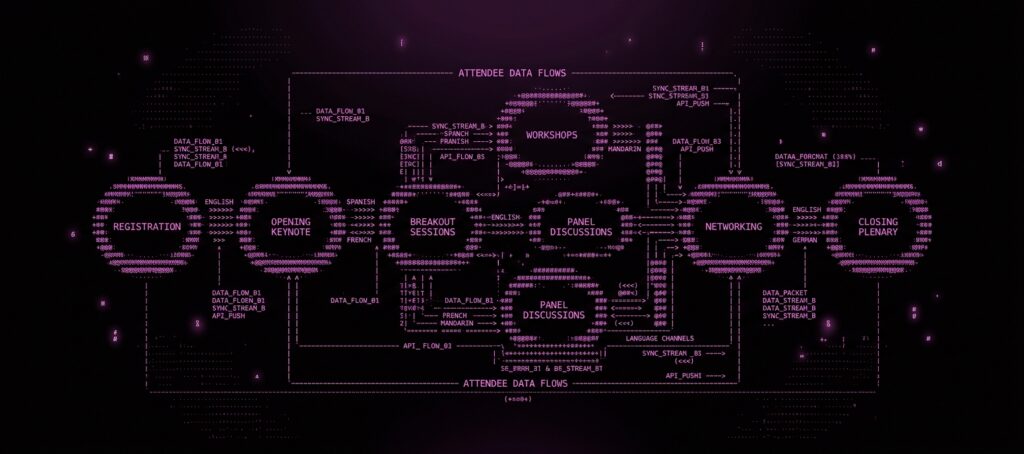
Event knowledge capture is the systematic practice of recording, transcribing, structuring, and preserving the expert knowledge, strategic insights, and institutional intelligence generated during conferences, summits, and professional gatherings so that this knowledge remains accessible and actionable long after the event ends. Unlike simple session recording, event knowledge capture transforms ephemeral spoken content into permanent, searchable organizational assets that retain their value for months or years.
Why Event Knowledge Capture Matters Now
Events are knowledge-dense environments. A three-day conference concentrates dozens of subject matter experts sharing insights that took years of experience to develop. Panel discussions produce multi-perspective analysis of complex problems. Q&A sessions surface the questions that practitioners actually struggle with. Workshop breakouts generate solutions to real operational challenges.
And then the event ends, and almost all of it disappears.
Research on conference knowledge retention shows that attendees retain only 14.9% of presented content after three days, dropping to 11.3% at 90 days (Event Tech Live). Only 10-20% of knowledge from training and professional development transfers to actual workplace practice.
The global knowledge management software market was valued at $23.2 billion in 2025 and is projected to reach $26.4 billion in 2026 (Fortune Business Insights). Organizations across sectors are investing heavily in capturing and retaining institutional knowledge. Events represent one of the most knowledge-rich environments in any organization, yet they are among the least systematically captured.
This guide covers what event knowledge capture means, why traditional approaches fail, how modern technology has changed what is possible, and how to implement knowledge capture at your events.
Understanding Event Knowledge Capture
Event knowledge capture sits at the intersection of two established disciplines: knowledge management and event technology. Knowledge management is the organizational practice of capturing, distributing, and effectively using knowledge. Event technology is the infrastructure that supports event operations. Event knowledge capture applies knowledge management principles specifically to the unique content generated at professional events.
What Counts as “Knowledge” at an Event
Not all event content is equally valuable for capture. Event knowledge exists in three layers:
Explicit Knowledge
Content that speakers intentionally share: presentation slides, prepared remarks, data cited in talks, and published research. Explicit knowledge is the easiest to capture because it already exists in documented form.
Tacit Knowledge
Expertise that speakers share without realizing it: the offhand comment about what actually works in practice, the war story about a failed implementation, the nuance added during Q&A that contradicts the tidy narrative of the presentation. Tacit knowledge is the most valuable content at any event and the hardest to capture.
Emergent Knowledge
Knowledge that does not exist before the event and emerges from the interaction between speakers, panelists, and attendees. When a panel of four experts debates a topic and reaches a nuanced consensus, that consensus is new knowledge that none of them held individually before the discussion. Emergent knowledge is uniquely valuable because it cannot be found anywhere else.
The critical insight: Most event “capture” systems focus on explicit knowledge (slides, recordings). The real value lies in tacit and emergent knowledge, which requires transcription, analysis, and synthesis to preserve.
The Knowledge Capture Gap
69% of organizations prioritize reducing duplicated work and knowledge loss (Fortune Business Insights). Yet most organizations have no systematic approach to capturing event knowledge. The gap exists because:
- Events are treated as experiences, not knowledge sources. Event teams focus on logistics, attendee satisfaction, and sponsor value. Content capture is an afterthought.
- Capture technology was prohibitively expensive. Before AI-powered transcription, capturing and processing every session required human transcriptionists, AV crews, and content editors.
- Raw recordings are not knowledge. Even organizations that record sessions end up with hundreds of hours of video that nobody watches. A 45-minute recording is not knowledge. It is raw material that requires processing to become useful.
- No one owns the knowledge output. The event team owns the event. The content team owns the blog. The knowledge management team owns the internal wiki. Nobody owns the task of turning event content into organizational knowledge.
The History of Event Knowledge Capture
Paper Proceedings (Pre-2000)
The earliest form of event knowledge capture was the conference proceedings: a printed volume of papers presented at an academic conference. Academic societies like IEEE and ACM have published proceedings for decades. The limitation was obvious: proceedings captured only formal papers, not the discussions, debates, and informal knowledge sharing that make conferences valuable.
Digital Recording (2000-2015)
Video recording and early web platforms made it possible to capture and distribute session recordings. TED Talks, launched in 2006, demonstrated that conference content could reach audiences far beyond the event itself. But TED captured keynotes, not breakouts. The model worked for high-production-value presentations, not for the full breadth of a multi-track conference.
Cloud and Transcription (2015-2020)
Cloud storage eliminated the cost barrier to keeping recordings. AI transcription services (Rev, Otter, Trint) made it affordable to convert audio to text. For the first time, event content could be searched, indexed, and processed at scale. But these tools worked on individual recordings, not across an entire event.
Event Intelligence (2020-Present)
The current era combines autonomous capture, real-time transcription, AI-powered summarization, and cross-session analysis to create comprehensive event knowledge systems. Knowledge management platforms reduce information retrieval time by 35-45% (Fortune Business Insights). Applied to events, this means attendees and stakeholders can find specific insights from a 100-session conference in seconds rather than hours.
Snapsight represents the leading edge of this evolution, with three AI agents (Operator, Analyst, and Insights) that autonomously capture, analyze, and deliver event knowledge across 75+ languages.
How Event Knowledge Capture Works
The Four-Stage Knowledge Capture Pipeline
Stage 1: Raw Capture
Every knowledge capture system begins with recording. But comprehensive knowledge capture requires more than a camera in the corner.
- Full audio capture in every session (keynotes, breakouts, workshops, roundtables)
- Speaker identification so insights are attributed to the right expert
- Audience interaction capture (Q&A, polls, chat messages, raised-hand questions)
- Contextual metadata (session title, topic, track, time, speakers, session type)
Stage 2: Transcription and Structuring
Raw audio becomes searchable text through real-time transcription. But transcription alone is not enough. The text must be structured:
- Speaker-attributed transcription (who said what)
- Topic segmentation (breaking a 45-minute session into its component topics)
- Technical term correction (ensuring domain-specific terminology is accurate)
- Cross-reference tagging (linking mentions of concepts, organizations, and people across sessions)
Stage 3: Analysis and Synthesis
This is where raw content becomes knowledge. AI-powered analysis identifies:
- Key insights from each session (the 3-5 most important takeaways)
- Consensus and disagreement across sessions on the same topic
- Emerging themes that appear across multiple sessions without being explicitly planned
- Data points and statistics cited by speakers, with source attribution
- Action items and recommendations proposed by speakers and panels
Stage 4: Distribution and Preservation
Captured knowledge has no value if it stays in a database. Distribution makes knowledge actionable:
- Attendee summaries delivered within hours of each session
- Executive briefs synthesizing key themes for leadership
- Searchable knowledge base accessible to all stakeholders
- Departmental reports tailored to the interests of different teams
- Long-term archive that preserves knowledge across years and events
Event Knowledge Capture in Practice: Examples
Example 1: Association Annual Conference (Knowledge for 50,000 Members)
A professional association with 50,000 members hosts an annual conference attended by 3,000 people. That means 94% of members do not attend. Historically, non-attendees received a post-conference newsletter with 5-6 session highlights.
With comprehensive knowledge capture, the association now provides:
- Complete session transcripts and summaries for every session, accessible to all members
- A searchable knowledge base where members can query: “What did speakers say about supply chain resilience?”
- Topic-specific intelligence reports sent to relevant member segments
- A quarterly journal drawing on conference knowledge for 12 months of content
- Continuing education credits for members who engage with captured content
The result: conference value extends to all 50,000 members, not just the 3,000 who attended. Membership retention improves because the association delivers knowledge continuously, not just during a three-day window.
Example 2: Corporate Leadership Summit (Knowledge for Strategic Decisions)
A multinational corporation hosts an annual leadership summit where 200 senior leaders share market intelligence, strategic priorities, and operational insights across 30 sessions.
Without knowledge capture, insights from breakout sessions remain with the 15-20 people in each room. When the CEO asks “What did our APAC leaders say about market entry timing?” three months later, the answer requires calling people and hoping they remember.
With knowledge capture:
- Every session is transcribed and summarized within hours
- Cross-session analysis identifies where regional leaders agree and disagree on strategy
- An internal knowledge base preserves strategic insights for reference in quarterly planning
- New leaders joining the company can review past summit content to build organizational context
Example 3: Scientific Symposium (Knowledge for Research)
A pharmaceutical company hosts an annual R&D symposium where 80 scientists present research across 6 tracks. Research insights shared verbally often never make it into formal publications.
Knowledge capture preserves:
- Preliminary research findings discussed before publication
- Cross-functional connections between research teams working on related problems
- Expert commentary on emerging methodologies and techniques
- Strategic direction signals from leadership presentations
Why Event Knowledge Capture Matters for Event Professionals
Proving Event Value
40% of organizers report difficulty proving event ROI in 2026, down from 70% in 2025 (Bizzabo). Knowledge capture provides tangible evidence of event value: X insights captured, Y reports generated, Z decisions informed by event knowledge. When the board asks “What did we get from the conference?”, a knowledge capture system provides documented answers.
Preventing Knowledge Loss
Events concentrate expertise. When a world-class panel debates the future of genomic medicine for 90 minutes, the insights generated have enormous value. Without capture, those insights exist only in the fading memories of the 200 people in the room. Knowledge capture ensures that institutional expertise, shared by invited experts at significant cost, becomes permanent organizational assets.
Enabling Year-Round Engagement
Events are time-bound. Knowledge is not. Captured event knowledge enables year-round engagement with members, customers, and stakeholders through:
- Monthly knowledge digests drawn from captured content
- Searchable archives that serve as ongoing reference tools
- Training programs built on expert sessions
- Research and analysis reports synthesized from multiple events
Creating Competitive Advantage
Organizations that systematically capture event knowledge build compounding intelligence over time. After five years of capturing annual conferences, an association has a knowledge base that no competitor can replicate. That knowledge base becomes a member benefit, a research resource, and a competitive moat.
Event Knowledge Capture vs. Event Recording
Event knowledge capture is frequently confused with event recording. They share a starting point (capturing audio/video) but diverge completely in purpose, process, and output.
Event Recording
Preserves the raw session. Output: a video file. The viewer must watch the entire recording to extract value.
Event Knowledge Capture
Extracts, structures, and preserves the knowledge within the session. Output: searchable transcripts, key insight summaries, cross-session analysis, topic-specific reports. The reader gets value in 60 seconds, not 60 minutes.
| Dimension | Event Recording | Event Knowledge Capture |
|---|---|---|
| Output | Video/audio files | Structured knowledge assets |
| Time to value | 45-60 min (watch full session) | 2-5 min (read summary/insights) |
| Searchability | Not searchable | Full-text search across all sessions |
| Cross-session analysis | Impossible | Automated theme and pattern detection |
| Long-term accessibility | Degrades (formats change, links break) | Structured data persists |
| Organizational integration | Standalone files | Feeds knowledge bases, CRMs, intranets |
The key difference: Recording preserves a moment. Knowledge capture preserves understanding.
The Future of Event Knowledge Capture
Event Knowledge Graphs
The next evolution of knowledge capture is the event knowledge graph: a structured database that maps every concept, claim, expert opinion, and data point expressed at an event into a queryable network of relationships. Instead of searching transcripts for keywords, users will ask questions: “What do cardiologists think about AI-assisted diagnosis, and how has that opinion changed over the last three annual meetings?”
Longitudinal Knowledge Bases
Organizations will build knowledge bases that span multiple events over multiple years. A medical society’s knowledge base will contain synthesized insights from every annual meeting since 2020, enabling trend analysis, opinion tracking, and research trajectory mapping that no single event could provide.
Personalized Knowledge Delivery
AI will deliver event knowledge to individuals based on their role, interests, and past engagement. A marketing director receives different insights from the same conference than a product engineer. Both get maximum value without sorting through irrelevant content.
Knowledge Capture as Event Product
Forward-thinking organizations will position captured knowledge as a product in its own right. “Full access to our conference knowledge base” becomes a membership tier, a sponsorship benefit, or a standalone subscription. The event generates knowledge. The knowledge base monetizes it continuously.
Getting Started with Event Knowledge Capture
Step 1: Define What Knowledge Matters
Not all event content is equally worth capturing. Identify which sessions generate the most valuable knowledge for your organization:
- Keynotes with industry leaders sharing strategic perspective
- Panels where experts debate current challenges
- Workshops where practitioners share methodologies
- Q&A sessions where real questions surface real issues
Step 2: Establish Capture Infrastructure
At minimum, event knowledge capture requires:
- Reliable audio recording in every priority session
- AI-powered real-time transcription
- Speaker identification and attribution
- Content processing and summarization
Step 3: Assign Knowledge Ownership
Someone must own the output of knowledge capture. This might be the content team, the knowledge management team, or a dedicated event intelligence function. Without ownership, captured knowledge sits unused.
Step 4: Build Distribution Channels
Determine how captured knowledge reaches stakeholders:
- Attendee emails with session summaries
- Internal knowledge base or wiki
- Department-specific reports
- Public-facing content (blog posts, articles, social media)
Step 5: Choose Technology
Comprehensive event knowledge capture requires AI-powered platforms that handle capture, transcription, analysis, and distribution at scale.
Snapsight was built for event knowledge capture, processing 10,415+ sessions across 627+ events in 75+ languages with 91% autonomous operation. The platform’s Analyst Agent synthesizes insights across sessions, enabling cross-event knowledge bases that compound in value over time. See event knowledge capture in action.
Knowledge Capture Readiness Checklist
- Priority sessions identified for capture
- Audio recording infrastructure in place for all target sessions
- Real-time transcription capability secured
- Knowledge ownership assigned to a specific team or role
- Distribution channels defined (email, knowledge base, reports)
- Success metrics established (knowledge assets produced, stakeholder access, usage rates)
- Long-term archiving plan in place
- Speaker consent for capture and distribution obtained
Meeting notes capture what the note-taker considered important, which is inherently selective and subjective. Event knowledge capture records everything, then uses AI to identify patterns, themes, and insights that a human note-taker would miss. Meeting notes from a panel discussion might capture 5-10 points. Knowledge capture preserves the complete discussion, identifies areas of agreement and disagreement, surfaces data points cited by speakers, and connects the discussion to themes from other sessions. The difference is comprehensiveness and objectivity.
Events with high knowledge density benefit most: medical and scientific conferences where research is presented, association conferences where industry experts share practitioner insights, corporate leadership summits where strategy is discussed, and professional development events where skills and methodologies are taught. Events that are primarily social or entertainment-focused (galas, networking mixers) generate less structured knowledge and benefit less from systematic capture.
Measure knowledge capture ROI across four dimensions: (1) Content output, the number of knowledge assets produced (summaries, reports, articles) and their equivalent production cost if created from scratch. (2) Audience extension, how many people access event knowledge beyond live attendees. (3) Decision impact, whether captured knowledge informed specific organizational decisions. (4) Time savings, how much faster stakeholders find event-generated insights compared to searching recordings or asking colleagues. Knowledge management platforms reduce information retrieval time by 35-45%, and that figure applies directly to event knowledge systems.
Event knowledge capture should operate within clear consent frameworks. Speakers should agree to knowledge capture in their speaker agreements. Attendees should be informed that sessions are being recorded and transcribed, typically through event registration terms and signage at the venue. Off-the-record sessions, private meetings, and informal conversations should never be captured without explicit consent. Most events already obtain recording consent; knowledge capture simply extends the use case from recording for on-demand viewing to recording for knowledge extraction and distribution.
Virtual and hybrid events are actually easier to capture than fully in-person events because the content already flows through digital channels. Video platform recordings, chat transcripts, polling data, and Q&A logs are all digital by default. The challenge with virtual events is not capture but processing: AI must handle varying audio quality, multiple speaker accents, and platform-specific formatting. Hybrid events combine the digital ease of virtual capture with the audio complexity of in-person sessions, requiring both physical microphone infrastructure and digital stream integration.